Owner’s manual
 Error Codes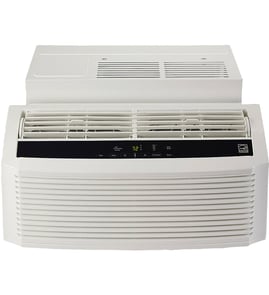




Is 1-ton AC enough for a 12X12 room?
Yes. For a 12 x 12 room (about 144 sq ft), 1 ton (about 12,000 BTU) is enough cooling capacity. The GE AZ45E12DABW5 is in the near-1-ton class (just under 12,000 BTU), so it is also an appropriate size for this room when airflow and vent settings are correct.
A 12 x 12 room usually needs far less than 12,000 BTU, so a near-1-ton room air conditioner has plenty of capacity.
- Room size: 12 x 12 = 144 sq ft
- Typical cooling range for 144 sq ft: about 5,000 to 8,000 BTU
- 1 ton of cooling: about 12,000 BTU
- If comfort is inconsistent, focus on airflow, filter condition, and ventilation settings first
| Room size | Typical BTU range | Near-1-ton (about 12,000 BTU) result |
|---|---|---|
| 12 x 12 (144 sq ft) | 5,000 to 8,000 BTU | Typically more than enough capacity |
Even with enough BTUs, these conditions reduce real-world cooling performance:
- Ventilation control left open, pulling in warm outdoor air (reduces cooling efficiency)
- Dirty air filter restricting airflow
- Strong sun load through windows or poor insulation
- Air leaks around doors, windows, or wall sleeve
- Heat sources in the room (multiple people, computers, cooking nearby)
The manual for GE AZ45E12DABW5 explains that bringing outdoor air in through the vent reduces heating and cooling efficiency; keeping the vent closed improves performance. See the AZ45E12DABW5 owner’s manual.
Oversizing in a small room can cause short cycling (frequent on and off operation), which can reduce humidity removal and make the room feel clammy. Dialing in airflow, filter maintenance, and vent position usually improves comfort quickly.
If your GE unit displays an error code or behaves abnormally, use GE error codes to match the code to likely causes and next steps.
Last updated: January 2026
What is the cost of AC in a 12X12 room?
A 12 x 12 room (144 sq. ft.) typically needs a 5,000 to 6,000 BTU window air conditioner; total cost is the unit price plus any installation and electricity. The GE AZ45E12DABW5 is a GE Zoneline (PTAC) style unit that installs in a wall case and uses specific electrical connection options, so its purchase and install cost is higher than a basic window unit. Use the AZ45E12DABW5 owner’s manual to confirm the required wall case, power connection method, and circuit protection.
- Window AC (5,000 to 6,000 BTU for 144 sq. ft.): $150 to $400
- Window AC (6,000 to 8,000 BTU, for hotter rooms or sun exposure): $250 to $600
- GE Zoneline/PTAC unit (like AZ45E12DABW5): $900 to $2,000+ (unit only)
- Wall case and grille (PTAC/Zoneline install): $150 to $400+
- Professional installation (if needed): $200 to $800+ (opening, sleeve, and electrical work)
| Room size | Typical BTU range | Best fit type |
|---|---|---|
| 120 to 180 sq. ft. | 5,000 to 6,000 | Window AC |
| 120 to 180 sq. ft. (high sun, poor insulation) | 6,000 to 8,000 | Window AC or small inverter window AC |
| Hotel style wall sleeve setup | 9,000 to 15,000 | PTAC/Zoneline (requires wall case) |
- Installation type: window opening vs. wall sleeve (PTAC/Zoneline)
- Electrical requirements: dedicated circuit, correct plug type, or direct connection
- Efficiency: higher EER/CEER or inverter models cost more up front but reduce operating cost
- Heat option: electric heat models cost more to buy and can cost more to run
Oversizing a small room can cause short cycling, uneven comfort, and higher noise; correct sizing improves humidity control and lowers energy use. PTAC/Zoneline units like GE AZ45E12DABW5 are ideal when you already have a wall case and the correct electrical setup.
Last updated: January 2026
How do I find the model number on my AZ45E12DABW5?
For the GE AZ45E12DABW5 room air conditioner, the model and serial numbers are printed on a label behind the room cover on the base pan. We use that exact model number to match the correct diagrams, manuals, and replacement parts.
- Turn the unit off and unplug it.
- Remove the room cover (front cover).
- Look for the rating label on the base pan behind the room cover.
- Write down both the model number and serial number.
- Use the full model number (including the last digit/engineering revision) when searching.
| What you need | Where it is | Why it matters |
|---|---|---|
| Model number | Label behind the room cover on the base pan | Ensures correct parts and documentation for your exact unit |
| Serial number | Same label | Helps identify production details for service and records |
GE Zoneline units use the last digit of the model number as the engineering revision. That revision can affect control settings and which replacement components fit, so matching the complete AZ45E12DABW5 model number prevents ordering the wrong part.
If the label is hard to read, take a clear photo with your phone and zoom in; then compare what you see to the format shown in the [AZ45E12DABW5 owner's manual].
Last updated: March 2026