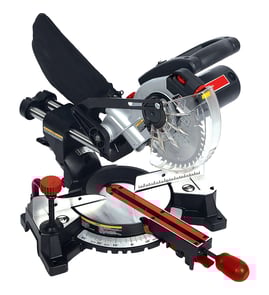

Is it worth getting a double bevel mitre saw?
Yes, a double bevel miter saw is worth it when you regularly cut crown molding, baseboard, or complex trim because it lets you bevel left and right without flipping the workpiece, which saves time and helps keep cuts consistent. For basic DIY crosscuts, a single bevel saw is usually enough.
A double bevel setup is most valuable when accuracy and repeatability matter more than cost.
- You cut crown molding nested or flat and need matching left and right bevels
- You do a lot of casing, baseboard, or picture-frame style miters
- You want fewer workpiece flips (less chance of shifting and changing your reference edge)
- You frequently cut long stock where flipping is awkward or unsafe
- You share the saw with others and want simpler, more consistent setups
If your work is occasional or straightforward, the extra features may not pay off.
- Mostly 90 degree crosscuts and simple miters
- Projects where you can comfortably flip the board for the opposite bevel
- Tight budget where blades, a stable stand, and good measuring tools matter more
| Feature | Single bevel miter saw | Double bevel miter saw |
|---|---|---|
| Opposing bevel cuts | Requires flipping the workpiece | No flip needed |
| Speed for trim work | Moderate | Faster |
| Chance of setup error | Higher (more repositioning) | Lower (less repositioning) |
| Typical cost | Lower | Higher |
Your Delta 36-220 is a 10 inch compound miter saw; on compound cuts, keeping the same fence reference and minimizing handling is a big part of getting tight joints. A double bevel design mainly improves workflow and consistency, not raw cutting power.
If you are comparing upgrades or replacing wear items (like a blade, switch, or guards), match by the exact model number and the part diagram for Delta 36-220; you can also search by model on Sears PartsDirect.
Last updated: February 2026
What brand makes the best mitre saw?
There is no single “best” miter saw brand for everyone; the best choice depends on how you use your saw (trim accuracy, framing speed, portability, or shop precision). For the Delta 36-220 10" compound miter saw, we focus on keeping your tool cutting accurately and safely with the right maintenance and replacement parts from Sears PartsDirect.
We recommend matching the brand and model to the work you do most often:
- Finish carpentry and trim: prioritize tight bevel/miter detents, low deflection, and a stable fence
- Framing and general construction: prioritize durability, easy adjustments, and common blade sizes
- Small shop or DIY: prioritize repeatable calibration, available parts support, and straightforward alignment
- Jobsite portability: prioritize weight, handle design, and stand compatibility
- Dust control: prioritize effective dust port design and shroud coverage
Even premium saws perform poorly if they are out of calibration or worn. On a 10" compound miter saw like the Delta 36-220, these factors drive real-world results:
| Factor | What you notice | Typical fix |
|---|---|---|
| Miter/bevel calibration | Gaps in miters, out-of-square cuts | Re-square fence, set stops, verify detents |
| Blade condition | Burning, tear-out, slow cutting | Replace blade, match tooth count to material |
| Fence/table wear | Inconsistent angles, shifting workpiece | Clean contact surfaces, check fasteners |
| Motor/brush health | Power loss, arcing, intermittent run | Inspect power path, brushes (if equipped) |
These checks apply to most brands and help you decide if a saw is truly performing well:
- Verify 90° crosscut with a reliable square (blade to fence and blade to table)
- Cut and flip-test a board to confirm miter accuracy (the joint should close with no gap)
- Check for play in the pivot and smooth slide/hinge movement (if applicable)
- Confirm the blade is correct for the material (fine-tooth for trim, fewer teeth for framing)
- Inspect the cord, switch, and connections for heat damage or looseness
“Best brand” usually means “best results for my work.” Accuracy, safety, and repeatability come from a solid saw plus correct setup, a sharp blade, and reliable electrical components. That is why keeping your Delta 36-220 maintained often delivers a bigger improvement than switching brands.
Last updated: February 2026
Why is 31.6 on a miter saw?
The 31.6° mark on your Delta 36-220 10-inch compound miter saw is a common “crown molding” preset. We use it (typically with a 33.9° bevel setting) to make accurate compound cuts for standard crown molding corners without doing angle math every time.
Most miter saws include 31.6° because it matches a common compound-cut geometry for crown molding when you cut it flat on the saw table (not nested against the fence). It helps you create tight inside and outside corner joints more consistently.
Common pair of settings:
- Miter: 31.6°
- Bevel: 33.9°
- Use case: Crown molding corner cuts (inside or outside)
This preset is designed around common crown molding “spring angles” and typical 90° room corners. It is a great starting point, but real-world trim work still benefits from test cuts.
- Works best for common crown profiles and square corners
- Helps reduce setup time for repeated cuts
- Still requires correct left/right orientation for inside vs. outside corners
- May not be exact if your corner is not a true 90°
- May not match specialty crown profiles or unusual spring angles
| Task | How the molding is positioned | Typical saw settings you will see | Goal |
|---|---|---|---|
| Crown molding, “flat” method | Flat on table | 31.6° miter + 33.9° bevel | 45° corner joint geometry |
| Crown molding, “nested” method | Against fence | Often different miter-only angles | Mimic wall/ceiling angle |
Crown molding cuts are “compound” because the molding meets both the wall and ceiling. The 31.6° mark is there to speed up repeatable setup so your joints close up cleanly with less trial-and-error, especially on a compound miter saw like the Delta 36-220.
If your miter detents feel off, the bevel will not lock, or the pointer does not line up, we use the model diagrams to check common wear points (detent plate, pivot hardware, bevel lock components). You can also search by model number for compatible replacement parts on Sears PartsDirect.
Last updated: February 2026
What should you never cut with a miter saw?
You should never use a miter saw like the Delta 36-220 10-inch compound miter saw to cut materials it is not designed for (masonry or ferrous metals), or to cut small, unsecured pieces near the blade. These situations cause binding, kickback, and loss of control.
Avoid these unless the saw and blade are specifically rated for the material:
- Brick, concrete, tile, or stone (masonry)
- Steel or iron (ferrous metals)
- Loose, unknown composites or plastics that can melt, splinter, or grab the blade
These are unsafe or misuse scenarios for a miter saw:
- Ripping boards (cutting with the grain)
- Freehand cuts (work not tight to the fence and table)
- Cutting very short pieces without a clamp, stop block, or proper jig
- Cutting warped or twisted stock without clamping
- Cutting stock thicker or wider than the saw can handle
| Task or material | Use the miter saw? | Better choice |
|---|---|---|
| Crosscutting lumber | Yes | Miter saw |
| Ripping lumber | No | Table saw or guided circular saw |
| Steel/iron | No | Metal-cutting saw with rated blade |
| Brick/tile/concrete | No | Masonry tool with rated wheel/blade |
A miter saw is built for controlled crosscuts with the work held firmly. When the material is too hard, too small, or not secured, the blade can grab and throw the workpiece (kickback).
For replacement parts, start with the parts list for Delta model 36-220, or search by model number on Sears PartsDirect.
Last updated: February 2026