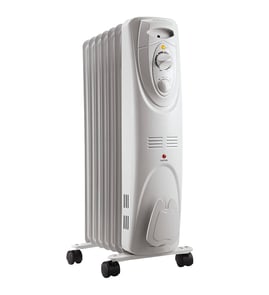

Are there any space heaters you can leave unattended?
No. We recommend you never leave any space heater unattended, including the Sears portable kerosene heater model 699350212. If you need heat while you are away or asleep, use a permanently installed, properly controlled heating source instead of a portable heater.
What to do instead (safer options)
- Turn the heater off before leaving the room or going to sleep.
- Use a central HVAC system or a fixed wall heater with proper controls.
- If you must use a portable heater while you are present, keep it on a stable, non-combustible surface.
- Maintain clear space around the heater; keep it away from curtains, bedding, paper, and furniture.
- Keep children and pets away from the heater.
- Use a working smoke alarm and carbon monoxide alarm in the home.
Why unattended operation is risky (especially for kerosene heaters)
Portable heaters can create hazards quickly if they are bumped, blocked, or placed too close to combustibles. With kerosene heaters, additional risks include fuel spills, flare-ups from improper fueling, and indoor air quality concerns if ventilation is inadequate.
Quick safety checklist for a portable kerosene heater
| Item to check | What “good” looks like | What to do if it is not good |
|---|---|---|
| Clearance | Open space on all sides | Move heater away from combustibles |
| Placement | Level, stable surface | Relocate to a flat, non-combustible area |
| Fueling | Cool heater, no spills | Let it cool fully; clean spills before lighting |
| Ventilation | Fresh air available | Increase ventilation; do not use in tight spaces |
Helpful DIY guidance
If you are troubleshooting a no-start or intermittent shutoff that tempts you to “set it and forget it,” basic electrical checks can help you diagnose safely.
- Are diy appliance repairs safe
- How to tell if a fuse is blown
- How to use a multimeter to test electrical parts video
Last updated: February 2026
Do space heaters have automatic shut-offs?
Yes, many space heaters do have automatic shut-offs, but it depends on the design. For the Sears model 699350212 portable kerosene heater, common shut-off protections include tip-over shutoff and an overheat or high-temperature limit that stops operation if conditions become unsafe.
What “automatic shut-off” usually means
Automatic shut-off is a safety function that stops the heater without you turning it off. On portable heaters, it most often includes:
- Tip-over switch: shuts the heater off if it’s knocked over
- Overheat protection: shuts the heater off if internal temperatures get too high
- Flame-out protection (kerosene heaters): stops fuel flow if the flame goes out
- Low-oxygen safety (some kerosene heaters): shuts down if oxygen levels drop
- Thermostat cycling (if equipped): turns heat output on and off to maintain a set temperature
How to tell if your 699350212 has it
Because we do not have model-specific documentation posted for 699350212, the most reliable way is to check the heater’s labeling and controls.
- Look for wording like “tip-over,” “overheat,” “safety shutoff,” “ODS,” or “high limit” on the control panel or rating label
- Check for a tilt switch under the base (often a small plunger-style switch)
- If the heater shuts down after running a while, let it cool and inspect for blocked air flow or dust buildup
- If you suspect an electrical safety device is open, use a meter to test continuity (with power disconnected)
Quick comparison of shut-off types
| Shut-off type | What triggers it | What you’ll notice |
|---|---|---|
| Tip-over | Heater tilts/falls | Immediate shutdown |
| Overheat/high limit | Internal temperature too high | Stops, may restart after cooling |
| Flame-out | Flame goes out | Heater stops and won’t keep burning |
| Low-oxygen (ODS) | Reduced oxygen | Shutdown after a short period |
Why it matters
Automatic shut-offs reduce the risk of overheating, unstable operation, and accidental tip-over events. On kerosene heaters, flame monitoring and fuel shutoff are especially important because they help prevent unburned fuel from continuing to flow.
For safe DIY electrical checks related to shut-off circuits, we recommend how to use a multimeter to test electrical parts video.
Last updated: February 2026
How much does it cost to run a 1500 W space heater 24 hours a day?
Running a 1500 W (1.5 kW) electric space heater for 24 hours uses 36 kWh of electricity. Your daily cost is 36 × your electric rate ($/kWh); for example, at $0.16/kWh it costs $5.76 per day.
Quick cost formula (works for any electric heater)
Use this equation:
- kW = watts ÷ 1000
- kWh per day = kW × hours used
- Cost per day = kWh × your $/kWh rate
For a 1500 W heater:
- 1500 ÷ 1000 = 1.5 kW
- 1.5 × 24 = 36 kWh/day
Cost examples (1500 W running continuously)
| Electric rate ($/kWh) | Cost per day (36 kWh) | Cost per 30 days |
|---|---|---|
| $0.12 | $4.32 | $129.60 |
| $0.16 | $5.76 | $172.80 |
| $0.20 | $7.20 | $216.00 |
| $0.25 | $9.00 | $270.00 |
What changes the real-world cost
Even with the same 1500 W rating, your actual cost often varies because:
- Thermostat cycling: many heaters do not draw 1500 W nonstop once the room warms up.
- Heat setting: “low” is often closer to 750 W, which cuts cost roughly in half.
- Room size and insulation: drafts and poor insulation increase run time.
- Outdoor temperature: colder weather increases duty cycle.
- Extension cords and outlets: poor connections can overheat and cause shutdowns (and are a safety risk).
Why it matters
A 1500 W heater is one of the highest-draw appliances you can plug into a standard household outlet. Knowing the kWh cost helps you compare options like lowering the thermostat, sealing drafts, or using the heater fewer hours.
For general DIY safety and best practices before working around heater wiring or controls, review are diy appliance repairs safe.
Last updated: February 2026