 Owner’s manual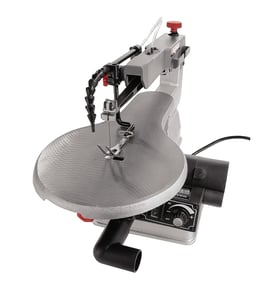

What is the best height for a scroll saw?
For the Craftsman scroll saw model 351216120, the best working height is the one that keeps your shoulders relaxed and your forearms roughly level while guiding the work on the table. Most users set the saw table about 1 to 2 inches above elbow height (standing or seated). For model-specific setup and mounting guidance, use the owner's manual.
How to set the height (quick method)
- Stand (or sit) in your normal cutting posture with shoulders relaxed.
- Bend your elbows to about 90 degrees.
- Measure from the floor to your elbow.
- Set the scroll saw table surface 1 to 2 inches above that measurement.
- Test-cut for 5 to 10 minutes; adjust up or down in small increments.
Standing vs. seated targets
| How you use the saw | Typical table height target | Why it helps |
|---|---|---|
| Standing | Elbow height + 1 to 2 in. | Reduces hunching and wrist strain |
| Seated on a tall stool | Elbow height + 1 to 2 in. | Improves fine control for intricate cuts |
| Mixed use | Split the difference | Minimizes readjustment |
Mounting and stability matter as much as height
A comfortable height only works if the saw is solid and vibration is controlled.
- Mount the saw on a stable, level bench or stand.
- Bolt the base through the mounting holes (hardware typically not included).
- Make sure the work surface does not flex; flex increases vibration and reduces cut accuracy.
- Keep the table clear of tools and scrap before turning the saw on.
Why it matters
Correct scroll saw height improves control on tight curves, reduces fatigue in your neck and shoulders, and helps you feed material smoothly. A stable mount also protects accuracy, especially on longer sessions and thicker stock.
Last updated: February 2026
How thick of wood can a 351216120 scroll saw cut?
On the Craftsman 351216120 scroll saw, the maximum thickness of cut is 2 inches at 90° (straight up-and-down cutting). If you tilt the arm to 45°, the maximum thickness drops to 1 1/2 inches. For the exact specs and setup details, use the owner's manual.
Quick specs for cutting thickness
- Max thickness at 90°: 2 in.
- Max thickness at 45° tilt: 1 1/2 in.
- Throat depth at 90° (capacity): 16 3/8 in.
- Blade speed range: 300 to 1400 strokes per minute
- Blade type/length: 5-inch pin-type blades
What to expect in real-world cutting
Even though the saw is rated for 2-inch thickness at 90°, we get the best results when we match blade, speed, and feed rate to the wood:
- Use a slower feed rate for smoother cuts and less blade wandering.
- For hardwood or thicker stock, start at a lower speed and increase gradually.
- Avoid forcing the workpiece; feeding faster than the blade can cut often leads to blade breakage.
Thickness limits by cut angle (at a glance)
| Cut setup | Typical use | Max thickness on 351216120 |
|---|---|---|
| 90° (no tilt) | Straight cuts, most patterns | 2 in. |
| 45° tilt | Bevel cuts while keeping the table level | 1 1/2 in. |
Why it matters
Cutting thicker material than the saw is designed for increases heat, vibration, and blade deflection. Staying within the 351216120 thickness limits helps you get cleaner scrollwork, reduces blade breakage, and keeps the variable-speed system working efficiently.
Last updated: February 2026
Where can I buy Craftsman replacement parts?
You can buy replacement parts for your Craftsman scroll saw model 351216120 directly through our model parts listing and diagrams on Sears PartsDirect. Using the model number helps match the correct components (like the blade guard, drive belt, switch cover, or line cord) to your exact saw.
Best way to get the right part for model 351216120
- Use the parts illustrations and lists in the owner's manual to identify the part name and reference number.
- Match the part to the correct section (base vs. arm assembly) before ordering.
- Confirm whether the item is standard hardware (often available locally) or a model-specific component.
- If you are replacing an electrical item (switch, cord, light), verify the symptom first so you do not replace the wrong part.
Common replacement parts listed for this scroll saw
The manual’s parts list for model 351216120 includes items such as:
| Area | Examples of parts you may need | When it’s commonly replaced |
|---|---|---|
| Arm assembly | Drive belt, pulleys, blade guard/holddown assembly | Slipping, vibration, blade control issues |
| Base/table | Table insert, covers, fasteners | Wear, damage, missing pieces |
| Electrical | Line cord, strain relief, switch cover, work light bulb | No power, intermittent power, light out |
Why it matters
Scroll saw parts are highly model-specific. Ordering by the exact model number 351216120 helps ensure fit and safe operation, especially for moving parts (belt, pulleys) and electrical parts (cord, switch).
Last updated: February 2026
What size blade for 351216120 scroll saw?
For the Craftsman 351216120 scroll saw, use 5-inch pin-end scroll saw blades. The operator’s manual also lists 5-inch blades in multiple tooth counts (for example, 15 TPI and 18 TPI), so you can match the blade to your material and cut quality.
Blade size and style that fits this model
The key fit requirement is the 5-inch length and pin-end mounting style.
- Blade length: 5 in.
- Blade type: Pin-end
- Common tooth counts listed for this saw: 15 TPI and 18 TPI
- Install direction: teeth point downward toward the table
For the exact blade installation steps and diagrams, use the owner's manual.
Choosing the right TPI (quick guide)
Tooth count affects speed, smoothness, and how easily the blade clears sawdust.
| What you’re cutting | Better choice | What to expect |
|---|---|---|
| Thicker wood, faster rough cuts | Lower TPI (around 10 to 15 TPI) | Faster cutting, rougher edge |
| General scroll work in wood | Mid TPI (around 15 to 18 TPI) | Balanced speed and finish |
| Thin stock, plastics, fine detail | Higher TPI (around 18 to 25 TPI) | Smoother edge, slower feed |
Installation and safety checks (before you cut)
A blade that fits but is installed incorrectly will wander, break, or burn the work.
- Unplug the saw before changing blades.
- Confirm the blade is seated fully in the upper and lower holders.
- Set blade tension so the blade is firm (not floppy); recheck after the first few minutes.
- Verify the teeth point downward toward the table.
- Do not use dull or bent blades.
Why it matters
Using the correct 5-inch pin-end blade keeps the blade clamped correctly in the holders, helps the saw track straight, and reduces blade breakage and vibration during scroll cutting.
Last updated: February 2026
What are the different types of scroll saws?
Scroll saws mainly fall into stationary benchtop models and portable models; within those types, key differences are throat size, blade style, speed control, and dust collection. Your Craftsman 351216120 is a stationary scroll saw with mechanical variable speed control and built-in dust collection (filter bag).
Main scroll saw types
- Stationary (benchtop) scroll saw: Heavier, more stable, designed to be bolted to a bench for accuracy and reduced vibration.
- Portable scroll saw: Lighter and easier to move; typically trades some stability and capacity for convenience.
Features that separate one scroll saw from another
- Throat size (capacity): Larger throat lets you turn bigger workpieces for inside cuts and curves.
- Blade type: Pin-end blades are quick to install; plain-end blades are common for fine detail and interior cuts.
- Speed control: Variable speed helps match blade speed to material (hardwood, softwood, plastics, nonferrous metals).
- Dust collection: Built-in blowers, chutes, or bags help keep the cut line visible.
- Table and/or arm tilt: Some saws tilt the table; others tilt the arm. The 351216120 uses an arm-tilt design while keeping the table horizontal.
- Blade tensioning and change system: Quick-tension levers and accessible clamps reduce blade-change time.
Quick comparison
| What you care about | Stationary scroll saw | Portable scroll saw |
|---|---|---|
| Best for | Precision, repeatable cuts | Light-duty work, moving between jobs |
| Stability | High (when mounted) | Medium to low |
| Typical features | Variable speed, better dust control | Simpler controls, smaller footprint |
Why it matters
Choosing the right type and features helps you cut cleaner curves, reduce blade breakage, and work safer. For example, a stable, mounted scroll saw and the right speed setting make it easier to control fine cuts without forcing the workpiece.
Model-specific notes for Craftsman 351216120
- Designed for cutting wood, plastics, and nonferrous metals
- Uses a locking rocker switch with a removable key for safety
- Includes built-in dust collection that deposits dust into a filter bag
- Arm tilts 0° to 45° for angled cuts while the table stays level
For operating details, mounting guidance, and safety steps (eye protection, blade direction, securing the saw), follow the owner's manual.
Last updated: February 2026