Owner’s manual
 Error Codes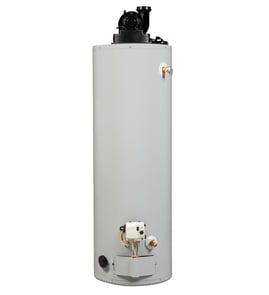





How much should I expect to pay for a new water heater installed?
For an American Water Heaters N50T61-403 gas water heater replacement, most homeowners should expect about $1,600 to $3,800 installed for a like-for-like tank swap; total price varies mainly by venting changes, gas line work, code upgrades, and disposal. Use the N50T61-403 use & care manual to understand venting, combustion air, and safety requirements that can affect labor.
- Standard tank replacement (similar size/fuel): ~$1,600 to $2,400
- Higher-complexity tank replacement: ~$2,400 to $3,800+ (venting, gas piping, access issues)
- Tankless conversion: ~$2,400 to $5,400+ (often higher due to venting and gas capacity changes)
- Heat pump (hybrid) water heater: ~$3,500 to $9,000 (usually electric and may need electrical upgrades)
- Vent connector or chimney work (sizing, slope, clearances)
- Combustion air changes (confined space requirements)
- Gas shutoff valve, drip leg, or union updates
- Water piping modifications (unions, shutoff valve, expansion tank)
- Drain pan and drain line additions
- Permit, inspection, and haul-away
| Item | Why it matters | Often changes price? |
|---|---|---|
| Venting changes | Safety and proper draft | Yes |
| Gas line sizing/work | Prevents ignition and performance issues | Yes |
| Expansion tank (closed system) | Controls thermal expansion | Sometimes |
| T&P relief valve/discharge pipe | Required safety discharge path | Sometimes |
| Access (attic, tight closet) | Labor time and materials | Yes |
A gas water heater install is not just “swap the tank”; venting, combustion air, and the temperature and pressure relief setup are safety-critical. Those requirements are a big reason installed pricing can vary widely even for the same gallon size.
Last updated: January 2026
What is the average cost of a 50 gallon gas water heater?
A typical 50-gallon gas water heater usually costs about $600 to $2,000+ for the unit, and about $1,000 to $3,100+ installed once labor and required materials are included. For American model N50T61-403, the exact price depends on venting type, efficiency features, and local code requirements.
- Venting type: standard atmospheric vent vs. power vent/direct vent
- Efficiency and recovery rate: higher BTU and faster recovery typically cost more
- Local code upgrades: shutoff valves, expansion tank, drip pan, seismic strapping (where required)
- Labor and access: tight closets, attic installs, or reworking venting and gas piping
- Permits and disposal: permit fees and haul-away can add to the total
| Cost item | Typical range | Notes |
|---|---|---|
| Water heater (50-gal gas tank) | $600 to $2,000+ | Basic to higher-end/high-recovery models |
| Installation labor | $400 to $1,000+ | Can be higher for complex venting or access |
| Total installed cost | $1,000 to $3,100+ | Often includes fittings, connectors, and disposal |
We cannot determine a single “average” price for N50T61-403 from model-specific documentation alone because pricing is set by the seller/installer and the installation conditions. However, your manual highlights common installation items that can affect cost, such as combustion air/venting requirements, gas piping, and the temperature and pressure relief valve discharge setup; see the N50T61-403 use & care manual.
Getting the right installed price is not just about the tank; it is about safe venting, correct gas supply setup, and code-compliant pressure relief protection. Those items protect your home and help the heater run reliably.
Last updated: January 2026
What is the average labor cost to install a 50 gallon gas water heater?
For an American water heater model N50T61-403, we can’t identify an “average” labor price from model-specific information because installation pricing is set by local contractors, permits, and site conditions. In most markets, labor to replace a 50-gallon gas water heater commonly falls in the $400 to $1,000+ range, with higher costs when venting or gas piping must be modified.
These are the job details that most often change labor time and price:
- Straight swap vs. relocation (moving the heater usually adds plumbing and vent work)
- Venting and combustion air changes (draft hood, vent connector, chimney tie-in)
- Gas piping work (new shutoff valve, drip leg, union, leak testing)
- Water piping updates (shutoff valve, unions, expansion tank in closed systems)
- Permit and code items (strapping, drain pan, discharge pipe routing)
- Access difficulty (attic, tight closet, crawlspace)
For model-specific venting, gas supply, and piping requirements, we follow the N50T61-403 use & care manual.
| Cost type | Common range | Notes |
|---|---|---|
| Labor only | $400 to $1,000+ | Basic replacement and startup checks |
| Total installed | $1,000 to $3,100+ | Heater, labor, and common materials |
| Add-on work (if needed) | +$200 to $2,000+ | Venting changes, gas line run, major plumbing updates |
Gas water heater installs are safety-critical. Correct venting, combustion air, and gas leak testing help prevent nuisance shutdowns and reduce the risk of carbon monoxide problems.
Not every install needs these, but they are common:
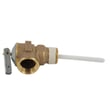
- Water heater temperature and pressure relief valve 100108279 (safety valve; replace if old, leaking, or incorrect rating)
- Drain valve (replace if it seeps or won’t close)
- Gas shutoff valve or flexible connector (often replaced for safety and code compliance)
Last updated: January 2026
What is the life expectancy of a 50 gallon gas water heater?
A 50-gallon gas water heater like the American N50T61-403 typically lasts 10 to 15 years. With good water quality and consistent maintenance (especially flushing sediment and protecting the tank with a healthy anode rod), it can sometimes last longer, but planning for replacement after year 10 is smart.
- Water quality and hardness (more minerals usually means more sediment)
- Sediment buildup in the tank (reduces efficiency and can overheat the bottom)
- Anode rod condition (protects the tank from corrosion)
- Operating temperature setting (higher temps can increase wear)
- Installation and venting quality (stable combustion and safe draft)
For model-specific maintenance and safety steps, follow the N50T61-403 use & care manual.
| Water heater type | Typical life expectancy | Notes |
|---|---|---|
| Standard tank, gas (50-gallon) | 10 to 15 years | Most common range for residential tanks |
| Standard tank, gas (well-maintained) | 15 to 20 years | More likely with regular flushing and anode checks |
- Rust-colored water or metallic smell at hot taps
- Water in the drain pan or signs of tank sweating/leaking
- Rumbling or popping sounds (often heavy sediment)
- Pilot issues or inconsistent burner operation
- Not enough hot water even after basic adjustments
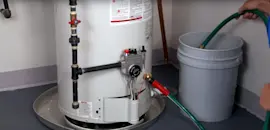
- Flush the tank periodically using the drain valve; replace it if it won’t open or won’t seal (see drain valve 100108269).
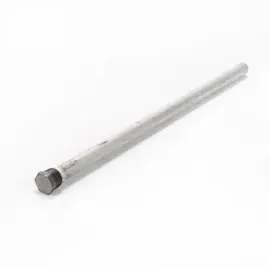
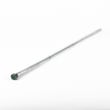
- Inspect and replace the anode rod when it’s heavily worn (see anode rod 100108571).
- Keep the area around the burner and air intake clean and unobstructed.
- Verify the temperature and pressure relief valve discharge piping is installed correctly and the valve is not leaking.
Once a tank starts corroding internally, failure can happen quickly. Staying ahead with flushing and anode rod replacement helps protect the tank, maintain efficiency, and reduce the chance of an unexpected leak.
Last updated: January 2026
What is the most common problem with gas water heaters?
The most common problem we see with gas water heaters like the American N50T61-403 is the pilot light going out or not staying lit, which is often tied to the pilot/thermocouple system getting dirty, misaligned, or failing. Sediment buildup in the tank is another frequent issue that reduces heating efficiency and can cause rumbling noises.
- Confirm the gas shut-off valve is fully open.
- Make sure the venting area is not blocked and the heater has adequate combustion air.
- Listen for rumbling or popping (often points to sediment in the tank).
- Check for water around fittings, the drain valve, and the base of the tank.
- If the pilot will not stay lit, follow the lighting steps in the N50T61-403 use & care manual.
| Symptom | Most likely cause | What it affects |
|---|---|---|
| Pilot will not stay lit | Weak/dirty pilot assembly, thermocouple signal issue, airflow/venting problem | Burner will not run, no hot water |
| Not enough hot water | Sediment buildup, temperature setting too low, dip tube issue | Recovery rate and usable hot water |
| Water too hot | Gas valve/temperature control out of calibration or failing | Scald risk, overheating |
| Water in drain pan | Leaking connection, T&P relief valve discharge, tank leak | Property damage risk |
If troubleshooting points to a failed component, these are common replacements for this model:
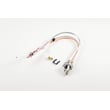
- Water heater pilot assembly 100112330 (pilot and safety sensing components)
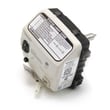
- American water heater water heater gas valve and temperature control assembly 100112336 (temperature control and gas regulation)
- Water heater temperature and pressure relief valve 100108279 (protects against excessive temperature/pressure)
- Water heater dip tube 100111192 (directs incoming cold water to improve hot water delivery)
Pilot and combustion issues can stop hot water completely, while sediment buildup quietly drives up gas use and shortens component life. Catching the symptom early helps you avoid repeated shutdowns and unnecessary part replacements.
Last updated: January 2026