
Can I add sawstop to any table saw?
No. You cannot add the SawStop flesh-sensing brake system to a Craftsman 351226541 tilting arbor saw (or most other table saws) because that safety system is engineered into specific saw designs with dedicated electronics, brake cartridge mounting, arbor geometry, and control logic.
We recommend focusing on proven table saw safety steps that work on the Craftsman 351226541 without redesigning the saw:
- Use a sharp, correct blade for the cut (ripping vs. crosscut) to reduce binding and kickback
- Set blade height correctly (typically just above the workpiece) to limit exposed teeth
- Keep the fence parallel to the blade; a misaligned fence is a common kickback trigger
- Use push sticks, push blocks, and featherboards to keep hands away from the blade path
- Stand slightly to the side of the blade line to avoid the kickback zone
- Keep the tabletop clean and waxed so stock feeds smoothly
Retrofitting a flesh-sensing brake is not like adding an accessory; it requires the saw to be built around the system.
| Feature needed | Why it matters | Typical retrofit outcome |
|---|---|---|
| Brake cartridge mount and clearance | The brake must stop the blade instantly without hitting the table/arbor parts | Not present on most saws |
| Sensing electronics and wiring | Detects contact and triggers the brake reliably | Not supported by existing controls |
| Arbor and trunnion design | Must survive the braking forces and allow safe blade drop | Major redesign required |
| System calibration | Prevents nuisance trips and ensures consistent activation | Not available on non-system saws |
A table saw injury is usually caused by either direct blade contact or kickback. A flesh-sensing brake addresses blade contact, but kickback prevention still depends on setup, technique, and guarding. Improving alignment, feed control, and work support reduces risk on every cut.
If you are shopping for replacement parts or accessories for the Craftsman 351226541, we recommend searching by the full model number to match the correct diagrams and hardware on Sears PartsDirect.
Last updated: February 2026
What are the three types of table saws?
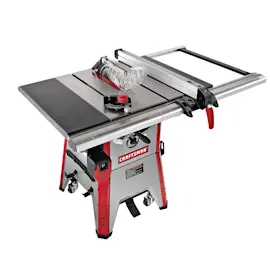
The three most common table saw types are jobsite/benchtop, contractor, and cabinet saws. Your Craftsman 351226541 is a tilting arbor saw; the “type” mainly affects portability, motor style, and how stable and accurate the saw feels during rip cuts and crosscuts.
- Jobsite/benchtop: light, portable, smaller table; best for transport and occasional use
- Contractor: larger footprint, more stable, typically belt-driven; good for a home shop
- Cabinet: heaviest and most rigid, enclosed base, strongest dust collection potential; best for frequent, high-precision work
| Type | Portability | Typical motor/drive | Best for |
|---|---|---|---|
| Jobsite/benchtop | High | Direct-drive | On-site work, small spaces |
| Contractor | Medium | Often belt-drive | DIY and serious hobby use |
| Cabinet | Low | Belt-drive, enclosed cabinet | Pro shops, maximum stability |
Focus on the work you do most and the space you have:
- If you move the saw often, prioritize weight, folding stand, and onboard storage.
- If you want smoother cuts in thicker stock, prioritize stability and fence accuracy.
- If dust control matters, prioritize an enclosed base and a dust port you can connect to a vacuum.
- If you cut sheet goods, prioritize table size and outfeed support.
- If you do repeatable rip cuts, prioritize a rigid, easy-to-square rip fence.
The saw “type” drives real-world results: a heavier, more rigid saw typically vibrates less, holds alignment longer (blade-to-miter-slot and fence-to-blade), and makes it easier to get consistent, accurate cuts.
For model-specific parts and diagrams for your Craftsman 351226541, start with the parts list for this model, or search by model number on Sears PartsDirect.
Last updated: February 2026
Are all table saw arbor nuts the same size?
No. Table saw arbor nuts are not all the same size because the nut must match the saw’s arbor shaft diameter and thread direction. On the Craftsman 351226541 tilting arbor saw, you need an arbor nut that matches the original arbor threads for that model.
Most saw blades are standardized by arbor hole size, but the arbor nut is not universal.
- Blade arbor hole: Commonly 5/8 inch on many 10-inch blades (so blades fit many saws)
- Arbor shaft threads: Vary by saw brand and model
- Thread direction: Can be right-hand or left-hand depending on design
- Nut style: Flange nut, hex nut, or nut with an integrated washer surface
- Washer/flange parts: Often model-specific and must match the nut and arbor shoulder
Use this as a reality check when comparing parts; always match the original nut and arbor.
| Saw/blade class | Common blade arbor hole | Arbor nut universality |
|---|---|---|
| Many 10-inch table saws | 5/8 in | Not universal |
| Many 12-inch saws | 1 in | Not universal |
Because this model page does not list specific part pages, the most reliable approach is to match the existing hardware.
- Unplug the saw and remove the throat plate
- Remove the blade and inspect the nut and flange/washer
- Measure arbor shaft diameter with calipers (or compare to known blade arbor hole size)
- Check thread direction by noting which way the nut loosens
- Search by model number 351226541 to match the correct replacement part on Sears PartsDirect
Using the wrong arbor nut can strip threads, prevent proper blade clamping, or allow the blade to loosen during operation. Correct fit and thread direction are critical for safe, stable cutting.
Last updated: February 2026
Can you use an 8 inch blade on a 10 inch table saw?
Yes, you can use an 8-inch blade on a 10-inch table saw like the Craftsman 351226541 as long as the blade fits the arbor and you use it within the saw’s guard and riving-knife limitations. The main tradeoff is reduced maximum cut depth compared with a 10-inch blade.
An 8-inch blade sits lower in the table, so it cannot cut as deep. That is usually fine for thinner stock, plywood, and many trim cuts.
- Less cut depth: expect a noticeably shallower maximum through-cut.
- Guard and riving knife alignment: the riving knife may sit too high for some 8-inch blades.
- Arbor fit still matters most: arbor hole size and blade thickness must match what your saw accepts.
- Dado vs. standard blade: many 8-inch sets are designed as dado stacks (not for full-depth through cuts).
Use this checklist before installing any smaller blade on the Craftsman 351226541.
- Arbor hole diameter matches your saw’s arbor.
- Blade kerf (thickness) is compatible with the riving knife and splitter setup.
- Blade RPM rating meets or exceeds the saw’s no-load RPM.
- Blade clears the throat plate and does not contact the insert.
- Blade can be used with the guard removed only when the operation requires it (for example, dado work), then reinstall the guard afterward.
Exact depth varies by saw design and blade geometry, but these ranges are typical for table saws.
| Blade diameter | Typical max cut depth at 90° | Best use cases |
|---|---|---|
| 10-inch | ~3 to 3-1/2 inches | General ripping and crosscutting |
| 8-inch | ~2 to 2-1/2 inches | Thinner stock, some joinery, many dado setups |
Using the correct blade size helps keep the guard system, riving knife, and kickback-reduction features working as intended. If the riving knife sits too high for the smaller blade, the cut can bind and increase kickback risk.
If you need to replace wear items (like the throat plate/insert, arbor hardware, or guarding components) for your Craftsman 351226541, start with the model parts list, or search by model number on Sears PartsDirect.
Last updated: February 2026
Does Craftsman make a good table saw?
Yes. Craftsman table saws are a solid choice for many DIYers and hobbyists, and a Craftsman 351226541 tilting arbor saw is typically a dependable “workhorse” for basic ripping and crosscutting when it’s tuned and used with the right blade and setup.
A table saw can be “good” in different ways; here’s how Craftsman models commonly stack up.
- Value: Strong performance for the price compared with many entry-level saws.
- Durability: Many older Craftsman saws hold up well with routine maintenance.
- Accuracy potential: Good results are achievable, but they often depend on careful alignment.
- Fence quality: Some fences need adjustment or upgrading to lock square consistently.
- Best fit: Great for learning and weekend projects; less ideal for production-level precision.
Use these practical checks to decide if your Craftsman saw is meeting your needs.
| Check | What you want to see | If it’s off, what it usually means |
|---|---|---|
| Fence parallel to blade | Consistent rip width front to back | Fence needs adjustment or is flexing |
| Blade to miter slot alignment | Smooth cuts, less burning | Trunnion/arbor alignment needs tuning |
| Vibration/noise | Steady sound, minimal shake | Worn bearings, loose pulleys, or unbalanced blade |
| Cut quality | Clean edges with minimal tear-out | Wrong blade type, dull blade, or feed rate issues |
These improvements usually deliver the biggest accuracy and safety gains on a Craftsman table saw.
- Install a sharp, purpose-built blade (rip blade for ripping, combo blade for general use).
- Square and lock the rip fence; verify with a tape measure and a reliable square.
- Confirm the miter gauge is set to true 90 degrees for crosscuts.
- Add outfeed support to prevent the workpiece from tipping during long cuts.
- Keep the tabletop clean and slick (paste wax helps reduce friction).
A “good” table saw is one that cuts accurately and predictably. When the fence, blade alignment, and blade condition are right, you get safer cuts, less kickback risk, and better-fitting joinery.
For parts lookups and model-based searching for your Craftsman 351226541, start with the parts list for this model, or search by model number on Sears PartsDirect.
Last updated: February 2026