Error Codes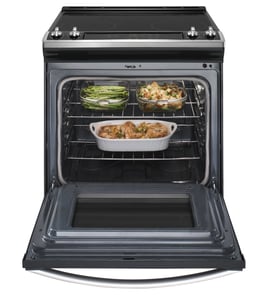




What is the average life of a GE stove?
A GE electric range like model JS760SP6SS typically lasts 13 to 15 years. Consistent cleaning, avoiding repeated high-heat self-clean cycles, and fixing heating or control issues early helps you reach (and often exceed) that average.
What affects lifespan the most
- Heat stress: frequent broiling, long bakes, and repeated self-clean cycles accelerate wear
- Power quality: loose terminal connections or repeated breaker trips can damage controls
- Cooling airflow: blocked vents can overheat the control area
- Cooktop use: heavy daily use wears surface elements and switches faster
- Maintenance habits: spills left to bake on can damage finishes and components
Typical lifespan by range type
| Range type | Typical average life | Notes |
|---|---|---|
| Electric range (radiant/halogen) | 13 to 15 years | More electronic controls and heating components to maintain |
| Gas range | 14 to 18 years | Often slightly longer due to simpler heat system |
Parts that commonly determine whether you repair or replace
If the range is otherwise in good shape, these repairs often restore performance and extend life:
- Replace a failed bake heater such as the range bake element WB44X45499
- Replace a weak broil heater such as the range broil element WB44X45491
- Correct temperature problems by testing or replacing the kenmore range oven temperature sensor WB21X22134
- Fix a burner that will not regulate heat by replacing a switch like the GE range surface element control switch WB24X25013
Why it matters
Knowing the expected lifespan helps you decide whether a repair is worth it. For a JS760SP6SS near the 13 to 15 year mark, a simple part replacement (element, sensor, switch) is usually a better value than living with slow preheat, uneven baking, or unreliable burner control.
Last updated: February 2026
Is GE profile considered high end?
Yes. GE Profile is generally considered GE’s higher-end mainstream line, positioned above standard GE models with more premium features and finishes; it is not GE’s top luxury tier. If you’re comparing options for a GE electric range like model JS760SP6SS, Profile typically means more advanced cooking modes and controls.
How GE Profile typically compares
GE’s lineup is usually grouped like this:
| Line | Typical position | What you usually get |
|---|---|---|
| GE (standard) | Core value line | Solid basics, fewer premium features |
| GE Profile | Higher-end mainstream | More features, upgraded design, more electronic controls |
| GE Cafe | Premium style-focused line | More design options, premium finishes, higher price |
What “high end” means in real-world use
When customers call a range “high end,” they usually mean a combination of performance, features, and fit and finish. GE Profile models commonly add:
- More precise oven temperature management and cooking modes
- More advanced control panels and settings
- Upgraded cooktop elements (dual or specialty radiant elements on many models)
- More premium exterior styling and hardware
- Extra convenience features (varies by model)
Why it matters when you’re troubleshooting or buying parts
More feature-rich ranges often rely on additional sensors, control boards, and cooling airflow to protect electronics. If your range is acting up, “Profile-level” features can mean the fix is more likely to involve a control, sensor, or cooling component rather than a simple mechanical issue.
Common examples on ranges like the GE JS760SP6SS include:
- Oven temperature regulation issues: check the kenmore range oven temperature sensor WB21X22134
- Control panel overheating or fan running issues: check the range control panel cooling fan WB26X29468
- Error codes and control-related symptoms: use GE freestanding range error codes
Quick buying guidance
If you want premium features without stepping into GE’s highest-priced lines, GE Profile is a strong “high end” choice within the mainstream category. If your priority is design-forward finishes and a more luxury feel, GE Cafe is typically the next step up.
Last updated: February 2026
What does F76 mean on an oven?
On a GE JS760SP6SS electric range, an F76 error points to a problem with the electronic control interface (the touch panel or its communication with the oven control). A power reset sometimes clears a temporary glitch; if the code returns, the control assembly typically needs service or replacement.
What to do first (safe reset)
- Turn the oven off.
- Shut off power at the breaker for 5 minutes (preferred over just turning the oven off).
- Restore power and set the clock.
- Try a simple bake cycle for 10 minutes.
- If F76 returns quickly, stop using the oven until the control issue is corrected.
Common causes of an F76 code
- Touch panel keys stuck or shorted (often after cleaning moisture gets behind the panel)
- Loose or oxidized ribbon cable/connector between the touch panel and control
- Failed oven control board (clock/control)
- Heat or steam intrusion into the control area
Parts that are often involved
On this model, the control system is commonly addressed by replacing the control assembly:
If the error is accompanied by unusual fan behavior or overheating around the control area, these parts can also be relevant:
Quick decision guide
| What you see | Most likely issue | Best next step |
|---|---|---|
| F76 appears once, then clears after reset | Temporary electronics glitch | Monitor after breaker reset |
| F76 returns immediately on power-up | Control/touch fault | Inspect connections; plan control replacement |
| Beeping, random key presses, unresponsive panel | Touch panel failure | Replace control assembly |
| Code appears after self-clean or heavy steam | Heat/moisture impact | Let cool fully; reset; check for recurrence |
Why it matters
The touch panel and oven control manage heating and safety logic. When they misread inputs or lose communication, the oven can shut down, beep continuously, or behave unpredictably. Fixing the control issue restores reliable temperature control and normal operation.
For GE-specific code explanations and related symptoms, we use our GE freestanding range error codes reference.
Last updated: February 2026
How do I reset my GE oven control board?
To reset the control board on your GE JS760SP6SS electric range, we recommend a hard power reset: turn the range circuit breaker OFF for 1 full minute, then turn it back ON. This clears many display glitches, beeping, and unresponsive keypad issues.
Reset options (use the one that matches the symptom)
- Hard reset (best overall): Switch the range breaker OFF for 60 seconds, then ON.
- Cancel a stuck cycle: Press Off/Clear once; wait 10 seconds and try a normal Bake cycle.
- Control lock (LOC): Press and hold Control Lock for about 3 seconds to toggle the lock.
- After a power outage: Confirm the breaker is fully ON (flip OFF then ON) and reset the clock.
Before you reset: quick safety and setup checks
- Make sure the cooktop and oven are cool.
- If the display is blank, verify the breaker is not tripped.
- Avoid pressing multiple keys rapidly; wait a few seconds between inputs.
- If the range is mid self-clean, let it cool; the door lock can stay engaged until safe.
What to do if the reset does not fix it
If the control stays dead, keeps beeping, or shows recurring fault behavior after a hard reset, the issue is usually in one of these areas:
| Symptom | Most common cause | What we check next |
|---|---|---|
| Oven temperature seems wrong | Failed sensor or wiring | Test/replace kenmore range oven temperature sensor WB21X22134 |
| Display works but oven acts erratic | Control board or keypad issue | Inspect connections; consider oven control & faceplate WB27X47794 |
| Errors during or after heating | Cooling/airflow problem | Check fan operation; consider range control panel cooling fan WB26X29468 |
Why it matters
A proper power reset clears the electronic control memory and reboots the keypad logic. If symptoms return quickly, that points to a failing sensor, cooling issue, or a control component that needs attention.
For code-specific guidance, use our GE freestanding range error codes reference to match the display code to the most likely fix.
Last updated: February 2026