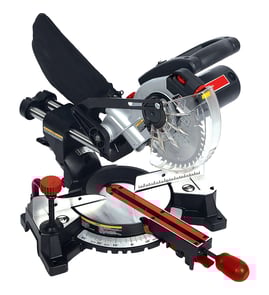

What are the parts of the miter saw?
On a Craftsman 113235120 12" compound miter saw, the main parts include the handle and trigger switch, motor and blade assembly, blade guard, fence, miter table (turntable), and the miter and bevel locking controls. These parts work together to support, position, and safely cut the workpiece.
- Handle and trigger (on-off) switch: where you grip the saw and start/stop the motor.
- Blade and arbor: the cutting blade mounts to the arbor; the arbor nut/bolt secures it.
- Lower blade guard: covers the blade as the head rises; retracts during the cut.
- Fence: the vertical backstop that keeps the board square to the blade.
- Miter table (turntable): the rotating base that sets left/right miter angles.
- Miter lock handle/knob: locks the turntable at the selected miter angle.
- Bevel lock lever/knob: locks the saw head tilt for bevel cuts.
| Part | Typical location | What to check if it feels “off” |
|---|---|---|
| Trigger switch | Inside the handle | Sticky trigger, intermittent power |
| Guard | Around the blade | Binding, slow return, sawdust buildup |
| Fence | Rear of the table | Loose fasteners, out-of-square setup |
| Miter lock | Front of the turntable | Won’t hold angle, slips under load |
| Bevel lock | Pivot/hinge area | Head drifts, bevel angle won’t hold |
Knowing the part names helps you troubleshoot accurately (for example, separating a fence alignment issue from a miter lock issue) and order the correct replacement when something is worn, loose, or damaged.
- Confirm the model number is 113235120.
- Identify the failed area (guard, switch, fence, miter lock, bevel lock).
- Match the part by description and diagram for your exact saw.
- Use Sears PartsDirect to search by model number and locate the correct parts list.
Last updated: February 2026
What should you never cut with a miter saw?
You should never use a miter saw (including the Craftsman 113235120 12" compound miter saw) to rip boards, cut ferrous metals or masonry, or make freehand cuts. Also avoid cutting tiny, unsupported pieces near the blade because they can shift, bind, or kick back.
- Ferrous metals (steel, iron, rebar): they can shatter abrasive wheels, damage the blade, and throw hot debris.
- Masonry products (brick, concrete, tile): dust and hardness can damage the saw and create unsafe debris.
- Unknown composites (some plastics, laminates, or resin-heavy materials): they can melt, chip, or grab the blade.
- Ripping (cutting with the grain): miter saws are built for crosscuts and miters, not long rip cuts.
- Freehand cuts: always keep the workpiece against the fence and supported on the table.
- Cutting warped, twisted, or bowed stock without clamping: the board can roll or pinch the blade.
- Cutting pieces that are too small to hold safely: small offcuts can become projectiles.
- Use a table saw or circular saw with a guide for rip cuts.
- Use the correct blade for the material (wood blade for wood; non-ferrous blade only when the saw and blade are rated for it).
- Clamp the workpiece and support long boards with outfeed stands.
- Keep hands out of the blade path; use a stop block or auxiliary fence for repeat cuts.
| Task | Better tool | Why it’s safer |
|---|---|---|
| Rip a 2x4 | Table saw or circular saw + straightedge | Controls long cuts and reduces binding |
| Cut steel angle | Metal-cutting saw | Designed for metal chips and heat |
| Cut brick/tile | Masonry saw | Controls dust and uses proper blade |
Most miter saw injuries come from the workpiece moving, binding, or kicking back. Avoiding the wrong materials and the wrong cut types keeps the blade from grabbing and keeps your hands away from the danger zone.
For parts diagrams and replacement components for your Craftsman 113235120, start with the model parts list, or search by model number on Sears PartsDirect.
Last updated: February 2026
Why is 31.6 on a miter saw?
The 31.6° mark on your Craftsman 113235120 12" compound miter saw is a built-in shortcut for making common crown molding corner cuts when the molding is cut as a compound miter (miter plus bevel). It helps you quickly hit the correct geometry for standard crown “spring angles” without doing trigonometry.
On many compound miter saws, 31.6° miter pairs with a bevel setting (often 33.9°) to create a tight 45° corner joint for typical crown molding profiles.
Common situations where you use it:
- Cutting crown molding for inside corners
- Cutting crown molding for outside corners
- Repeating the same corner cuts accurately (batch work)
- Reducing trial-and-error when you do not have a crown chart handy
These are the most common “preset” numbers you see on saw scales for crown molding.
| Crown molding spring angle | Typical miter setting | Typical bevel setting |
|---|---|---|
| 38° (common) | 31.6° | 33.9° |
| 45° (less common) | 35.3° | 30.0° |
Even with the preset, the cut can be off if the molding is not positioned consistently.
- Keep the molding flat on the table (for the “flat” method) and tight to the fence
- Hold the work firmly; crown can rock and change the effective angle
- Make a test cut on scrap from the same molding run
- Confirm your corner is actually 90°; out-of-square corners need adjustment
- Use a sharp blade; tear-out can make a “good” angle look wrong
Crown molding cuts are sensitive because you are joining two angled faces at once. The 31.6° mark exists to speed up setup and improve repeatability, especially when you are doing multiple corners on the same job.
If you need replacement parts (for example, a fence, table insert, switch, or motor components) for Craftsman model 113235120, start with the parts list for this model, or search by model number on Sears PartsDirect.
Last updated: February 2026
Can I cut a 4x4 with a 10 inch miter saw?
Yes, you can cut a 4x4 (actual size about 3-1/2 in. x 3-1/2 in.) with many 10-inch miter saws, but only if the saw’s 90-degree cutting capacity is deep enough; otherwise you’ll use a controlled flip-cut. Your Craftsman 113235120 is a 12-inch compound miter saw, so it’s typically better suited for 4x4 crosscuts than a 10-inch saw.
Blade diameter alone does not guarantee capacity; the saw’s design sets the real limit.
- Check the published max cut depth at 90 degrees (needs about 3-1/2 inches for a true one-pass cut)
- Sliding models usually have more crosscut capacity than non-sliding models
- Fence height and guard/head geometry can limit tall stock clearance
- Beveling reduces capacity, so a 4x4 may not clear at common bevel angles
- A sharp framing or finish blade reduces binding and burning
If the saw won’t reach full depth, a flip-cut is the standard workaround.
| Cut method | When it works best | How to keep it accurate |
|---|---|---|
| One-pass | Saw clears 3-1/2 in. at 90 degrees | Keep the 4x4 tight to fence and table; clamp it |
| Flip-cut | Saw depth is less than 3-1/2 in. | Mark all four faces; cut, rotate 180 degrees, finish the cut |
We recommend these basics for clean, controlled cuts on thick lumber.
- Place the 4x4 flat on the table, tight to the fence
- Clamp the workpiece, especially if the offcut will be short
- Let the blade reach full speed before entering the wood
- Lower the head smoothly; do not force the cut
- Keep hands well outside the blade path; support long stock
Cutting at the limit of a 10-inch miter saw increases the chance of binding, tear-out, and out-of-square cuts. Matching the method (one-pass vs flip-cut) to the saw’s capacity improves accuracy and reduces strain on the motor.
For model-based diagrams and to look up replacement items for Craftsman 113235120, start with the parts list for your saw or search by model on Sears PartsDirect.
Last updated: February 2026