Owner’s manual



Are older KitchenAid mixers better?
Older KitchenAid stand mixers are not automatically “better,” but many older designs feel more durable because they use simpler, more mechanical drivetrains and are often easier to service. For your KitchenAid KP26M1XPB5 (6-quart bowl-lift), “better” usually means matching the mixer’s condition and repairability to how you bake. For model-specific care and use details, check the KP26M1XPB5 owner's manual.
What “better” usually means in real use
Older mixers tend to win on serviceability; newer mixers tend to win on convenience and updated safety features.
- Durability feel: heavier housings and straightforward gearcases often feel tougher
- Repairability: common wear parts (gears, seals, control parts) are typically replaceable
- Performance: a well-maintained older mixer can mix as well as a newer one
- Noise and smoothness: depends more on gear wear and lubrication than age
- Parts availability: matters more than the year it was made
Quick comparison: older vs. newer (what to look for)
| What you care about | Older mixers often deliver | Newer mixers often deliver |
|---|---|---|
| Long-term service | Easier mechanical repairs | More electronics in some designs |
| Speed consistency | Good if gears are healthy | Good if control is healthy |
| Cost to keep running | Lower if you DIY | Lower if nothing fails |
How to judge your KP26M1XPB5 specifically
Condition beats age. If your KP26M1XPB5 shows any of the symptoms below, it usually points to a serviceable part rather than “the mixer is bad.”
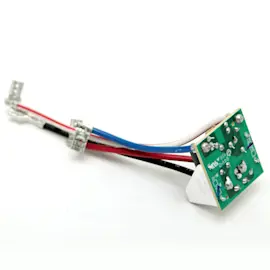
- Inconsistent speeds or surging: check the mixer control assembly WP9706648
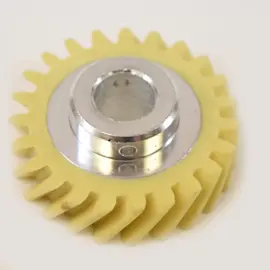
- Grinding, clicking, or stalls under load: inspect the stand mixer worm follower gear W11086780
- Grease leakage at the gearcase: replace the gasket WP9709511 and/or seal WP9706247
- Excess vibration or wobble: check for worn bearings like the bearing WPW10170080
Why it matters
A stand mixer is a gear-driven machine. When the control system, gears, seals, and bearings are in good shape, an “older” mixer and a “newer” mixer both perform well. When those parts wear, the mixer feels weak, noisy, or inconsistent, regardless of age.
Last updated: February 2026
What does KP26M1XPB5 mean in KitchenAid?
KP26M1XPB5 is the KitchenAid model number that identifies a specific 6-quart 600 Professional bowl-lift stand mixer configuration (series, capacity, design revision, and finish). We use that exact model number to match the correct diagrams, parts, and service information for your mixer; see the owner's manual for model-specific details.
What the characters typically indicate
KitchenAid model numbers are a structured identifier, not a single “word” with one definition. For KP26M1XPB5, the characters commonly map to these kinds of details:
- KP: product line/series family identifier
- 26: capacity/size family (commonly tied to 6-quart class mixers)
- M1: design or engineering revision within the series
- XP: configuration/feature package within that revision
- B5: color or finish code for the exterior housing
Why the exact model number matters for parts
Small differences in revision or finish can change which parts fit, especially on a bowl-lift stand mixer.
- Ensures the correct gearcase and seals are selected
- Helps match the right speed control components
- Prevents ordering the wrong housing color/finish parts
- Improves accuracy when troubleshooting noise, leaking grease, or speed issues
Common examples of parts that can vary by model/revision
| Part area | What can differ | Example part on this model page |
|---|---|---|
| Speed control | Board, knob style, calibration | Mixer control assembly WP9706648 |
| Gear train | Gear tooth profile, follower style | Stand mixer worm follower gear W11086780 |
| Sealing surfaces | Gasket and seal dimensions | Seal WP9706247, gasket WP9709511 |
Quick tip: where to find the model number on the mixer
On bowl-lift KitchenAid mixers, the model/serial label is typically on the underside of the base. Match it character-for-character (including letters and numbers) before ordering parts.
Why it matters
Using KP26M1XPB5 (not just “KitchenAid 600” or “6-quart”) is the fastest way to get parts that fit the first time and avoid compatibility issues with the motor, gear housing, and control assembly.
Last updated: February 2026
What is the #1 rated stand mixer?
There is not one universal “#1 rated” stand mixer because rankings depend on what you make most (cookies, bread dough, large batches, attachments). For heavy-duty mixing, a bowl-lift design like the KitchenAid KP26M1XPB5 (6-quart 600 Professional) is a top-tier choice for power and capacity; use the owner's manual to match speeds and capacity to your recipes.
How to pick the best stand mixer for your kitchen
- Capacity: 5 to 6 quarts covers most home baking; 6 quarts is better for double batches.
- Drive style: Bowl-lift mixers handle stiffer doughs and larger loads more consistently.
- Speed control: Look for smooth low-speed mixing and stable mid-range speeds.
- Attachments and hub: Useful if you plan to add pasta rollers, grinders, or other tools.
- Serviceability: Common wear items (gears, seals, control parts) should be replaceable.
Quick comparison: what “#1” usually means
| If you mostly make... | What matters most | A strong fit |
|---|---|---|
| Cookies, cakes, frosting | Smooth speed control, easy bowl access | Tilt-head or bowl-lift |
| Bread and pizza dough | Torque, stability, bowl-lift frame | Bowl-lift (like KP26M1XPB5) |
| Big batches for holidays | Bowl size, motor durability | 6-quart class |
If your KP26M1XPB5 is not performing like a top-rated mixer
Performance issues can make any mixer feel “not #1”. These are the most common fix paths:
- Surging, dead speeds, or inconsistent RPM: check the mixer control assembly WP9706648
- Clicking, grinding, or poor kneading power: inspect the stand mixer worm follower gear W11086780
- Grease seepage or oil around the gearcase: replace the seal WP9706247 and gasket WP9709511
Why it matters
“Best” is really about matching capacity, torque, and speed control to what you cook. A properly tuned bowl-lift mixer like the KP26M1XPB5 excels at heavier doughs and larger batches, which is exactly what many “top-rated” lists reward.
Last updated: February 2026