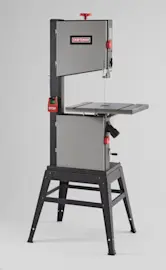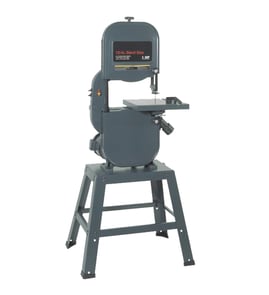

What are the main parts of a band saw?
The main parts of a Ryobi BS902 9-inch band saw are the wheels that drive the blade, the blade-guiding and tensioning system, the work table, and the motor and drive components. Together, these parts keep the blade tracking straight and cutting safely and accurately.
Main band saw parts (what they do)
- Drive wheel (lower wheel): Transfers power to the blade; it is driven by the motor (often through a belt and pulley).
- Upper wheel: Supports the blade loop and helps maintain blade alignment.
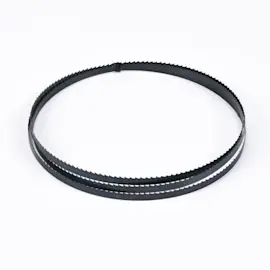
- Blade: The continuous cutting band; tooth style and width affect cut speed, finish, and turning radius.
- Blade guides (side guides and thrust bearing): Keep the blade from twisting or being pushed backward during a cut.
- Tension control: Tightens or loosens the blade so it runs stable without slipping.
- Tracking adjustment: Centers the blade on the wheels so it does not walk off during operation.
- Table and blade slot (throat): Supports the workpiece and provides clearance for the blade.
Quick “where to look” map
| Area of the saw | Parts you will typically find there | Why it matters |
|---|---|---|
| Upper housing | Upper wheel, tracking knob, tension mechanism | Keeps the blade centered and properly tensioned |
| Lower housing | Drive wheel, motor, belt/pulley (common setup) | Provides cutting power and blade speed |
| Around the blade | Guide blocks/bearings, thrust bearing, guard | Controls blade deflection and improves cut accuracy |
| Work surface | Table, tilt/squaring adjustments, fence (if equipped) | Controls cut angle and repeatability |
Why it matters for troubleshooting
Knowing these parts helps us narrow down symptoms fast:
- Blade slips or stalls: tension control, drive belt/pulley, drive wheel
- Blade wanders or won’t cut straight: tracking adjustment, blade guides, blade condition
- Excess vibration or noise: wheels, bearings, blade weld/condition, belt alignment
Parts lookup tip
When you are ready to identify and order replacement parts for the Ryobi BS902, start with the model-based diagrams and parts list, then search by the exact model number on Sears PartsDirect to match the correct wheel, guide, belt, switch, or hardware for your saw.
Last updated: February 2026
What is the 3-tooth rule for bandsaws?
The 3-tooth rule for a band saw blade means that, while cutting on your Ryobi BS902 9-inch band saw, at least three blade teeth should be in contact with the workpiece at all times. This prevents tooth breakage, improves chip clearance, and helps the blade cut smoother and last longer.
How to use the 3-tooth rule (quick blade selection)
Use the thickness of the material to pick a tooth pitch (TPI) that keeps 3 or more teeth engaged.
- Measure the material thickness at the cut line (not the overall board width)
- Choose a blade pitch so 3 to 6 teeth are typically in the cut for most work
- If you see tooth snagging or broken teeth, move to a higher TPI (finer blade)
- If the blade loads up with dust or chips and burns, move to a lower TPI (coarser blade)
- For curves, also consider blade width; narrower blades turn tighter but can wander more
Typical TPI guidance (rule-of-thumb table)
These are common starting points for small shop band saws like the BS902; adjust based on wood species, feed rate, and cut quality goals.
| Material thickness | Target teeth in cut | Common starting TPI range |
|---|---|---|
| 1/8 to 1/4 in. | 3 to 6 | 14 to 24 TPI |
| 1/4 to 3/4 in. | 3 to 8 | 6 to 14 TPI |
| 3/4 to 2 in. | 3 to 10 | 3 to 6 TPI |
What happens if you break the rule
- Too few teeth engaged (TPI too low): teeth can hook, chatter, and strip off
- Too many teeth engaged (TPI too high): gullets pack with sawdust, causing heat, burning, and slow cutting
- Either condition: more vibration, rougher finish, and shorter blade life
Why it matters
Band saw teeth need enough support from the workpiece to cut cleanly, and the gullets need room to carry chips out of the kerf. Keeping at least three teeth in the cut balances strength and chip removal, which is especially important on a compact 9-inch band saw.
Parts and setup note
If you are shopping for replacement parts (blade guides, tires, drive belt, switch, or bearings) for the Ryobi BS902, start with the model parts list, or search by model number on Sears PartsDirect.
Last updated: February 2026
What is the best all around bandsaw blade?
For a Ryobi BS902 9-inch band saw, the best all-around blade is typically a 1/4-inch wide, 6 TPI (teeth per inch) hook or skip-tooth blade in carbon steel. That combination tracks well for most straight cuts and gentle curves in wood, and it is forgiving for general DIY use.
Our go-to “general purpose” blade setup
A single blade cannot do everything perfectly, but this setup covers the widest range of common projects on a 9-inch saw.
- Width: 1/4 in. (best balance of curve ability and stability)
- TPI: 6 TPI (good chip clearance and a smoother finish than 3 to 4 TPI)
- Tooth style: skip-tooth or hook (reduces burning and clears sawdust)
- Material: carbon steel (cost-effective for wood)
- Use case: general ripping, light resawing, and moderate curves
Quick blade selection chart
| What you are cutting | Blade width | TPI range | Best tooth style |
|---|---|---|---|
| General wood cutting | 1/4 in. | 6 | Skip or hook |
| Tight curves | 1/8 to 3/16 in. | 10 to 14 | Regular |
| Straight cuts, light resaw | 3/8 in. | 3 to 4 | Hook |
| Plastics (most types) | 1/4 in. | 10 to 14 | Skip |
Why it matters (performance and safety)
Using the wrong blade is the fastest way to get wandering cuts, burning, excessive vibration, and premature blade breakage. Matching blade width and TPI to the job also reduces the urge to force the workpiece, which helps keep cuts controlled.
Tips to get better results with any blade
- Tension correctly: too loose wanders; too tight breaks blades.
- Track the blade: center it on the wheels before cutting.
- Set guides close: keep side guides and thrust bearing just off the blade.
- Feed rate: let the teeth cut; forcing causes drift and heat.
- Use the right blade for metal: for steel or frequent metal cutting, use a dedicated metal-cutting blade and slower feed.
If you need to match a blade to your exact project and confirm fit for the BS902, use the model number when searching on Sears PartsDirect.
Last updated: February 2026
Where can I buy replacement parts for Ryobi?
For your Ryobi BS902 9" band saw, we recommend starting with the model-specific parts list for BS902 so you get the right fit and function; if you do not see what you need there, search by the full model number (BS902) on Sears PartsDirect to find additional compatible parts and diagrams.
Best way to find the correct part for BS902
- Match the model number exactly: BS902
- Use the exploded parts diagram to confirm where the part installs
- Compare the part description (for example: blade guide, tire, switch, belt)
- If multiple versions exist, match mounting style and dimensions
- For electrical items, match voltage and terminal style
Common BS902 band saw parts people replace
Even without a manual listed for this model, these are the most common wear or failure items on a 9-inch band saw:
- Band saw blade
- Blade guide bearings/blocks
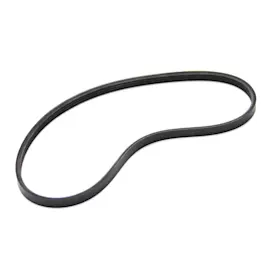
- Drive belt
- Wheel tires
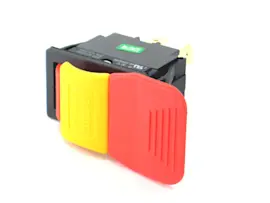
- Switch or power cord
- Table insert and blade guard components
Quick checklist before ordering
| What you’re replacing | What to confirm first | Why it matters |
|---|---|---|
| Blade | Length, width, tooth count (TPI) | Prevents tracking issues and poor cuts |
| Tires | Wheel diameter and tire style | Keeps the blade centered and reduces vibration |
| Switch/cord | Amperage rating, connector style | Avoids overheating and wiring problems |
| Guides | Bearing size or block type | Improves cut accuracy and blade life |
Why it matters
Band saw parts are highly model-specific; using the BS902 model number and diagram-based identification prevents ordering a part that looks similar but will not mount correctly or will cause tracking, vibration, or safety issues.
Last updated: February 2026