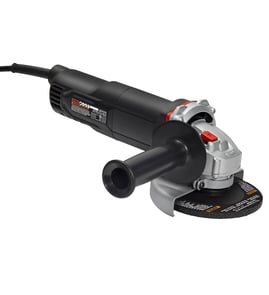

Can I cut a 2x4 with an angle grinder?
Yes; you can cut a 2x4 with the Milwaukee 6145 4-1/2 inch sander-grinder, but only with a wood-rated accessory and strict control. This tool spins fast, so wood can grab and kick back; a circular saw is the safer, cleaner choice for lumber.
Choose accessories that are explicitly labeled for wood and for angle grinder use.
- Use a wood carving wheel or wood cutting wheel labeled for angle grinders
- Use a carbide-tooth wood wheel only if the wheel’s maximum RPM rating meets or exceeds your grinder’s no-load RPM
- Avoid metal cut-off wheels (they bind and overheat in wood)
- Avoid abrasive masonry wheels (poor control and excessive burning)
- Avoid high-tooth-count circular saw blades on a grinder (high grab and kickback risk)
A grinder can climb in wood; setup prevents most accidents.
- Clamp the 2x4 to a stable bench; never hold it by hand
- Keep the guard installed and positioned between you and the wheel
- Let the tool reach full speed before touching the wood
- Make a shallow scoring pass first, then deepen the cut gradually
- Stand slightly to the side of the wheel’s rotation path
- Stop immediately if the wheel starts to bind; reposition the work and restart
| Tool | Best for 2x4 cuts | Cut quality | Kickback risk |
|---|---|---|---|
| Circular saw | Straight, repeatable cuts | Clean | Low |
| Reciprocating saw | Rough cuts, demolition | Rough | Medium |
| 4-1/2 inch sander-grinder (wood wheel) | Occasional rough trimming | Rough | High |
Wood fibers can catch a high-speed wheel and pull the tool forward. Using a wood-rated wheel, clamping the lumber, and taking shallow passes reduces binding, overheating, and loss of control.
For general DIY safety guidance that also applies to power tools, review are diy appliance repairs safe.
Last updated: February 2026
What is the most powerful angle grinder?
There is no single “most powerful” angle grinder because power depends on the grinder size class (4-1/2 inch, 6 inch, 7 to 9 inch), corded vs. cordless, and the tool’s rated watts/amps. For your Milwaukee 6145 4-1/2 inch sander/grinder, “most powerful” usually means the highest amp rating (corded) or highest voltage and sustained output (cordless) in the same wheel size.
Use these specs to compare grinders fairly within the same wheel diameter and duty cycle:
- Amps (corded): higher amps generally means more available power under load.
- Watts (input vs. output): marketing often lists input watts; output can be lower.
- No-load RPM: higher RPM is not the same as higher torque.
- Sustained power under load: better electronics and cooling keep power from dropping.
- Gearcase and motor size: larger housings often support higher continuous output.
These ranges help set expectations when shopping or comparing tools:
| Grinder class | Common wheel size | Typical power range | Best use case |
|---|---|---|---|
| Compact | 4-1/2 to 5 inch | ~7 to 13 amps corded (or 18V class cordless) | Cutting, grinding, flap discs, light to medium duty |
| Mid-size | 6 inch | ~13 to 15 amps corded | Heavier grinding, longer duty cycles |
| Large | 7 to 9 inch | ~13 to 15 amps corded (higher torque designs) | Deep grinding, large cutoffs, industrial work |
More power can reduce bogging and speed up cuts, but it also increases kickback risk and heat. Matching power to the wheel size, guard, and accessory rating helps you get faster work without sacrificing control.
- Use the right wheel type for the job (cutoff vs. grinding vs. flap disc).
- Let the wheel do the work; excess pressure slows RPM and overheats the motor.
- Keep vents clear; dust buildup reduces cooling and sustained output.
- Use properly rated extension cords; voltage drop reduces power.
- If performance suddenly drops, check for worn brushes, a damaged cord, or a failing switch.
For electrical troubleshooting steps and safe testing, use our how to use a multimeter to test electrical parts video.
Last updated: February 2026
How do I find the model number on my 6145?
The model number for your Milwaukee 6145 4-1/2" sander/grinder is usually printed on the tool’s rating label (nameplate). On most grinders, that label is on the motor housing or near the handle where the power cord enters.
Check these common spots first:
- Side of the main motor housing (near the Milwaukee logo area)
- Underside or back of the housing near the rear handle
- Near the cord strain relief where the power cord enters the tool
- On the gear case area (metal head) on some versions
- On a wraparound label near the switch area
For ordering the correct power tool parts, we recommend recording all label details, not just “6145”:
- Model number (6145)
- Type number (often shown as “TYPE” on Milwaukee tools)
- Catalog number (sometimes listed separately)
- Electrical rating (volts and amps)
- Serial number (helps identify production run)
| Label item | Why it matters |
|---|---|
| Model number (6145) | Identifies the tool family |
| Type number | Pinpoints the exact version for diagrams and parts |
| Serial number | Helps confirm the correct revision |
Use these practical checks to narrow it down:
- Compare your tool’s switch style (slide vs. paddle) and guard style to diagrams
- Match the gear case shape and spindle lock location
- Bring the tool to a well-lit area and look for faint stamped or printed characters
For more help confirming the correct model number format before you order, use [how to find your appliance model number (and what it means for parts)].
Milwaukee grinders can share similar housings but use different switches, armatures, brushes, or guards by type number; using the full identification from the nameplate prevents ordering the wrong replacement parts.
Last updated: March 2026