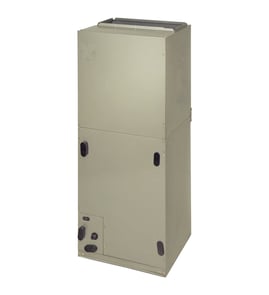

Is a fan coil the same as an air handler?
Yes. For your Carrier FK4DNF003000 (fan coil), “fan coil” and “air handler” are commonly used to describe the same indoor unit: a blower (fan) that moves air across a heating and/or cooling coil to condition the air.
How the terms are used in HVAC
In most residential split systems, people use these terms interchangeably. In practice, the name usually depends on what the indoor unit is paired with and what features it includes.
- Air handler: general term for the indoor blower cabinet that moves and conditions air.
- Fan coil: often used when the unit’s main job is moving air across a coil (cooling coil, heating coil, or both).
- Many units also include controls, safety switches, and sometimes an electric heat kit.
Quick comparison
| Term you hear | What it usually means | What you should check before ordering parts |
|---|---|---|
| Air handler | Indoor blower unit for a split system | Model number and control board style |
| Fan coil | Indoor unit focused on air moving across a coil | Coil type, blower motor, and wiring connections |
Why it matters for parts and troubleshooting
Using the right term helps you land on the correct parts list and wiring layout for your exact model. For example, if you are diagnosing no-blower, no-cooling, or intermittent operation, the control board is often part of the troubleshooting path.
Common “air handler or fan coil” symptoms that point to controls or wiring
- Blower will not start, but thermostat is calling
- Blower runs continuously when it should cycle
- Outdoor unit runs but weak airflow indoors
- Intermittent operation after power resets
- Burnt smell or visible heat damage near low-voltage wiring
If you are testing electrical components, use a meter and follow safe power-off practices; our how to use a multimeter to test electrical parts video is a good starting point.
Parts you can shop for this model
If you determine a control issue, the model-specific control board listed for FK4DNF003000 is board circ HK61EA005.
Last updated: February 2026
How many CFM do I need for a 3 ton air handler?
For a 3-ton air handler (like the Carrier FK4DNF003000 fan coil), you typically need about 1,200 CFM of airflow. That is based on the common HVAC target of ~400 CFM per ton to move enough air across the evaporator coil for proper cooling and dehumidification.
Quick rule of thumb (and when to adjust it)
Most residential systems are set up around 350 to 450 CFM per ton depending on comfort goals and conditions.
- Standard cooling: ~400 CFM per ton (3 tons = ~1,200 CFM)
- Better dehumidification (humid climates): ~350 CFM per ton (3 tons = ~1,050 CFM)
- Higher sensible cooling (drier climates): ~450 CFM per ton (3 tons = ~1,350 CFM)
What happens if CFM is too low or too high?
Airflow that is far off target can cause comfort problems and equipment stress.
- Too low: coil can get too cold, reduced cooling, possible icing, noisy return air
- Too high: reduced dehumidification, drafty vents, higher blower noise
- Either way: uneven temperatures and longer run times
Target airflow table for a 3-ton setup
| Airflow target | CFM per ton | Approx. total CFM (3 tons) |
|---|---|---|
| Dehumidify more | 350 | 1,050 |
| Typical target | 400 | 1,200 |
| Maximize airflow | 450 | 1,350 |
How we recommend checking airflow on a fan coil
Because FK4DNF003000 configurations vary (duct static pressure, filter type, coil, blower settings), we recommend verifying airflow instead of guessing.
- Confirm the blower speed tap/setting is correct
- Check the air filter and return grille for restriction
- Inspect the evaporator coil for dirt buildup
- Measure external static pressure and compare to the blower performance data
- If you are troubleshooting electrical control issues, inspect the control board connections (a failed board can prevent the blower from reaching the correct speed); see board circ HK61EA005
Why it matters
Correct CFM protects the evaporator coil, improves comfort, and helps your Carrier air handler deliver the capacity your 3-ton system is designed for.
Last updated: February 2026
How tall is a 3 ton carrier air handler?
A 3-ton Carrier air handler is typically about 40 to 55 inches tall, but the exact height depends on the cabinet style (upflow, horizontal, or multi-position) and the specific series. For your Carrier FK4DNF003000 fan coil, use the model-specific parts and cabinet configuration to confirm fit before ordering.
Typical height ranges (what you can plan around)
Most 3-ton fan coil and air handler cabinets fall into these common ranges:
- Standard vertical cabinet: ~40 to 55 inches tall
- Compact/low-profile cabinet: ~34 to 45 inches tall
- Horizontal applications: height is often less critical than overall clearance and service access
| Configuration | Typical height | What changes it most |
|---|---|---|
| Upflow / downflow | 40 to 55 in. | Coil size, blower section, filter rack |
| Horizontal | 34 to 45 in. | Drain pan style, hanger kit, duct transitions |
| Closet / tight install | 34 to 45 in. | Return-air setup, platform, secondary drain pan |
How to confirm the height for FK4DNF003000
Use these practical checks to lock in the correct measurement for your install:
- Measure the cabinet height only (exclude the supply plenum and any field-fabricated transitions).
- Confirm whether you have a factory filter rack or an add-on return box that adds height.
- Check for a secondary drain pan or float switch that may require extra clearance.
- Verify the orientation (vertical vs. horizontal) because the “height” dimension changes with mounting.
- Match your unit’s electrical/control setup; a replacement control can affect service access needs.
If you are troubleshooting fitment while replacing controls, the board circ HK61EA005 is a common component that can drive service-clearance needs around the blower/control area.
Why it matters
Air handler height affects more than “will it fit.” It also impacts condensate drainage slope, duct alignment, filter access, and whether a technician can safely service the blower and control board without removing the cabinet.
Last updated: February 2026
How big is a 4 ton air handler?
A “4 ton” air handler refers to cooling capacity (about 48,000 BTU/hr), not a single standard cabinet size. For Carrier fan coil systems like model FK4DNF003000, physical dimensions vary by series, orientation (upflow, downflow, horizontal), and installed options such as an electric heat kit.
Typical size range for a 4 ton air handler
Most 4 ton air handlers fall into these common ranges:
- Width: about 17 to 24 inches
- Depth: about 20 to 26 inches
- Height: about 45 to 60 inches
- Weight: often 90 to 160 lb (varies with coil and heater)
What changes the size the most
These factors usually drive the biggest dimension differences:
- Orientation and drain pan setup (vertical vs. horizontal)
- Coil design (A-coil vs. slab coil, cabinet style)
- Electric heat kit installed (adds depth and wiring space)
- Filter rack or return plenum configuration
- Cabinet insulation and sound features
Quick planning checklist (so it fits the closet or attic)
Before ordering parts or planning a replacement, we recommend:
- Measure the existing cabinet width, depth, and height at the widest points
- Confirm service clearance (front panel removal and blower access)
- Note duct connection sizes (supply plenum and return opening)
- Check drain line location and secondary pan space
- Verify the model number on the data tag using how to find your appliance model number (and what it means for parts)
Capacity vs. size at a glance
| What you’re looking at | What it tells you | What it does not tell you |
|---|---|---|
| “4 ton” rating | Approx. 48,000 BTU/hr airflow/capacity class | Exact cabinet dimensions |
| Model number (FK4DNF003000) | The specific Carrier fan coil configuration | The size of other 4 ton models |
Why it matters
Air handler size affects whether the unit physically fits, whether the duct transitions line up, and whether you can remove panels for service. Getting the model number right also helps ensure you order the correct control parts, such as the board circ HK61EA005.
Last updated: February 2026
What is FK4DNF003000?
FK4DNF003000 is the model number for a Carrier fan coil (air handler). We use this exact model number to match the correct replacement parts and electrical components for your specific unit so the fit, wiring connections, and ratings line up.
What the model number tells you
For Carrier air handlers, the model number identifies the exact indoor unit configuration. That matters because parts can vary by cabinet size and control setup.
Use FK4DNF003000 when you need to:
- Pull the correct parts list and diagrams for your air handler
- Confirm a control board matches your wiring connectors
- Verify mounting hardware and brackets match the cabinet
- Order the right replacement part the first time
Example parts listed for this model
These are examples of parts associated with FK4DNF003000 on our parts list:
- Board circ HK61EA005 (control board)
- Bracket part number 314900-203 (mounting/support hardware)
Quick comparison
| Part | What it does | Common replacement reason |
|---|---|---|
| Board Circ (control board) | Controls blower operation and low-voltage functions | No blower, intermittent operation, visible board damage |
| Bracket | Secures internal components | Vibration noise, loose components, bent or broken mount |
Why it matters
Using the exact model number FK4DNF003000 prevents ordering a similar-looking part that does not match the mounting points, connectors, or control logic of your Carrier air handler.
Last updated: February 2026
