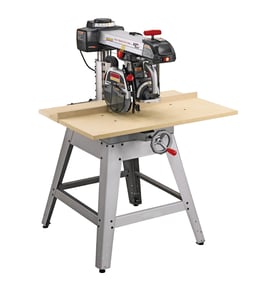

Are radial arm saws worth anything?
Yes. A Craftsman radial arm saw cabinet like model 22205-CABINET can still be worth money and worth owning, especially for accurate, repeatable crosscuts and dado work on wide stock. Value depends mostly on condition, completeness, and how well the saw can be tuned and used safely.
What affects the value most
- Condition of the arm and carriage travel: smooth movement with minimal play matters more than cosmetics.
- Motor health: starts quickly, runs smoothly, no burning smell, no excessive sparking at brushes.
- Fence and table condition: a solid, flat table and straight fence help accuracy.
- Completeness: blade guard, anti-kickback parts, yoke/lock knobs, and hardware increase value.
- Ability to hold alignment: if it stays square after locking, it is more desirable.
Typical used-market value range
Most homeowner-grade radial arm saws sell for about $50 to $150 in working condition. Heavier, older cast-iron builds and well-maintained setups tend to land at the higher end, while missing guards, rough bearings, or alignment issues push value down.
| Condition | What you typically see | Value impact |
|---|---|---|
| Excellent | Clean, complete, cuts square, smooth travel | Highest |
| Average | Works but needs table/fence refresh or tuning | Mid |
| Rough | Missing guard/parts, noisy bearings, won’t stay aligned | Lowest |
Why it matters (utility vs. resale)
Radial arm saws are still very useful for wide crosscuts, repetitive cutoffs with stops, and dadoes. They are less popular today because many users prefer the convenience of a miter saw or table saw, and because a radial arm saw demands careful setup and disciplined technique to stay safe and accurate.
Quick safety and setup checks before you buy or sell
- Unplug the saw before inspecting anything mechanical.
- Verify the guard is present and functional.
- Check for side-to-side play in the carriage and arm.
- Confirm the arm locks firmly at 90 degrees.
- Make a test cut and check for square and repeatability.
For help identifying the exact model and matching the right diagrams when shopping for replacement items, use how to find your appliance model number (and what it means for parts).
Last updated: February 2026
What are common problems with radial arm saws?
Common problems with a Craftsman radial arm saw cabinet like model 22205-CABINET include inaccurate cuts from alignment drift, rough or hard sliding travel on the arm, blade wobble from arbor issues, and electrical problems such as a bad switch or damaged cord. Most issues are fixable with inspection, cleaning, adjustment, and basic electrical testing.
Most common symptoms and likely causes
- Cuts are not square or repeatable: fence not straight, arm not locked, yoke not indexed, table not flat
- Blade wanders or chatters: dull blade, wrong blade type, loose arbor nut, worn bearings
- Carriage does not slide smoothly: dirty rails, dry rollers/bearings, damaged track surfaces
- Motor struggles or trips power: binding cut, failing start components, worn brushes (if applicable), low voltage
- Saw will not start: bad switch, loose wiring, damaged power cord, blown fuse in the circuit
Quick checks we recommend (in order)
- Unplug the saw and verify the blade stops fully before touching anything.
- Check mechanical tightness: arm lock, yoke lock, bevel/miter locks, arbor nut.
- Verify alignment: confirm the fence is straight and the arm is set to true 90 degrees for crosscuts.
- Inspect the blade: replace if dull, warped, or the wrong type for the cut.
- Clean and lubricate sliding surfaces: remove pitch and sawdust buildup; keep rails smooth and dry (avoid oily buildup that traps dust).
- Electrical diagnosis (if it will not run): test the switch and cord for continuity using a meter.
Troubleshooting guide by symptom
| Symptom | What to check first | Typical fix |
|---|---|---|
| Inaccurate cuts | Arm/yoke locks, fence straightness | Re-square and tighten, rebuild/replace fence surface |
| Excess vibration | Blade condition, arbor tightness | Replace blade, tighten arbor, inspect bearings |
| Hard to slide | Rail cleanliness, roller wear | Clean rails, adjust rollers, replace worn rollers |
| Won’t start | Cord, switch, wiring connections | Repair wiring, replace switch/cord as needed |
Why it matters
Radial arm saw problems often compound: a slightly loose lock or dirty rail can turn into inaccurate cuts, kickback risk, and premature wear on bearings, rollers, and the motor.
For safe electrical testing and wiring checks, we recommend using how to use a multimeter to test electrical parts video.
Last updated: February 2026
When did Craftsman stop making radial arm saws?
Craftsman radial arm saws were produced and sold for many years, with the biggest era of widespread sales running from the late 1950s into the 1990s. For model 22205-CABINET, the most accurate way to date your saw is by the model and serial information on the machine itself.
What we can say with confidence
Craftsman radial arm saws span multiple decades and multiple manufacturing sources. Because of that, there is not one single “stop date” that applies to every Craftsman radial arm saw.
- Craftsman radial arm saws were widely sold from the late 1950s onward
- Many popular Craftsman radial arm saw lines were most common through the 1970s to 1990s
- Some models continued to appear after others were discontinued
- The 22205-CABINET identifier is a parts listing category for a cabinet-style radial arm saw, not a build year
How to date your specific Craftsman saw
Use the identification plate on the saw to narrow the timeframe and ensure you match parts correctly.
- Locate the model and serial tag (often on the cabinet, arm, or motor area)
- Write down the full model number and serial number exactly as shown
- Check the motor nameplate (volts, amps, RPM) for additional clues
- Note the switch style and cord type (older vs. newer safety designs)
- Compare guard style and casting details to the parts diagrams for your exact model
| What you have | What it tells you | Why it helps |
|---|---|---|
| Model number | Product family and configuration | Improves parts matching |
| Serial number | Production sequence and era | Narrows the date range |
| Motor nameplate | Motor generation and specs | Confirms compatibility |
Why it matters
Dating the saw helps you choose compatible replacement parts and set it up safely. Older radial arm saws often need extra attention to guarding, alignment, and electrical condition before regular use.
Safe next steps for inspection
- Unplug the saw before removing covers or checking wiring
- If you test electrical components, use how to use a multimeter to test electrical parts video
- If you are tracing a circuit issue, use how to read a wiring schematic video
Last updated: February 2026