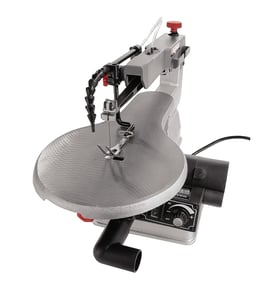

Should I get pinless or pinned scroll saw blades?
For the Craftsman 113236130 13-inch scroll saw, we recommend pinless (plain-end) blades for most projects because they give you the best control for tight turns and fine detail. Choose pinned blades only when your saw’s blade clamps are set up strictly for pinned ends or you’re doing simple, thicker cuts.
Quick comparison: pinless vs pinned blades
| Feature | Pinless (plain-end) blades | Pinned blades |
|---|---|---|
| Best for | Fretwork, puzzles, intricate curves | Basic cuts, thicker stock, beginner practice |
| Inside cuts | Excellent (fits smaller pilot holes) | Limited (needs larger entry holes) |
| Blade changes | Can be slightly slower at first | Often faster and simpler |
| Compatibility | Many saws accept them with the right clamps/adapters | Common on some older entry-level saws |
How to choose the right blade style for your 113236130
Use these checks to decide what to buy first:
- Look at your blade clamps: if they clamp a flat blade end securely, pinless is the right choice.
- Check your typical work: names, portraits, ornaments, and tight-radius patterns favor pinless.
- Consider inside cuts: if you drill small pilot holes for interior cutouts, pinless is the practical option.
- Match blade size to material: thinner materials and fine detail use smaller, finer-tooth blades; thicker hardwoods use larger blades.
- Plan for learning curve: pinned blades feel easier at first, but pinless gives better long-term flexibility.
What we see most often (and what to buy first)
If you are unsure, start with a small assortment of pinless blades in a few tooth patterns (for example, skip-tooth and reverse-tooth styles). That covers most scrolling tasks and helps reduce tear-out on the bottom face of the wood.
Why it matters
Blade style affects cut quality, turning radius, and how easily you can do inside cuts. Pinless blades open up more project types, especially detailed work where clean edges and tight curves matter.
Ordering tip
We list replacement parts for the Craftsman 113236130 on this model page; for broader blade and accessory searches by model number, use Sears PartsDirect.
Last updated: February 2026
How do I know which scroll saw blade to use?
For your Craftsman 113236130 13" scroll saw, pick a blade based on the material type, thickness, and the kind of cut you want: smaller blade numbers for tight, detailed work and thin stock; larger numbers for thicker wood and straighter cuts. For blade and accessory shopping by model, use the parts list for this saw first, then search by model on Sears PartsDirect.
Quick blade selection guide (what to match)
- Material: softwood, hardwood, plywood, plastic, or non-ferrous metal (use blades made for that material).
- Thickness: thicker stock needs a larger blade size/number and usually fewer teeth per inch.
- Cut style: tight inside curves and fretwork need a smaller, narrower blade.
- Finish quality: choose tooth style to control tear-out and sanding time.
- Your saw’s blade clamp style: confirm whether your saw uses pinned or pinless (plain-end) blades before buying.
Tooth styles and when to use them
| Tooth style | Best for | What you’ll notice |
|---|---|---|
| Skip-tooth | Faster cutting in wood | More aggressive cut, rougher edge |
| Double skip-tooth | General purpose, smoother than skip | Good control, decent speed |
| Reverse-tooth | Plywood and veneered stock | Less bottom-side tear-out |
| Spiral | Cutting in any direction without turning work | Wider kerf, rougher finish |
Blade size rules of thumb (practical)
- #1 to #3: thin wood and fine detail (tight turns, small radii).
- #5 to #7: most general scroll work in typical craft wood thicknesses.
- #9 to #12: thicker stock and straighter cuts (more power, less finesse).
Why it matters
The wrong blade makes a scroll saw feel underpowered or hard to control. Matching blade type and size reduces burning, blade breakage, wandering cuts, and tear-out, so your Craftsman scroll saw tracks cleaner and safer.
Helpful setup checks before you cut
- Set blade tension so the blade “pings” when plucked (firm, not over-tight).
- Use a slower feed rate; let the teeth do the work.
- Keep the workpiece flat on the table; avoid twisting the blade.
- If you see burning, switch to a sharper blade or a tooth style that clears sawdust better.
Last updated: February 2026
How thick of wood can I cut with a scroll saw?
Most scroll saws, including the Craftsman 113236130 13-inch scroll saw, cut best in thinner stock; for clean, controlled cuts we treat 3/4 inch to 1-1/2 inches as the practical range, with up to about 2 inches possible in softer wood using the right blade and a slow feed rate.
Practical thickness guidelines
- 1/4 inch to 3/4 inch: Ideal for most scrolling, tight turns, and fine detail.
- 3/4 inch to 1-1/2 inches: Good for thicker plaques, name signs, and stack cutting (with the right blade).
- 1-1/2 inches to ~2 inches: Possible for straight or gentle curves; expect slower cutting and more blade heat.
- Over ~2 inches: Not a good match for a scroll saw; a band saw is usually the better tool for thick stock.
What determines the maximum thickness?
The “how thick can I cut” answer depends more on setup than the saw’s throat size.
- Blade type and size: Larger, coarser blades clear sawdust better in thick wood.
- Wood species: Softwoods cut thicker more easily; dense hardwoods reduce practical thickness.
- Cut style: Tight inside curves reduce thickness capability because the blade twists and binds.
- Feed rate: Pushing too fast overheats the blade and causes wandering.
- Blade tension and hold-down: Proper tension and stable work support reduce deflection.
Quick setup targets (use these as a baseline)
| Material thickness | Blade choice (typical) | Best use case |
|---|---|---|
| 1/4 to 3/4 inch | Fine-to-medium tooth | Detailed fretwork, tight curves |
| 3/4 to 1-1/2 inches | Medium-to-coarse tooth | General cutting, moderate curves |
| 1-1/2 to ~2 inches | Coarse tooth | Straight cuts, gentle curves |
Why it matters
Cutting stock that is too thick for the blade and pattern leads to burning, rough edges, broken blades, and inaccurate cuts. Staying in the practical thickness range gives cleaner results and protects the saw’s motor and blade clamps.
Parts and support
If you need replacement parts for your Craftsman 113236130 scroll saw (blade clamps, switches, cords, or hardware), start with the model parts list and diagrams, or search by model number on Sears PartsDirect. For electrical troubleshooting basics, we also recommend how to use a multimeter to test electrical parts video.
Last updated: February 2026
Can you make straight cuts with a scroll saw?
Yes. You can make straight cuts with a Craftsman 113236130 13-inch scroll saw, but it takes more setup and technique than a saw designed for ripping; blade drift and flex make long, perfectly straight cuts harder to hold.
Best ways to get straighter cuts
- Use a wider, stiffer blade (skip-tooth or reverse-tooth styles often track better than very fine blades).
- Increase blade tension to the saw’s normal operating range; low tension increases wandering.
- Slow your feed rate; pushing too fast forces the blade to deflect.
- Keep the workpiece flat on the table and apply steady, even pressure.
- Let the blade do the work; steer gently instead of twisting the wood.
- Use a straightedge fence or shop-made guide when the cut allows it.
Quick technique checklist (what we do in the shop)
| Goal | What to change | What you’ll notice |
|---|---|---|
| Reduce drift | Higher tension, slower feed | Cut line stops “walking” sideways |
| Reduce blade flex | Wider blade, less pressure | Straighter kerf, less burning |
| Improve accuracy | Fence/guide, mark clearly | Easier to repeat straight cuts |
When a scroll saw is the right tool (and when it is not)
A scroll saw excels at tight curves, inside cutouts (pierced work), and delicate patterns. For long rip cuts or cabinet-grade straight edges, a table saw or band saw with a fence is typically the better choice.
Why it matters
Trying to force a scroll saw into long straight cuts usually leads to blade breakage, rough edges, and wasted stock. Matching blade choice, tension, and feed rate to the material gives you cleaner results and safer control.
Parts and support
If you need replacement parts for your Craftsman 113236130 scroll saw (such as blades, clamps, or electrical components), start with the model’s parts list, or search by model number on Sears PartsDirect.
Last updated: February 2026
Are all scroll saw blades universal?
No. Scroll saw blades are not universal; your Craftsman 113236130 scroll saw must use a blade style that matches its blade holders (pinned or plain-end) and a blade length that fits the saw’s clamp travel and tension range.
What “universal” really means for scroll saw blades
Most compatibility issues come down to how the blade mounts. If the ends do not match your holders, the blade will not tension correctly.
| Blade style | How it mounts | Typical compatibility note |
|---|---|---|
| Pinned | Cross pins at each end | Common on many entry-level and older saws; fewer blade choices |
| Plain-end (pinless) | Smooth ends clamped in holders | Widest blade selection; requires pinless-capable clamps |
How to choose the right blade for Craftsman 113236130
Use these checks before you buy blades:
- Identify the mount type: remove the current blade and look for pins versus plain ends.
- Match the blade length to your saw: scroll saw blades are commonly sold in several standard lengths; choose the length that matches what is already installed or what your saw’s holders are designed to tension.
- Choose the tooth pattern for the cut: skip-tooth for faster cuts, reverse-tooth for cleaner bottoms, spiral for multi-direction cutting.
- Match blade width to the work: narrower blades turn tighter; wider blades track straighter.
- Match blade material to the job: high-carbon steel for wood, bi-metal for longer life and harder materials.
Why it matters
A blade that is the wrong mount style or length cannot be tensioned correctly. That leads to blade slippage, excessive vibration, crooked cuts, and frequent blade breakage.
Ordering tip
If you do not know what your Craftsman 113236130 uses, start by matching the blade currently on the saw (mount style and length), then search your model number on Sears PartsDirect to shop blades and other compatible replacement parts.
Last updated: February 2026