
How to get a miter saw to lift up?
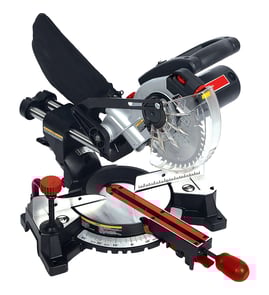
On the Craftsman 31523730 motorized miter saw, the head is usually locked down for storage with a hold-down pin or lock lever. To lift it, press the handle down slightly to remove tension, then pull the lock pin or release lever and let the head rise slowly.
Quick unlock steps (most common)
- Unplug the saw before touching any lock, guard, or switch.
- Put one hand on the handle and press the saw head down about 1/2 to 1 inch.
- Pull the hold-down pin straight out (or move the lock lever to the unlock position).
- Keep control of the handle and let the head rise slowly (do not let it snap up).
- If it will not release, wiggle the handle slightly while pulling the pin.
If it still will not lift
A stuck head is usually caused by sawdust buildup, a bent pin, or binding at the pivot.
- Clear packed sawdust around the pivot area and the lock pin hole.
- Check that the pin is not bent and that it slides in and out smoothly.
- Inspect the return spring area for debris or a spring that has slipped out of place.
- Confirm the bevel and miter locks are not over-tightened and causing binding.
- Add a small amount of light machine oil to the pin and pivot points, then work the head up and down by hand.
What you should feel (normal vs. not)
| What happens | What it usually means | What to do |
|---|---|---|
| Pin pulls easily and head rises smoothly | Normal operation | Raise slowly and test movement |
| Pin will not pull unless you push down | Normal tension on the lock | Push down slightly, then pull |
| Pin pulls but head stays down | Pivot binding or return spring issue | Clean pivot, inspect spring |
| Head jerks up fast | Return spring too strong or head not controlled | Keep a firm grip; rise slowly |
Why it matters
Forcing the handle up without releasing the lock can bend the hold-down pin, damage the pivot, or make the saw unsafe to control when it finally releases.
For more help identifying the correct model number before ordering parts or looking up diagrams, use how to find your appliance model number (and what it means for parts).
Last updated: February 2026
What are the three types of miter saws?
The three common miter saw types are standard (non-sliding) miter saws, compound miter saws, and sliding compound miter saws. Craftsman model 31523730 is a compound-style miter saw (miter plus bevel capability), not a sliding compound saw.
The 3 types, explained
- Standard (non-sliding) miter saw: Makes left and right miter cuts; best for trim and narrower boards.
- Compound miter saw: Makes miter cuts and bevel cuts (the head tilts); useful for crown molding and angled joinery.
- Sliding compound miter saw: A compound saw with sliding rails so the head travels forward and back; designed for wider crosscuts.
Quick comparison
| Type | Key capability | Best for |
|---|---|---|
| Standard miter | Miter cuts only | Basic trim and framing cuts on narrow stock |
| Compound | Miter + bevel | Molding, picture frames, multi-angle work |
| Sliding compound | Wider crosscuts + miter + bevel | Shelving, wider boards, fewer flipped cuts |
How to pick the right type
- Choose standard if you only need miter angles and cut narrow material.
- Choose compound (like the Craftsman 31523730) if you need bevel cuts for molding and finish work.
- Choose sliding compound if you regularly crosscut wider boards and want more capacity.
Why it matters
The saw type determines bevel capability and crosscut capacity; that affects accuracy, repeatability, and how often you need to reposition or flip the workpiece.
To make sure you are matching parts and diagrams to the correct saw, use how to find your appliance model number (and what it means for parts).
Last updated: February 2026
What is the 31.6 on a miter saw?
The 31.6° mark on a miter saw is a common preset (detent) used to cut crown molding laid flat. On many saws, 31.6° miter is paired with a 33.9° bevel to produce tight inside and outside corner joints on a Craftsman 31523730 motorized miter saw.
What the 31.6° setting means
When crown molding is cut “flat” (resting on the saw table instead of nested against the fence), you use two adjustments:
- Miter (31.6°): rotates the table left or right
- Bevel (typically 33.9°): tilts the blade
- Detent/preset: helps you hit the angle repeatedly and accurately
- Left vs. right corners: you mirror the settings depending on the corner and which piece you’re cutting
Common crown molding angle pairs
These are the standard “crown flat” combinations used for the most common spring angles.
| Crown spring angle | Common miter setting | Common bevel setting |
|---|---|---|
| 38° (most common) | 31.6° | 33.9° |
| 45° (less common) | 35.3° | 30.0° |
Tips to get tight corners
- Confirm the crown’s spring angle (often 38° or 45°)
- Make test cuts on scrap and label each piece (inside left, inside right, etc.)
- Keep the molding flat and fully supported; use extensions or a stand if needed
- Clamp when possible; keep hands well away from the blade path
- If corners are out of square, adjust the miter slightly and re-test
Why it matters
Crown molding gaps show immediately. The 31.6° detent exists because it speeds up repeatable, accurate cuts for common crown profiles when you have multiple corners to fit.
For help identifying the exact model number when ordering Craftsman parts or looking up diagrams, use how to find your appliance model number (and what it means for parts).
Last updated: February 2026
Which Mitre saw is the most accurate?
The most accurate miter saw is the one that stays square and repeats the same miter and bevel angles after calibration. For a Craftsman model 31523730 motorized miter saw, accuracy comes from a rigid fence and pivot, a quality blade, and careful setup more than any single “best” brand.
What “most accurate” means in real use
Accuracy is a combination of:
- Repeatable miter detents (0°, 45°, common angles)
- Fence and table staying 90° to the blade
- Minimal play in the pivot, arm, and slide (if equipped)
- A straight, sharp blade that does not deflect
- Stable work support so the board cannot shift
How we recommend comparing saw accuracy
Use the same test method on any saw you are considering.
- Crosscut a straight 1x6; check for square with a reliable square
- Cut a 45° miter on two pieces; close them into a 90° corner and check the joint
- Make 10 repeat cuts using the same detent; measure if the angle drifts
- Check fence flatness and whether it stays aligned after tightening
| What you check | What “accurate” looks like | What causes errors |
|---|---|---|
| 0° crosscut | Perfectly square end | Fence out of square, worn pivot, blade deflection |
| 45° miter pair | Tight corner with no gap | Detent off, table not flat, stock shifting |
| Repeatability | Same angle every time | Loose detent plate, flex, inconsistent clamping |
Make your Craftsman 31523730 cut more accurately
These steps improve precision on most miter saws:
- Install a sharp, high-tooth-count blade for trim work
- Clean pitch from the blade; resin buildup causes wandering cuts
- Square the fence to the blade; then verify the 0° miter detent
- Confirm bevel stops with a square; adjust if your saw allows
- Support long stock and use a stop block for repeat cuts
Why it matters
A saw that is square and repeatable reduces re-cuts, improves joint fit, and prevents wasted material, especially on trim and finish carpentry.
For help confirming you are shopping for the correct parts and diagrams for this saw, use how to find your appliance model number (and what it means for parts).
Last updated: February 2026
How thick can a 7.25 miter saw cut?
Most 7-1/4 inch (7.25) miter saws cut about 2 to 2-3/8 inches thick at a 90° crosscut; capacity drops on miters and bevels. For your Craftsman 31523730 motorized miter saw, the most accurate way to confirm max thickness is to measure the saw’s actual downcut depth.
Typical thickness capacity (what to expect)
These ranges match what we see across many 7-1/4 inch miter saw designs:
- 90° miter, 0° bevel (straight crosscut): ~2 to 2-3/8 in.
- 45° miter, 0° bevel: typically less than the 90° cut (often ~1-1/2 to 2 in.)
- 0° miter, 45° bevel: typically less than the 90° cut (often ~1-5/8 to 2 in.)
- Compound cuts (miter + bevel): usually the smallest thickness capacity
Quick reference table
| Common stock | Actual thickness | Usually within 7-1/4 in. saw thickness at 90°? |
|---|---|---|
| 1x lumber | 3/4 in. | Yes |
| 2x lumber | 1-1/2 in. | Yes |
| 4x4 post | 3-1/2 in. | No (typically) |
How to measure your Craftsman 31523730’s true max thickness
Use this method to get a reliable number for your exact saw and blade:
- Unplug the saw and lock the head up
- Place a flat scrap board on the table against the fence
- Lower the head fully (simulate a cut) and measure from table to lowest tooth point
- Repeat at 45° miter and 45° bevel if you use those cuts
- If the blade guard, motor housing, or fence contacts the work early, that is your real limit
Why it matters
Over-capacity cuts can bind the blade, increase kickback risk, and ruin accuracy. Knowing the true downcut depth helps you choose a safer approach (flip-cut, multiple passes, or a larger saw).
For general safety practices before DIY work, use our guide: are diy appliance repairs safe.
Last updated: February 2026