 Owner’s manual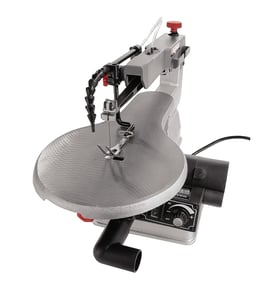

How do I change the blades on a scroll saw?
On the Craftsman 137216160 scroll saw, we change the blade by unplugging the saw, releasing blade tension with the quick-release lever, removing the old 5-inch pin-type blade, then installing the new blade and re-tensioning it. Confirm the exact clamp and lever locations in the owner's manual.
Blade change steps (safe, repeatable)
- Turn the switch OFF and unplug the scroll saw.
- Raise the blade guard/hold-down foot so you can access the blade area.
- Lift the quick-release tension lever to remove tension.
- Remove the blade from the blade holder(s).
- Install a new 5-inch pin-type blade (this saw uses 5-inch pin-type blades only).
- Lower the quick-release tension lever to re-tension the blade.
- Before cutting, make sure the blade is not touching the wood; then turn the saw ON.
Blade direction and setup tips
Most scroll saw blades cut on the downstroke. Set the blade so the teeth point down toward the table; this improves control and helps keep the workpiece flat.
Quick checks before you start cutting
- Blade is centered in the table insert/access hole
- Hold-down foot is resting on the workpiece surface
- Workpiece is not pressed against the blade when starting
- Feed pressure is light; do not force the wood into the blade
Choosing the right blade for the cut
Use blade width and tooth style to match the material and the curve radius.
| What you are cutting | Blade choice | What to expect |
|---|---|---|
| Tight curves, thin stock | Narrower blade | Better turning radius |
| Thicker wood | Wider blade | Straighter tracking, fewer tight curves |
| Plywood/particle board | Fresh blade more often | Abrasive material wears blades faster |
Why it matters
Correct blade installation and tension reduce blade breakage and deflection, which improves cut accuracy and helps prevent the workpiece from lifting during a cut.
Last updated: February 2026
How do I know which scroll saw blade to use?
For the Craftsman 137216160 scroll saw, choose a blade based on (1) the blade style your saw accepts and (2) your material thickness and curve tightness. Start with a fine, narrow blade for thin stock and tighter curves; move wider as material gets thicker (see the 137216160 owner's manual).
1) Confirm the blade style your saw accepts
Use the blade type specified for model 137216160 in the manual; that fit determines what you can buy and install.
- Check whether your saw uses pin-end, plain-end, or either style
- Verify the blade length and how it clamps in the upper and lower holders
- Match the blade to the cutting task (tight curves vs. straighter cuts)
2) Match blade size to thickness and curve radius
As a rule, narrower blades turn tighter and wider blades track straighter.
| Cutting need | Best starting choice | What you get |
|---|---|---|
| Thin wood (about 1/4 inch or less) | Very fine, narrow blade | Tight turns and cleaner detail cuts |
| Thicker wood | Wider blade | Less twisting and better straight tracking |
| Tight inside curves | Narrow blade | Smaller turning radius |
| Straighter cuts | Wider blade | Reduced wandering |
3) Cutting tips that prevent breakage and wandering
- Unplug the saw before changing blades or adjusting the hold-down/guard.
- Let the teeth cut on the downstroke; do not force the workpiece.
- Keep the workpiece flat to the table; twisting the stock snaps blades.
- Feed extra slowly on thick stock (over about 1 inch) to extend blade life.
- Replace blades often; typical sharp life is 1/2 to 2 hours of cutting.
Why it matters
The wrong blade fit will not tension correctly, and the wrong width for the job increases deflection, rough edges, and blade breakage. Matching fit first, then width and tooth pattern, gives cleaner cuts and better control.
Last updated: February 2026
How thick of wood can a scroll saw cut through?
On the Craftsman 137216160 scroll saw, the maximum cutting thickness is 2 inches at a 90° cut and 1 inch at a 45° cut. For the cleanest control and longest blade life, we get the best results cutting wood under 1 inch thick (see the owner's manual).
Quick thickness guide (Craftsman 137216160)
- Up to 2 in.: straight 90° cuts (maximum capacity)
- Up to 1 in.: 45° bevel cuts (maximum capacity)
- Under 1 in.: best overall results and easiest handling
- Over 1 in.: feed very slowly; avoid twisting the blade to reduce breakage
- Plywood/particle board: expect faster blade wear because they are abrasive
Capacity at a glance
| Cut type | Max thickness (model 137216160) | What to expect |
|---|---|---|
| 90° (straight) | 2 in. | Slow feed near max thickness; more blade stress |
| 45° (bevel) | 1 in. | Reduced capacity due to table tilt and blade angle |
| Typical “best results” | < 1 in. | Smoother cuts, better control, fewer broken blades |
Tips for cutting thicker stock successfully
- Use a wider blade for thicker material; it tracks straighter (but cuts wider curves).
- Keep the workpiece flat on the table and the hold-down foot set to control lifting.
- Feed the wood very, very slowly when thickness is over 1 inch.
- Let the blade cut on the downstroke; forcing the cut increases heat and breakage.
- Replace blades often; dull teeth wander and burn the wood.
Why it matters
Staying within the saw’s depth-of-cut limits helps prevent blade breakage, reduces motor strain, and improves accuracy, especially when you are cutting hardwoods or making tight curves.
Last updated: February 2026
What are some common scroll saw mistakes?
Common mistakes on the Craftsman 137216160 scroll saw include forcing the workpiece, starting the cut with the wood pressed against the blade, using the wrong blade type, and running the saw while it is not securely fastened. These issues cause vibration, blade deflection, broken blades, and inaccurate cuts (or kickback-like binding).
Most common mistakes (and what to do instead)
- Forcing the cut: feed only as fast as the saw can cut; forcing deflects the blade and ruins accuracy.
- Starting with the workpiece touching the blade: start the saw first, then slowly feed the material into the moving blade.
- Not securing the saw: bolt or clamp the saw to a firm, level bench so it does not rock; vibration makes cuts wander.
- Feeding too fast in thick stock: when cutting wood thicker than about 1 inch, guide it very slowly and avoid twisting the blade.
- Using the wrong blade style: this model uses 5-inch pin-type blades only; the wrong blade will not track or clamp correctly.
- Backing out incorrectly when the blade binds: shut off and unplug, wedge the kerf open, then back the blade out.
Quick setup checks that prevent vibration and wandering cuts
- Place the saw on a firm, level surface.
- Clamp or bolt the base down so the tool cannot tip or walk.
- Confirm the blade is installed correctly and tensioned per the owner's manual.
- Support large workpieces at table height so they do not lever against the blade.
Blade choice and feed rate: a simple guide
| What you are cutting | Common mistake | Better approach |
|---|---|---|
| Thin wood (about 1/4 inch or less) | Using a wide blade and forcing tight curves | Use a fine, narrow blade; guide gently |
| Thicker wood (over about 1 inch) | Pushing fast to “power through” | Slow feed; avoid bending or twisting the blade |
| Plywood/particle board | Expecting long blade life | Replace blades more often; these materials are abrasive |
Why it matters
Most “scroll saw problems” are really control problems: too much feed pressure, poor support, or vibration. When we let the teeth cut on the downstroke and keep the saw stable, we get cleaner lines, fewer broken blades, and safer operation.
Last updated: February 2026