Owner’s manual
 Error Codes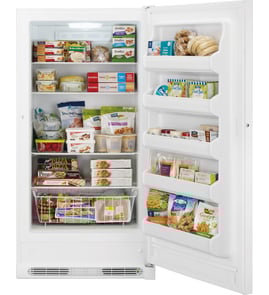




What is the average lifespan of an upright freezer?
Most upright freezers last 10 to 15 years. For your Frigidaire FFU14FC4AW0 upright freezer, consistent temperatures, clean airflow, and good door sealing are the biggest factors that help it reach (or exceed) that typical lifespan.
What affects lifespan the most
- Room conditions: Hot garages and tight clearances make the compressor run longer.
- Door seal quality: A leaking gasket forces longer run times and adds frost.
- Defrost performance: Heavy frost buildup reduces cooling efficiency.
- Condenser cleanliness: Dust buildup raises operating temperatures.
- Usage habits: Frequent door openings and warm food loads increase wear.
Quick maintenance that helps it last longer
Use these habits to reduce strain on the sealed system and compressor:
- Keep the freezer set near 0°F for normal food storage.
- Leave proper clearance around the cabinet for ventilation.
- Keep the door closed as much as possible; organize so you can grab items fast.
- Defrost and clean if you see persistent frost or airflow blockage.
- Inspect the door seal for gaps, tears, or areas that do not grip paper.
Common “end-of-life” symptoms vs. fixable issues
| Symptom | Often fixable? | What to check first |
|---|---|---|
| Warm temps but fan runs | Yes | Frost buildup, airflow blockage, defrost system |
| Heavy frost on back wall | Yes | Defrost heater and defrost thermostat |
| Runs constantly | Sometimes | Door gasket leaks, dirty condenser, warm location |
| Clicking, won’t start | Sometimes | Start components, power supply, compressor health |
Why it matters
A freezer that is running efficiently protects food quality, uses less electricity, and reduces wear on high-cost components like the compressor.
For model-specific operating and care guidance, follow the FFU14FC4AW0 owner's manual.
Last updated: January 2026
How big is a 14 cu ft freezer?
A 14 cu ft upright freezer like the Frigidaire FFU14FC4AW0 is typically a full-height, narrow cabinet designed to fit in a kitchen, garage, or utility space. Most 14 cu ft uprights are about 28 inches wide, about 60 inches tall, and about 28 to 32 inches deep.
Typical size range (what “14 cu ft” usually looks like)
Capacity (14 cubic feet) describes interior storage volume, not the outside dimensions. For most upright freezers in this size class, you can expect:
- Width: about 27 to 30 inches
- Height: about 59 to 64 inches
- Depth: about 27 to 32 inches (often deeper with the handle)
- Door swing clearance: plan extra space on the hinge side
For the exact exterior dimensions and clearance requirements for FFU14FC4AW0, use the FFU14FC4AW0 owner's manual.
Space planning checklist (before you buy or move it)
Use these quick checks to avoid fit and airflow problems:
- Measure the opening width at the front and back (walls are not always square).
- Confirm depth with the door closed, then add space for the handle.
- Leave ventilation space around the cabinet (follow the manual’s clearance guidance).
- Make sure the freezer can pass through doorways and hallways on the way in.
- Verify the door can open far enough to remove baskets and shelves.
Quick reference table
| What you’re measuring | Typical for a 14 cu ft upright | Why it matters |
|---|---|---|
| Width | 27 to 30 in. | Fits between cabinets or in a garage bay |
| Height | 59 to 64 in. | Fits under shelving and door frames |
| Depth | 27 to 32 in. | Avoids blocking walkways; handle adds depth |
| Clearance | Per manual | Prevents overheating and poor cooling |
Why it matters
A freezer can be “14 cu ft” and still vary a few inches in width, height, and depth. Those inches affect door swing, airflow, and whether the freezer cools efficiently once installed.
Last updated: January 2026
Why is my Frigidaire upright freezer not freezing?
If your Frigidaire FFU14FC4AW0 upright freezer isn’t freezing, the most common causes are a warm temperature setting, restricted airflow from frost buildup, dirty condenser area, or a failed cooling/defrost component. Start with basic checks, then move to the evaporator fan and defrost system using the FFU14FC4AW0 owner's manual.
Quick checks we recommend first
- Confirm the control is set colder and give the freezer 12 to 24 hours to stabilize after changes.
- Make sure the door closes fully and isn’t being held open by packages.
- Check for heavy frost on the back interior panel (a strong sign of a defrost problem).
- Verify air vents inside are not blocked by food.
- Clean dust from the condenser area (restricted heat release reduces cooling).
What the symptoms usually mean
| What you notice | Most likely cause | What to check next |
|---|---|---|
| Runs a lot, little or no cooling | Poor heat removal or sealed system issue | Clean condenser area; listen for compressor operation |
| Heavy frost on back wall | Defrost system failure | Defrost timer, defrost heater, defrost thermostat |
| Freezer is warm, fan is quiet | Evaporator fan issue | Fan blade obstruction or motor failure |
| Frost-free but still warm | Temperature control or refrigeration issue | Control settings; compressor start components |
Parts that commonly fix “not freezing” on this model
If you see heavy frost or the freezer warms up over time, these model-matched parts are common suspects:
- Defrost timer 5304518034 (can stall in defrost or fail to advance)
- Freezer defrost heater 216730700 (heater does not melt frost off the evaporator)
- Thermostat 297216600 (defrost bi-metal thermostat can prevent heater operation)
Why it matters
When airflow is blocked by frost or the condenser area can’t shed heat, the freezer may run constantly but still stay warm. Catching a defrost or airflow problem early helps prevent food loss and reduces strain on the compressor.
Last updated: January 2026