Owner’s manual
 Error Codes



What are the dimensions of the Samsung RF28HMEDBSR?
The Samsung RF28HMEDBSR bottom-mount refrigerator is typically about 35 3/4 in. wide and about 70 in. tall (with hinges). Depth varies based on whether handles and hinges are installed; use the exact configuration measurements listed in the RF28HMEDBSR owner's manual when planning a tight fit.
When you measure for installation, we recommend checking these points:
- Width at the widest point (usually the case width)
- Height to the top of the hinge cover (not just the cabinet)
- Depth with handles (deepest point)
- Depth without handles (for counter-depth planning)
- Door swing clearance (space needed to open doors fully)
- Ventilation clearance behind and above the cabinet
| Measurement label | What it includes | Why it changes |
|---|---|---|
| WxHxD with hinges and handles | Full installed footprint | Deepest and tallest configuration |
| WxHxD with hinges, no handles | Installed height, reduced depth | Handles removed or recessed |
| WxHxD without hinges and doors | Cabinet only | Used for moving through doorways |
A few inches can determine whether the RF28HMEDBSR fits between cabinets, clears an overhead soffit, or allows the doors and freezer drawer to open without hitting a wall. Using the correct “with handles” or “without handles” depth prevents surprises on delivery day.
- Measure the opening in three places (top, middle, bottom) for width.
- Confirm flooring height changes (tile transitions can affect door clearance).
- Plan extra room for the water line and power cord behind the unit.
- If you are replacing an older fridge, verify the doorway and hallway clearance too.
Last updated: February 2026
What are the dimensions of the Samsung RF28HMEDBSR?
The Samsung RF28HMEDBSR refrigerator is a full-size, 36-inch-class unit; the exterior width is typically about 35 3/4 inches and the overall height is about 70 inches. Depth varies most by whether the doors and handles are installed; confirm your exact configuration in the RF28HMEDBSR owner's manual.
These are the measurements that most often affect fit, door swing, and how far the refrigerator will project past cabinets:
- Width: measure at the widest point (often the hinge area)
- Height: measure floor to the top of the hinge cover (about 70 in. overall)
- Depth: compare with handles vs. without handles
- Door swing clearance: allow room for French doors to open fully
- Rear clearance: leave space for airflow and the water line
| Configuration | What changes most | Why it matters |
|---|---|---|
| With doors and handles | Deepest overall depth | Determines cabinet alignment and “stick-out” |
| With doors, no handles | Slightly less depth | Helps if you are tight to an island or walkway |
| Without doors | Much less depth | Useful for moving through doorways |
- Measure width across the front at the widest point.
- Measure height from the floor to the top hinge cover (do not measure to the top of the door only).
- Measure depth from the back panel to the front of the handle (or to the door face if handles are off).
- Add space for water line routing and ventilation behind the cabinet.
Using the correct height (about 70 inches) and the correct depth for your handle/door setup prevents common problems like cabinet interference, doors hitting walls, and kinking the water supply line.
Last updated: February 2026
Why is ice forming in the bottom of my Samsung fridge?
Ice at the bottom of your Samsung RF28HMEDBSR bottom-mount refrigerator forms when moisture turns into frost and meltwater cannot drain away, so it refreezes into a sheet of ice. The top causes are a frozen or clogged defrost drain, door air leaks, or blocked airflow.
- Confirm doors close fully and nothing is pinched in the gasket.
- Look for a solid ice sheet on the freezer floor or water under crispers.
- Make sure interior vents are not blocked by food packages.
- Verify the refrigerator is level; slightly higher in front helps doors self-close.
- Check for heavy frost on the rear interior panel.
Defrost water should flow to the drain pan; when the drain freezes or clogs, water pools and refreezes.
- Unplug the refrigerator.
- Remove the freezer drawer to access the bottom area.
- Melt ice with warm towels or a hair dryer on low (keep heat moving).
- Flush the drain with hot water using a turkey baster until it runs freely.
- If your unit uses a drain cap and it is damaged or missing, replace it with refrigerator drain cap DA67-01301A.
Warm, humid air entering the compartment creates excess frost that later melts and refreezes.
- Clean the gasket with warm soapy water; dry it fully.
- Do the paper test; the paper should resist being pulled out when the door is closed.
| What you see | Most common cause | Best next step |
|---|---|---|
| Ice sheet on freezer floor | Frozen/clogged drain | Defrost and flush drain |
| Water under crispers | Drain restriction | Clear drain, recheck in 24 hours |
| Heavy frost on back wall | Door leak or blocked vents | Check gasket, clear vents |
A restricted drain and air leaks create a repeat cycle of frost, meltwater, and refreezing; that can block airflow and cause temperature swings. For model-specific access steps and panel locations, use the RF28HMEDBSR owner's manual.
Last updated: February 2026
Why is my Samsung bottom freezer not freezing?
If your Samsung RF28HMEDBSR bottom-mount refrigerator freezer is not freezing, the most common causes are restricted airflow from frost buildup, a failed evaporator fan, a temperature sensor problem, or a sealed-system issue (compressor/inverter). Start with settings and airflow checks before replacing parts; confirm procedures in the RF28HMEDBSR owner's manual.
- Make sure the freezer is set to about 0°F (typical target).
- Verify the freezer door closes fully; check for gaps in the gasket.
- Avoid overpacking; blocked vents prevent cold air circulation.
- Look for heavy frost on the rear freezer panel (often points to a defrost or airflow problem).
- Listen for the evaporator fan when the door switch is pressed (fan should run during cooling).
- After a power outage or move, allow 24 hours for temperatures to stabilize.
| What you notice | Likely area to check | What to do next |
|---|---|---|
| Freezer warm, fresh food also warming | Cooling system not running well | Check condenser area for airflow; listen for compressor operation |
| Freezer warm, fresh food OK | Airflow/evaporator issue | Check for frost buildup and evaporator fan operation |
| Frost blanket behind rear panel | Defrost/airflow restriction | Defrost manually (unplug, doors open) and recheck cooling |
| Ice maker slow, dispenser weak | Water system issue (separate from freezing) | Address water filter and supply, not the freezer temp |
Only replace parts after basic checks above point to them:
- Temperature sensing issues: a failed sensor can misread temps and reduce cooling; see refrigerator temperature sensor DA32-10104N or refrigerator temperature sensor DA32-00033C.
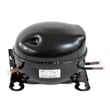
- Sealed-system or compressor not starting: if the compressor is not running or starts then stops, the overload or inverter can be involved; a confirmed compressor failure may require Samsung refrigerator compressor NC1MV90ALPASH.
A freezer that cannot reach 0°F can cause food spoilage and forces the compressor to run longer, which increases wear on components like the compressor, inverter, and fans. Fixing airflow restrictions early prevents repeat icing and temperature swings.
Last updated: February 2026