Owner’s manual



Why is my GE front load washer leaking from the bottom?
A GE WCVH4800K0WW front load washer usually leaks from the bottom because water is escaping at the door gasket, pump filter area, or a loose fill or drain hose connection. We start by checking for oversudsing, then inspect the pump filter access and all hose connections.
Quick checks (fastest wins first)
- Look for water at the back left; if it is wet, reduce detergent (oversudsing can cause leaks).
- Confirm the fill hoses are tight at both the faucets and the washer.
- Confirm the drain hose is properly inserted and secured at the household drain.
- Check the door gasket for tears and for objects stuck in the folds.
- Open the lower-right access door and check the pump filter cap and drain hose plug for seepage.
Clean the pump filter (common bottom-leak source)
Your washer has a pump filter that can trap small items; if it is clogged or not seated, water can leak near the bottom front.
Follow the steps in the WCVH4800K0WW owner's manual to:
- Open the bottom-right access door
- Drain any water using the small drain hose and plug
- Remove and rinse the pump filter
- Reinstall the filter fully and close the access door
Parts that often solve bottom leaks on this model
If you find the leak is coming from the tub-to-boot area or a loose clamp, these model-matched parts are common fixes:
| Leak location you see | Likely issue | Model-matched part to check |
|---|---|---|
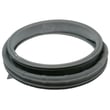
| Bottom front, near door opening | Door boot not sealing or torn | Washer door boot WH08X32017 |
| Around the boot connection | Clamp loose or distorted | Washer tub boot clamp WH08X10044 |
| Under tub area, persistent seep | Tub seal worn | Tub seal WH08X10046 |
Why it matters
Even a small leak can lead to oversudsing errors, poor draining, and damage to nearby components. Fixing the source early also helps prevent mold and odor around the door gasket.
Last updated: February 2026
Where to find model on GE washer?
On the GE WCVH4800K0WW front-load washer, we find the model and serial number label inside the door opening (door jamb area). This label is what you will use to match parts, look up troubleshooting info, and confirm the exact version of your washer.
Where to look on model WCVH4800K0WW
Check these spots in this order:
- Open the washer door and look along the door opening (door jamb) for a sticker or metal tag
- Check the inside edge of the front panel around the door opening
- If the label is hard to see, use a flashlight and look for small print that includes both MODEL and SERIAL
- Write the model number exactly as shown (for this washer it should read WCVH4800K0WW)
For a diagram-style reference and other identification details, use the WCVH4800K0WW owner's manual.
What the model number is used for (and why it matters)
The model number ensures we match the correct GE washer parts and service information. Even small model variations can change which control board, door lock, or tub components fit.
Common examples where the exact model matters:
- Ordering electronic parts like a control board or user interface
- Matching door components and seals
- Looking up cycle behavior and troubleshooting steps
- Confirming installation and electrical requirements
Quick checklist: what to record
| Item to record | What it looks like | Why we need it |
|---|---|---|
| Model number | Starts with letters and numbers (example: WCVH4800K0WW) | Confirms the exact washer version |
| Serial number | Longer string, often includes letters | Helps identify production details |
| Brand | GE | Ensures correct documentation and parts family |
If the label is missing or unreadable
- Check for a second label nearby in the same door opening area
- Look for a faint imprint where a sticker may have been removed
- Use your purchase paperwork; it often lists the model number
Last updated: February 2026
Why is my GE washing machine not draining water?
If your GE WCVH4800K0WW washer is not draining, the most common causes are a clogged pump filter, a blocked or kinked drain hose, or a failing drain pump. We recommend draining the unit safely, cleaning the pump filter, then checking for hose restrictions before replacing parts.
Quick checks (start here)
- Unplug the washer before accessing the pump filter area.
- Open the lower access door (bottom right) and drain water using the small drain hose and plug.
- Remove and rinse the pump filter, then reinstall it snugly.
- Check the drain hose for kinks, crushing, or a clog at the standpipe.
- Listen during the drain portion of the cycle; a hum with little or no water movement often points to a restriction or a weak pump.
For the exact access steps and safety notes, follow the WCVH4800K0WW owner's manual.
What the symptoms usually mean
| What you notice | Most likely cause | What to do next |
|---|---|---|
| Water stays in tub, filter area full of debris | Pump filter clogged | Clean pump filter and retry drain |
| Washer hums but drains slowly or not at all | Partial blockage or weak pump | Clear hose/standpipe; consider pump replacement |
| Drains sometimes, then stops | Intermittent blockage (coin, sock) | Recheck filter and sump hose path |
| No drain sound at all | Control, wiring, or pump issue | Verify cycle start; then diagnose pump/control |
Parts that commonly fix a no-drain problem
If cleaning the filter and checking the hose does not restore draining, the drain pump is a common next step for this model. Use the exact part matched to your model:
Why it matters
A washer that cannot drain can leave clothes soaking wet, prevent high-speed spin, and cause odor over time. Clearing the pump filter and drain path first often restores normal operation without replacing additional parts.
Last updated: February 2026
How much does it cost to replace a gasket on a GE washing machine?
On a GE WCVH4800K0WW washer, replacing the door gasket (also called the door boot) typically costs $190 to $450 total: about $150 to $250 for the part plus $0 to $200+ labor, depending on whether you DIY or hire service. Use the WCVH4800K0WW owner's manual to confirm the correct procedure and checks after reassembly.
Typical cost breakdown (parts vs. labor)
- Part cost (door gasket/boot): commonly $150 to $250 for front-load washers
- DIY labor: $0 (your time)
- Service labor: often 1 to 2 hours, plus trip/diagnostic fees in some areas
- Extra parts sometimes needed: clamps, spring clips, or a tub seal if there is related leakage
| Scenario | What you pay for | Typical total |
|---|---|---|
| DIY replacement | Part (and any clamps) | $150 to $275 |
| Pro replacement | Part + labor | $250 to $450+ |
Parts that are commonly involved on this model
If you are replacing a leaking or moldy door gasket, we often see these related items come up during the same repair:
- Washer door boot WH08X32017 (the gasket itself)
- Washer tub boot clamp WH08X10044 (helps secure the boot)
- Spring clip WH02X10305 (retaining clip used on some assemblies)
- Tub seal WH08X10046 (if the leak is actually at the tub seal area)
How to keep the cost down (and avoid repeat leaks)
- Clean the boot folds and drain holes; debris here can mimic a “bad gasket.”
- Verify the washer is level; out-of-level operation can cause rubbing and premature wear.
- After installation, run a full cycle and check for leaks (the manual recommends checking for leaks and proper operation after setup).
- If the door won’t close or lock afterward, inspect the boot seating and clamp alignment before replacing other parts.
Why it matters
A torn or poorly seated gasket can cause water leaks, odor/mildew, and door-closing problems. Replacing the boot correctly (and securing it with the right clamp/clip) prevents repeat service calls and protects the control area from moisture.
Last updated: February 2026