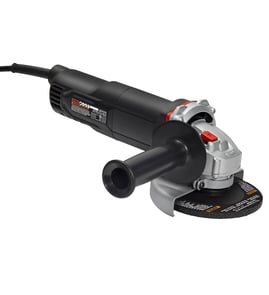

Can I use a 4 blade on a 4.5 grinder?
Yes, you can typically use a 4-inch wheel or blade on a 4-1/2 inch grinder like the Craftsman 135277001, as long as the wheel fits the arbor correctly and the wheel’s maximum RPM rating meets or exceeds the grinder’s no-load RPM.
- Unplug the grinder before changing wheels.
- Confirm the wheel’s arbor hole matches the grinder’s spindle (common sizes are 5/8 inch or 7/8 inch with an adapter bushing).
- Make sure the wheel seats flat on the inner flange and the outer flange tightens evenly.
- Verify the wheel’s max RPM is at least the grinder’s rated RPM.
- Use the correct guard for the wheel type (cutoff wheel vs grinding wheel vs flap disc).
- Do a 30 to 60 second test run in a safe direction before cutting or grinding.
| What to match | What to look for | Why it matters |
|---|---|---|
| Arbor/spindle fit | Correct hole size or bushing | Prevents wobble and wheel breakage |
| Wheel type | Cutoff, grinding, flap disc, wire wheel | Wrong type can shatter or grab |
| RPM rating | Wheel max RPM ≥ tool RPM | Overspeed can cause failure |
| Guard clearance | Wheel diameter and thickness | Reduces exposure if a wheel fails |
A 4-inch wheel is smaller, so it usually clears the guard more easily than a 4-1/2 inch wheel. The real risks come from a poor arbor fit, incorrect flanges, using the wrong wheel type, or running a wheel that is not rated for the grinder’s speed.
If you need to troubleshoot a grinder that will not start, trips a breaker, or has intermittent power, use a meter to check the cord, switch, and internal connections: how to use a multimeter to test electrical parts video.
Last updated: February 2026
What cannot be cut with an angle grinder?
Some materials are effectively “angle-grinder resistant” (they rapidly destroy cutting discs), and some items should never be cut because the risk of fire, explosion, or toxic exposure is too high. For a Craftsman 135277001 disc grinder/sander, the safest rule is: if you cannot fully identify the material and what is inside it, do not cut it.
These can stop progress or consume multiple wheels quickly:
- “Angle grinder proof” composites (some ceramic sphere or layered composites designed to blunt or shatter abrasive wheels)
- Extremely hard, wear-resistant steels and alloys (common in hardened tool components)
- Thick, high-chromium wear plate and abrasion-resistant liners (often used in industrial applications)
- Some carbide-based or sintered wear materials (they can chew up discs)
Even if a disc could bite into the surface, these are unsafe to cut:
- Pressurized cylinders or tanks (propane, refrigerant, compressed air)
- Fuel containers, aerosol cans, or anything that held flammables
- Sealed drums or unknown containers (unknown vapors and residues)
- Magnesium and some other reactive metals (sparks and hot chips can ignite)
- Materials that create hazardous dust when cut (for example, some composites, coatings, or treated materials)
Use this before you power up:
- Confirm the item is not pressurized and has no trapped contents
- Identify the material (steel, aluminum, stainless, masonry, composite)
- Choose the correct accessory (cut-off wheel vs. grinding wheel; metal vs. masonry)
- Inspect the wheel for cracks and verify the rated RPM meets or exceeds the tool
- Control sparks and dust; keep combustibles away and use appropriate PPE
| Material | Typical result with the right wheel | Notes |
|---|---|---|
| Mild steel | Cuts well | Use a metal cut-off wheel; expect sparks |
| Stainless steel | Cuts, slower | Use stainless-rated discs to reduce loading |
| Aluminum | Cuts but can load discs | Use the correct wheel; keep the cut cool |
| Concrete/brick | Cuts with masonry wheel | Creates heavy dust; use dust control |
| Hardened steel | Often very slow | May glaze or burn through wheels quickly |
Angle grinders fail fast when the wheel is wrong for the material, and the biggest hazards come from what you cannot see (pressure, vapors, reactive metals, and toxic dust). Avoiding the “never cut” items prevents the most serious accidents.
For safer DIY habits and PPE basics, use our are diy appliance repairs safe guide.
Last updated: February 2026
How deep will a 230mm angle grinder cut?
A 230 mm (9-inch) angle grinder typically reaches about 70 mm (2-3/4 inches) of maximum cut depth with a cut-off wheel. Your Craftsman 135277001 is a smaller angle grinder that uses a smaller wheel, so its practical cut depth is much less.
These are common maximum depth ranges for standard abrasive cut-off wheels (not circular saw blades):
- 115 mm (4-1/2 inch): about 30 mm
- 125 mm (5 inch): about 38 mm
- 230 mm (9 inch): about 70 mm
| Wheel diameter | Typical max cut depth | Common use |
|---|---|---|
| 115 mm | ~30 mm | Thin metal, small cuts |
| 125 mm | ~38 mm | General-purpose cutting |
| 230 mm | ~70 mm | Thicker stock, deeper cuts |
We size cutting expectations to the wheel the tool is designed to run. A 4-1/2 inch grinder like model 135277001 is built around the 115 mm range, so plan on roughly 30 mm maximum depth with a cut-off wheel, then cut from both sides for thicker material.
- Wheel wear reduces diameter and depth quickly
- Guard and flange clearance can limit reach
- Cut-off wheels cut deeper than grinding wheels
- Material pinch and binding reduce usable depth
- Forcing the cut increases kickback risk
Matching wheel size to the grinder prevents unsafe setups and helps you plan the cut correctly (single pass vs. cutting from both sides).
For general safety practices that also apply to power tools, use are diy appliance repairs safe.
Last updated: February 2026