


What's the difference between an over-the-range microwave and a countertop microwave?
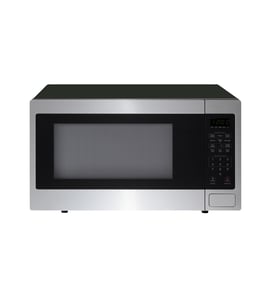
A countertop microwave like the Panasonic NN-S969BA sits on a counter or shelf and only cooks food, while an over-the-range (OTR) microwave mounts above the range and also works as a vent hood with a fan and filters to manage smoke and odors.
Quick comparison
| Feature | Countertop microwave | Over-the-range microwave |
|---|---|---|
| Installation | Plug-in; no mounting required | Mounted to wall and cabinet; more involved |
| Venting | None | Recirculating or vented outside (model dependent) |
| Space impact | Uses counter space | Frees counter space; uses space above range |
| Typical airflow features | Not applicable | Fan speeds, grease filters, sometimes charcoal filters |
| Best for | Simple setup, flexible placement | Saving counter space and adding ventilation |
How to choose for your kitchen
- Choose countertop if you want the simplest setup, plan to move it, or do not need ventilation.
- Choose OTR if you want to free up counter space and you cook often on the range (steam, smoke, grease).
- Measure your space first: OTR units must align with cabinet width and mounting points; countertop units need a stable, level surface and clearance for airflow.
- Consider noise and airflow: OTR fan performance varies by model and venting method.
- Think about serviceability: countertop models are easier to remove for cleaning or replacement.
Why it matters
An OTR microwave is doing two jobs (microwave plus ventilation), so installation, airflow, and filters become part of everyday performance. A countertop microwave like the NN-S969BA focuses on cooking performance and convenience, with fewer fit and venting constraints.
Related repair and safety tips
If you are troubleshooting cooking performance on any microwave style, start with our guide: why is my microwave not heating.
Last updated: January 2026
Can you use an over-the-range microwave as a countertop?
Over-the-range (OTR) microwaves are built to be mounted to a cabinet and wall above a range, not to sit on a counter. For safety and proper ventilation, we treat OTR units as install-only appliances; for countertop use, choose a true countertop model like Panasonic NN-S969BA.
Why an OTR microwave should not be used on a countertop
OTR microwaves rely on their mounting setup for stability, airflow, and safe clearances. Setting one on a counter can block vents and create tipping or heat issues.
- Venting and cooling air paths can be restricted on a countertop
- The unit can be unstable without the designed mounting points
- Door opening force can shift the microwave if it is not secured
- Cord routing and rear clearance may not match countertop requirements
- Cabinet and wall clearances are part of the intended installation design
Quick comparison: OTR vs countertop
| Feature | Over-the-range microwave | Countertop microwave |
|---|---|---|
| Intended placement | Mounted above range | Sits on counter |
| Support method | Bracket and cabinet bolts | Feet on counter surface |
| Venting design | Integrated exhaust and cooling | Cooling vents designed for counter clearances |
| Best choice when | Replacing an existing OTR | You want a portable, non-mounted unit |
If you already have an OTR microwave and need a countertop solution
We recommend switching to a countertop model and keeping the counter area set up for safe airflow.
- Leave several inches of clearance around side and rear vents
- Use a dedicated, properly grounded outlet (avoid extension cords)
- Place the microwave on a level, sturdy surface
- If your current unit has turntable issues, replace worn turntable parts instead of changing placement
Helpful parts for Panasonic NN-S969BA turntable problems
If your Panasonic NN-S969BA is a countertop microwave and the tray is missing, cracked, or not rotating smoothly, these model-matched parts are common fixes:
- Panasonic glass tray A06014M00AP (cracked, missing, or wobbling tray)
- Roller ring F290D9330AP (noisy rotation, rough rolling, tray not gliding)
Why it matters
Microwaves move a lot of air for cooling and can shift when the door opens. Using the correct microwave type for the installation prevents overheating, poor performance, and physical stability problems.
Last updated: January 2026
How deep is a countertop microwave?
Most countertop microwaves measure about 14 to 18 inches deep front to back for the cabinet, and 15 to 20 inches deep when you include the door and handle. For Panasonic NN-S969BA, measure your unit and allow open space behind it so the vents and power cord are not pinched.
How we recommend measuring microwave depth
Measure two depths so you know both the footprint and the true front-to-back space needed.
- Cabinet depth: back panel to the front face of the cabinet
- Overall depth: deepest point (often the door or handle)
- Cord clearance: extra space so the plug and cord are not bent
- Vent clearance: keep intake and exhaust vents unobstructed
Typical depth ranges you will see
| Depth type | Typical range | What it helps you plan |
|---|---|---|
| Cabinet depth | 14 to 18 in. | Countertop footprint |
| Overall depth (door/handle) | 15 to 20 in. | Total space to wall/backsplash |
| Extra space for cord and airflow | 2 to 4 in. | Prevents overheating and cord damage |
Why it matters
Microwaves rely on airflow through their vents to keep the magnetron and electronics cool. When the back or sides are tight to a wall or enclosed in a cubby, heat builds up and performance and reliability drop.
Quick fit checklist for NN-S969BA
- Confirm the door opens fully without hitting a backsplash or cabinet edge
- Leave space so rear and side vents are not blocked
- Avoid pushing the microwave tight against the wall if it kinks the cord
- Make sure the turntable rotates smoothly; replace a chipped or warped tray with the Panasonic glass tray A06014M00AP
Last updated: January 2026


