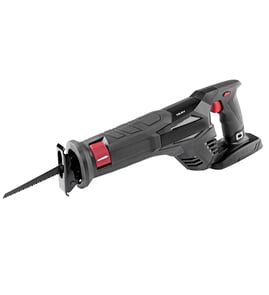

Is there a difference between a reciprocating saw and a Sawzall?
A reciprocating saw is the tool type; “Sawzall” is a Milwaukee brand name that many people use generically for any reciprocating saw. Your Ryobi EJ-100 is a reciprocating saw, even if someone casually calls it a Sawzall.
Both terms usually refer to the same style of saw that cuts with a back-and-forth (reciprocating) blade motion.
- Uses a straight blade that moves in and out rapidly
- Common for demolition, pruning, and rough cutting
- Works with many blade types (wood, metal, bi-metal, carbide-grit)
- Often includes a pivoting shoe and variable speed trigger
The difference is mainly naming and branding, not how the tool works.
| Term | What it means | Example |
|---|---|---|
| Reciprocating saw | Generic tool category | Ryobi EJ-100 reciprocating saw |
| Sawzall | Brand name (Milwaukee) often used as a nickname | “Pass me the Sawzall” |
Using the correct term helps you match the right items to your Ryobi EJ-100, especially when you are comparing blade shank styles, stroke length, and whether the saw uses a tool-free blade clamp.
- Match the blade to the material (wood vs. metal vs. masonry)
- Choose the right blade length for the cut depth
- Use the right tooth count (TPI) for speed vs. smoothness
- Confirm the blade clamp accepts standard reciprocating saw blades
When you search, use the exact model number EJ-100 so you land on the correct Ryobi parts list and diagrams. We also recommend using our guide: how to find your appliance model number (and what it means for parts).
Last updated: February 2026
What should you not do with a reciprocating saw?
You should not use your Ryobi EJ-100 reciprocating saw in ways that increase kickback, blade breakage, or loss of control; avoid forcing the cut, bypassing safety features, or cutting materials you cannot secure and support.
- Do not run a dull, bent, cracked, or wrong-type blade for the material.
- Do not force the saw; let the blade speed and tooth pitch do the work.
- Do not cut with the shoe (base) floating; keep the shoe firmly against the work.
- Do not cut unsupported material; clamp the workpiece and support both sides of the cut.
- Do not start the cut with the blade already pressed hard into the material.
- Do not reach under the work or place hands in the cut path.
- Do not use the tool in wet conditions or where the cord/battery area can be damaged.
- Verify the blade is fully seated and locked in the clamp.
- Match blade length and tooth count to the job (wood, metal, demolition).
- Remove nails/screws when possible; use a demolition blade only when needed.
- Wear eye protection and hearing protection; gloves help with vibration and sharp edges.
- Keep the cord (if corded) routed behind you and away from the blade.
Most reciprocating saw injuries and tool damage come from loss of control: a dull or incorrect blade can grab, the work can shift, or the saw can bounce if the shoe is not braced. Good support and the right blade reduce kickback and make straighter, faster cuts.
| Symptom | Most likely cause | What to do |
|---|---|---|
| Excessive vibration/bouncing | Shoe not braced, blade too long | Brace shoe; switch to shorter blade |
| Slow cutting | Dull blade, wrong tooth pitch | Replace blade; use correct TPI |
| Blade keeps bending/breaking | Forcing cut, twisting in kerf | Ease pressure; keep blade straight |
For general DIY safety guidance that applies to power tools, review are diy appliance repairs safe.
Last updated: February 2026
Do all reciprocating saw blades fit all saws?
Most reciprocating saw blades fit most saws because many use a standard 1/2-inch universal shank, but not every blade fits every tool. For the Ryobi EJ-100 reciprocating saw, the blade must match the saw’s clamp style (typically a universal shank) and the saw’s capacity.
Many modern reciprocating saws are designed around a universal 1/2-inch shank blade. That standardization is why blades often interchange across brands like Ryobi, Milwaukee, DeWalt, and Bosch.
- Shank type: 1/2-inch universal shank is most common
- Clamp style: tool-less lever clamp vs. screw clamp (both can accept universal shanks, but wear or damage can prevent locking)
- Blade thickness: extra-thick demolition blades can be harder to clamp in worn chucks
- Blade length: must clear the shoe and not bottom out in the chuck
- Application match: wood, metal, pruning, or demolition blades should match the job and material
Fit problems usually come from the saw’s blade clamp or the blade’s shank geometry.
| Symptom | Most likely cause | What we do first |
|---|---|---|
| Blade will not insert fully | Debris or rust in clamp | Clean clamp slot; cycle clamp open/closed |
| Blade inserts but falls out | Worn clamp, weak spring, damaged shank | Try a different blade brand; inspect clamp wear |
| Blade wobbles excessively | Clamp wear or wrong thickness | Use a standard-thickness blade; check clamp alignment |
A blade that is not fully seated and locked can slip under load, cut poorly, and increase vibration. Correct fit protects the blade clamp, improves control, and helps the EJ-100 cut straighter and faster.
If you’re troubleshooting a blade that will not lock in place because of a suspected electrical or wiring issue (for example, intermittent power while cutting), use how to use a multimeter to test electrical parts video to verify basic electrical checks safely.
Last updated: February 2026
What is the meaning of EJ-100?
On the Ryobi EJ-100 reciprocating saw, EJ-100 is the tool’s model number, used to identify the exact version of the saw when you’re looking up parts diagrams, compatible replacement parts, or service information. It is not an abbreviation you need to decode for operation.
For Ryobi power tools, the model number is the most reliable identifier because it ties directly to the saw’s design and parts list.
- Confirms the exact Ryobi reciprocating saw version you own
- Helps match the correct parts breakdown (even when similar saws look alike)
- Reduces ordering mistakes when parts vary by revision
- Speeds up troubleshooting by narrowing to the right configuration
Model numbers are typically printed on the tool’s data label.
- On the housing near the motor area
- Near the handle or trigger area
- On the base/shoe area or frame
- Sometimes on a sticker or metal plate with other specs
“EJ” can mean different things in other industries, but on this Ryobi tool page it functions as a model identifier.
| Term | What it means here | What it can mean elsewhere |
|---|---|---|
| EJ-100 | Ryobi model number for a reciprocating saw | Abbreviations unrelated to tools |
| EJ | Part of the model code | Environmental justice, units, language terms, etc. |
Using the exact model number (EJ-100) is what keeps a repair straightforward. Even small design changes can affect fitment for items like the switch, wiring, brush assemblies, or the shoe and blade clamp components.
For help confirming you have the right model number before ordering, use how to find your appliance model number (and what it means for parts).
Last updated: February 2026
Is a 10 amp reciprocating saw powerful enough?
A “10 amp” rating applies to corded electric reciprocating saws; it does not apply to the Ryobi EJ-100, which is a gas reciprocating saw. For a corded saw, 10 amps is powerful enough for most DIY cutting and light-to-moderate demolition with the right blade.
A 10-amp corded reciprocating saw is a solid all-around class for common home projects.
- Cutting 2x lumber, plywood, and framing members
- Cutting wood with nails using a demolition blade
- Cutting PVC/ABS pipe
- Cutting thin metal (conduit, angle, sheet) with a metal blade
- Light demolition such as removing trim, studs, and fasteners
For the EJ-100, focus on real-world cutting performance factors instead of amps.
- Engine condition and tune (fresh fuel mix, clean air filter, good spark)
- Blade type and sharpness (dull blades make any saw feel weak)
- Material thickness and how often the blade binds
- Keeping the shoe planted to reduce vibration and improve control
| Your job | 10-amp corded saw | Ryobi EJ-100 gas saw |
|---|---|---|
| Occasional DIY cuts | Yes | Yes |
| Light-to-moderate demo | Yes | Yes |
| Thick metal, frequent binding | Borderline | Borderline |
| All-day heavy demolition | No | No |
Amps are only a current rating for corded tools; they do not translate to gas models like the Ryobi EJ-100. Blade choice, sharpness, and technique drive cutting speed and control on both types.
For help confirming you are using the correct model number when looking up Ryobi parts, use how to find your appliance model number (and what it means for parts).
Last updated: February 2026