Installation guide
 Owner’s manual
 Error Codes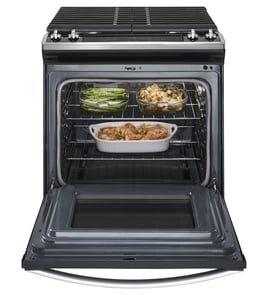



Is GE profile considered high end?
Yes. GE Profile is widely considered the higher-end tier within the main GE appliance lineup, with more premium design and feature sets than standard GE models. For a GE gas range like model JGS760SP3SS, “Profile” typically signals upgraded cooking features and a more premium finish package; confirm the exact feature set in the JGS760SP3SS owner's manual.
How GE Profile fits in the GE lineup
GE uses multiple product families; “Profile” generally sits above standard GE and below GE’s true luxury lines.
- Standard GE: core features, value-focused
- GE Profile: upgraded features, more tech-forward options, premium styling
- Luxury lines (varies by market): highest-end materials, specialized features, higher price points
What “high end” usually means for a gas range
On ranges, “high end” usually comes down to burner performance, oven cooking modes, and convenience features.
| Feature area | Standard GE (typical) | GE Profile (typical) |
|---|---|---|
| Surface burners | Basic output range | More high-output options, better control features |
| Oven cooking | Standard bake/broil | More advanced modes (often convection and specialty modes) |
| Connectivity | Often none | Often Wi-Fi capable on many models |
| Fit and finish | Basic | More premium styling and controls |
Quick ways to confirm what you have
Use these checks to identify whether your specific range is a Profile model and what it includes.
- Check the model number on the rating label (commonly behind the range drawer area).
- Review the feature list and control descriptions in the JGS760SP3SS owner's manual.
- Look for features commonly associated with upgraded lines (for example, convection modes and Wi-Fi connect).
- Compare your cooktop layout to the parts list; higher-output burner components may be present (example: range extra large surface burner, 18,000-btu WB16X24722).
Why it matters
Knowing whether your range is GE Profile helps set expectations for performance and also helps ensure you order the correct GE parts (burners, igniters, controls) for model JGS760SP3SS.
Last updated: February 2026
Is a gas stove 110 or 220?
A GE gas range like model JGS760SP3SS typically plugs into a standard 120-volt household outlet (often called 110/120V) to power the igniters, oven controls, lights, and fans; it does not use a 240-volt (220/240V) circuit like many electric ranges.
What the electrical connection does on a gas range
Even though the cooktop and oven heat with gas, the range still needs electricity for key components:
- Spark ignition for surface burners
- Oven ignition and electronic control operation
- Oven light and display
- Convection and cooling fans (if equipped)
- Safety and sensing circuits
For installation details and grounding requirements, follow the JGS760SP3SS installation guide.
Quick comparison: gas vs. electric range power
| Range type | Typical outlet/circuit | What electricity powers |
|---|---|---|
| Gas range (JGS760SP3SS) | 120V (110/120V) | Ignition, controls, lights, fans |
| Electric range | 240V (220/240V) | Heating elements plus controls |
Why it matters
Using the correct outlet and grounding helps the igniters and control board work reliably and supports safe operation during installation. A gas range that is not properly grounded can have ignition and control problems.
Related installation tips we recommend
- Use a properly grounded 120V outlet; do not use an adapter that defeats grounding
- Keep the gas shut-off valve accessible after the range is in place
- Use a new flexible gas connector during installation
- Seal openings behind and under the range to reduce drafts that can affect burner flames
- If you are above 6,000 ft elevation, use the correct high-altitude conversion kit and follow its instructions
Last updated: February 2026
What does F3 mean on a gas stove?
On the GE JGS760SP3SS gas range, F3 is treated as a function error code from the electronic oven control. The first fix is to cancel the cycle, let the oven cool, then reset power; if the code returns, service is typically needed (see the JGS760SP3SS owner’s manual).
What to do when F3 shows up
- Press Cancel/Off to stop the current cooking mode.
- Let the oven cool for about 1 hour.
- Restore operation and see if the code clears.
- If it returns, turn off power to the range for at least 30 seconds, then restore power.
- If the code repeats again after the reset, schedule service.
Quick reset checklist (safe and effective)
| Step | What you do | Why it matters |
|---|---|---|
| 1 | Cancel/Off | Stops the control from continuing the fault state |
| 2 | Cool down | Heat-related faults can clear after cooling |
| 3 | Power reset (30 seconds) | Reboots the control board and relays |
| 4 | Retest bake/broil | Confirms whether the fault is persistent |
Common causes we see behind “F3” style errors
On many GE ranges, F-number codes are triggered by a control sensing a problem such as temperature-sensing issues or an electronic control fault. For this model, the manual groups these as “function error codes,” so we focus on the proven reset steps first.
If you are troubleshooting an oven temperature-related issue, the oven temperature sensor is a common component to test or replace; for this model that part is the range oven temperature sensor WB24X25557.
Why it matters
An F3 code means the range control is detecting a condition it does not like. Resetting correctly can clear a temporary fault; repeated F3 codes point to a problem that can affect baking accuracy and safe operation.
Last updated: February 2026
What gas is used in gas stoves?
Most gas stoves use natural gas (methane) or propane (LP) gas. Your GE gas range JGS760SP3SS leaves the factory set up for natural gas, and it can be converted to propane by a qualified installer using the instructions in the installation guide.
Common fuel types you may see
In homes, these are the most common fuels for gas ranges:
- Natural gas: supplied by a utility gas line
- Propane (LP): supplied from a propane tank; requires correct LP orifices and regulator settings
- Butane: used in some regions (less common in the U.S.)
What this means for GE model JGS760SP3SS
The installation instructions for this model specify:
- The range is factory set for natural gas
- Propane conversion must be done by a qualified propane gas installer
- The conversion orifices and instructions are located on the back of the range
- At high altitude (over 6000 ft), a kit may be required; for propane, that kit is hotpoint range high-altitude lp conversion kit WB28X29255
Quick comparison: natural gas vs propane
| Item | Natural gas | Propane (LP) |
|---|---|---|
| Typical supply | Utility line | Tank (on-site) |
| Range setup | Factory default on JGS760SP3SS | Requires conversion |
| Key risk if wrong | Poor flame, soot, unsafe combustion | Poor flame, soot, unsafe combustion |
Why it matters
Using the correct gas type and conversion parts helps your burners ignite properly, keeps flames stable, and supports safe combustion. A range set for natural gas will not operate correctly on propane unless it is converted.
Last updated: February 2026
What if I can't find my part on Sears PartsDirect?
If you cannot find a part for your GE JGS760SP3SS gas range, we recommend confirming the full model number, then using the diagrams and part lists to match the exact part name and ID; if it still does not appear, contact our parts specialists with your model and serial number.
Quick checks that solve most “missing part” searches
- Confirm the model number is exactly JGS760SP3SS (letters and numbers must match).
- Use the exploded-view diagrams and part lists in the JGS760SP3SS owner's manual to identify the correct part description.
- Search by the part ID or part number if you have it (example: WB13X40206).
- Check for common naming differences (example: “igniter” vs “glow bar”, “valve” vs “regulator”).
- If you are replacing a burner component, verify which burner position it fits (front/rear, oval, extra-large).
If you have symptoms, start with the most likely part family
Many customers search by symptom, but parts are listed by component name. These examples can help you narrow it down:
| Symptom | Common part area to check | Example part for this model |
|---|---|---|
| Oven will not heat | Oven igniter, gas valve, sensor | Range oven burner igniter WB13X40206 |
| Surface burners click but do not light | Spark module, burner cap, valve | Range spark module WB13X24741 |
| Oven temperature seems off | Oven temperature sensor | Range oven temperature sensor WB24X25557 |
Why it matters
GE ranges often use multiple similar-looking parts across burner sizes and oven functions. Matching the exact model number, part ID, and location on the range prevents ordering a part that does not fit or does not solve the problem.
Last updated: February 2026