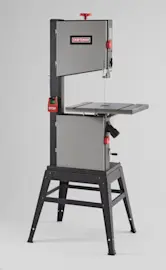
Owner’s manual

How to determine the size of a bandsaw?
For a band saw, the “size” is primarily defined by wheel diameter and throat depth because those specs determine blade length and how wide a workpiece you can cut. On the Craftsman 351214000 band saw, the wheel diameter is 10 inches and the throat depth is 9 5/8 inches (at 90°).
What measurements define band saw size
Most manufacturers describe band saw size using these core measurements:
- Wheel diameter: the diameter of the band wheels (affects blade length and tracking stability)
- Throat depth: distance from the blade to the frame (limits how wide a piece you can cut)
- Maximum depth of cut: how tall a piece you can cut under the guides
- Blade length and blade width range: what blades the saw can physically run
Craftsman 351214000 key sizing specs (quick reference)
| Spec | What it tells you | Value |
|---|---|---|
| Wheel diameter | Common “band saw size” label | 10 in. |
| Throat depth at 90° | Max cut width to the left of blade | 9 5/8 in. |
| Max depth of cut at 90° | Max cut height | 4 5/8 in. |
| Max depth of cut at 45° | Max cut height on bevel | 2 3/4 in. |
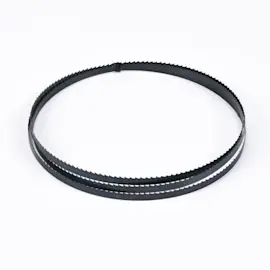
| Blade length | Blade size you must buy | 70 1/2 in. |
| Blade width range | Curve vs straight-cut capability | 1/8 to 1/2 in. |
| Overall dimensions | Footprint and height | 21 x 14 x 34 in. |
For the full spec list and setup details, use the owner's manual.
Why it matters
Choosing blades, setting expectations for resaw height, and planning shop space all depend on these “size” specs. For example, throat depth limits the maximum width you can cut, while blade width affects how tight a curve you can follow.
Helpful next step for blade selection and performance
If you are trying to match “size” to real-world cutting results (slow cutting, wandering cuts, rough edges), use our DIY resources:
If you need to look up parts by model number, start with the parts list for Craftsman 351214000 or search by model on Sears PartsDirect.
Last updated: February 2026
What is the 3-tooth rule for bandsaws?
On the Craftsman band saw model 351214000, the 3-tooth rule means you keep at least three blade teeth in contact with the workpiece during the cut. This prevents blade shocking (tooth stripping and rough cutting) and helps the blade track and cut more smoothly; see the blade pitch guidance in the owner's manual.
How to apply the 3-tooth rule (quick steps)
- Measure the material thickness you are cutting (the dimension the teeth pass through).
- Choose a blade pitch (TPI) so 3 or more teeth are engaged in that thickness.
- For soft materials, we typically use 6 to 8 TPI.
- For harder materials, we typically use 8 to 12 TPI to reduce tooth shock.
- Feed at a moderate speed; forcing the cut can still strip teeth even with the right TPI.
- Confirm blade tension and tracking are adjusted correctly before cutting.
Simple TPI selection examples
These examples show how the rule works in practice (thickness is approximate):
| Material thickness | Good starting point | Why it fits the rule |
|---|---|---|
| 1/4 inch | 10 to 14 TPI | Keeps multiple teeth engaged in thin stock |
| 1/2 inch | 6 to 10 TPI | Balances chip clearance and smoothness |
| 1 inch | 4 to 6 TPI | Prevents too many teeth packing the gullets |
Why it matters
When too few teeth contact the material, each tooth takes too big a bite and the blade can “shock,” which can strip teeth and make the saw cut slowly or wander. When the pitch is too fine for thick stock, chips can overload the gullets and the cut can heat up and get rough.
Related cutting symptoms and fixes
If your cuts still look wrong after choosing the right pitch, these guides help you narrow it down:
Parts and diagrams
We use your model number 351214000 to match the correct diagrams and replacement parts. If you do not see what you need in the model parts list, search by model on Sears PartsDirect.
Last updated: February 2026
What should you not do with a band saw?
On the Craftsman 351214000 band saw, you should not put your hands near the moving blade, reach across the cut line, cut round stock without a cradle, back out of a cut while the blade is moving, or leave the saw running unattended. Follow the safety and adjustment steps in the owner's manual.
Do not do these high-risk actions
- Do not reach over or around the blade path to steady the workpiece.
- Do not cut round or irregular stock without a support cradle or jig.
- Do not force the feed rate; pushing too hard can deflect the blade and cause binding.
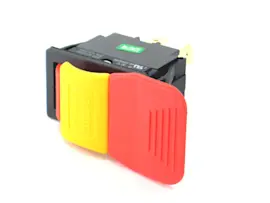
- Do not operate with missing, damaged, or malfunctioning parts (switch, guards, power cord); unplug the saw until repaired.
- Do not service, adjust, or change the blade with the saw plugged in.
- Do not use a damaged extension cord or a long extension cord run; keep cord length short and properly grounded.
Safe operating basics we recommend
Before each session, we use this quick checklist:
- Verify blade tracking, blade tension, and blade guides are correctly set.
- Confirm the table is square to the blade for straight cuts.
- Use the rip fence or miter gauge when appropriate for control.
- Keep the saw clean and dry; clear chips and dust buildup.
- Replace dull or damaged blades; a sharp blade cuts cooler and straighter.
Common “don’t” situations and the safer move
| If you are about to… | Do this instead | Why it’s safer |
|---|---|---|
| Cut a tight curve in one pass | Make relief cuts first | Reduces blade twisting and binding |
| Push hard to speed up the cut | Use light, steady pressure | Prevents blade deflection and drift |
| Leave the saw tensioned for storage | Release blade tension for long downtime | Helps extend blade and wheel/tire life |
| Troubleshoot a no-start issue while plugged in | Switch OFF and unplug first | Prevents unexpected start-up |
Why it matters
Most band saw injuries and poor cut quality come from the same root causes: hands too close to the blade, unstable workpieces, and incorrect blade tension, tracking, or guide adjustment. Keeping setup correct and feed pressure light protects you and improves accuracy.
For parts and diagrams for Craftsman 351214000, start with the model parts list, or search by model on Sears PartsDirect.
Last updated: February 2026