 Owner’s manual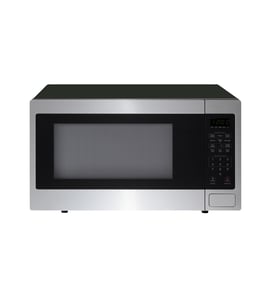



Can you use a hood microwave on the counter?
No. We do not recommend using an over-the-range (hood) microwave on a countertop; those units are designed and safety-tested to be mounted in a cabinet installation, not set on a counter. For your GE JES1657SM1SS countertop microwave, follow the placement and clearance rules in the JES1657SM1SS owner’s manual.
What you can do instead
- Use a true countertop microwave (like GE JES1657SM1SS) on a stable, level counter.
- Keep the front of the door at least 3 inches back from the counter edge to reduce tip risk.
- Do not cover or block any openings (airflow is required for safe operation).
- Do not place items on top of the microwave while it is running.
- Do not mount a countertop microwave over a sink or near a heat source.
Quick comparison: hood microwave vs countertop microwave
| Feature | Over-the-range (hood) microwave | Countertop microwave (GE JES1657SM1SS) |
|---|---|---|
| Intended installation | Mounted to cabinet and wall | Sits on countertop |
| Venting/airflow design | Built for enclosed mounting and venting | Built for open-air counter placement |
| Safe on a counter | No | Yes, when placed correctly |
Why it matters
Using a hood microwave on a counter can create stability and ventilation problems. Microwaves need proper airflow and secure placement to prevent overheating and reduce the chance of tipping during normal door use.
Last updated: February 2026
What are common problems with GE profile microwaves?
Common problems we see with GE Profile microwaves include arcing (sparks), not heating, turntable not rotating, and nuisance breaker trips. For your GE JES1657SM1SS countertop microwave, the JES1657SM1SS owner's manual highlights arcing causes (metal or foil contact, twist ties, gold rim dishes) and lists several normal sounds and light changes.
Most common symptoms and what they usually mean
- Arcing or burn marks inside the cavity: Often caused by foil, metal, or food splatter carbonizing and creating a spark path.
- Microwave runs but does not heat: Commonly points to a high-voltage system issue (magnetron, diode, capacitor) and needs qualified service.
- Turntable not rotating: Usually a worn coupler, a damaged ring, or a tray that is not seated correctly.
- Breaker trips or house fuse blows: Can be a shorted component, a failing door switch, or a power supply issue.
- Unusual noises, steam at the door, dimming light: Often normal operating characteristics depending on power level.
Quick checks you can do safely (no disassembly)
- Press CLEAR/OFF immediately if you see sparks.
- Remove any metal/foil, twist ties, or gold rim cookware.
- Clean the cavity and waveguide cover area (if accessible) to remove baked-on splatter.
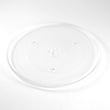
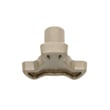
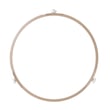
- Verify the turntable stack-up is correct:
- Plug the microwave into a different circuit if you notice TV/radio interference or suspect an overloaded circuit.
Symptom-to-likely-cause guide
| Symptom | Common cause | Best next step |
|---|---|---|
| Sparks/arcing | Foil/metal contact, improper cookware, carbonized splatter | Stop, remove cause, clean cavity |
| No heat | High-voltage component failure | Schedule service (high voltage hazard) |
| Turntable not turning | Coupler/ring/tray issue | Inspect and replace worn turntable parts |
| Breaker trips | Shorted component, door switch issue, circuit overload | Stop using; have unit checked |
Why it matters
Arcing and breaker trips are safety-related symptoms. Correcting cookware and cleaning issues prevents repeat damage; heating and electrical faults can worsen quickly and should be handled by a qualified technician.
Last updated: February 2026
What is the average lifespan of a GE microwave?
Most GE microwaves, including countertop models like GE JES1657SM1SS, typically last 7 to 10 years with normal household use. Heavy daily use, poor airflow around the cabinet, and repeated overheating can shorten life; consistent cleaning and proper use help it reach the high end of that range.
Typical lifespan and what changes it
- Light use (a few minutes/day): often closer to 10 years
- Moderate use (15 to 30 minutes/day): commonly 7 to 10 years
- Heavy use (multiple long cycles/day): can be closer to 5 to 7 years
- Poor ventilation or frequent overheating: shortens magnetron and control life
- Frequent arcing (sparks) or metal use: can quickly damage the cavity and waveguide cover
Quick checklist to help your microwave last longer
- Keep the interior clean so food splatter does not carbonize and cause arcing.
- Leave clearance around the microwave so heat can escape.
- Use microwave-safe containers; avoid foil, metal trim, and twist ties.
- Do not run it empty; it can overheat internal components.
- If heating becomes weak or uneven, stop using it and troubleshoot before damage spreads.
Repair vs. replace: a practical guide
| If your JES1657SM1SS is… | Usually makes sense to… | Why |
|---|---|---|
| Under 5 years old | Repair | Parts and labor often cost less than replacement value |
| 7 to 10 years old | Compare costs | Age-related failures become more common |
| Over 10 years old | Replace | Reliability drops and repair value declines |
Why it matters
A microwave that is near end-of-life often shows early warning signs (longer cook times, intermittent power, burning smells, arcing). Addressing those symptoms early helps prevent damage to high-voltage components and reduces the chance of repeat failures.
For model-specific use, care, and cleaning guidance, follow the JES1657SM1SS owner’s manual.
Last updated: February 2026
Is a 1.6 cu ft microwave big?
Yes. A 1.6 cu ft countertop microwave is considered a larger, family-size capacity; it typically fits full-size dinner plates and many casserole dishes, making it a practical choice for everyday reheating and cooking in a GE microwave like model JES1657SM1SS.
What “big” means for microwave capacity
Microwave capacity is measured in cubic feet (cu ft). In most kitchens, 1.6 cu ft lands in the larger countertop range.
- Good for families and frequent use
- More room for wide plates and medium-to-large bowls
- Better for batch cooking (multiple servings)
- Less need to rotate food manually (especially with a working turntable)
- Takes more counter space than compact models
Quick size comparison (typical ranges)
| Capacity | Common description | Best for |
|---|---|---|
| 0.7 to 1.1 cu ft | Compact | Dorms, small kitchens, basic reheating |
| 1.2 to 1.6 cu ft | Mid to large | Most households, larger plates |
| 1.7+ cu ft | Extra large | Big cookware, frequent batch cooking |
Fit and placement tips for JES1657SM1SS
Capacity does not equal exterior dimensions, so always confirm clearances and safe placement.
- Place the microwave on a stable, level surface
- Keep the front of the door at least 3 inches back from the counter edge to reduce tipping risk
- Do not store items on top while operating
- Use a properly grounded outlet
For model-specific guidance, use the JES1657SM1SS owner’s manual.
Why it matters
Choosing a larger capacity microwave helps prevent overcrowding, improves heating results, and reduces spills from tall containers. It also makes turntable parts more important for even cooking.
If your turntable system is missing or not rotating, common related parts include the coupler WB06X10861 and rotating ring WB06X10862.
Last updated: February 2026


