Owner’s manual
 Error Codes



Can Samsung fridge height be adjusted?
Yes. On the Samsung RF34H9960S4 refrigerator, we adjust overall height by turning the front leveling legs; we adjust uneven door height separately using snap rings at the hinge after the cabinet is level. Use the steps in the owner's manual to avoid door alignment issues.
How to adjust the refrigerator height (leveling)
Leveling changes the cabinet height and helps doors close and seal correctly.
- Open the doors and locate the leveling leg control lever near the front base.
- Insert a flat-head screwdriver into the control lever slot.
- Turn the control lever clockwise to raise the refrigerator.
- Turn the control lever counterclockwise to lower the refrigerator.
- Recheck that the refrigerator is level side-to-side and front-to-back.
- If the floor is uneven, support the rear legs with a solid panel so the unit sits stable.
How to adjust door height (if one door sits lower)
If one door is lower than the other, level the refrigerator first; then correct the door height.
- Compare door tops and identify which door is low.
- Lift the lower door slightly.
- Insert one snap ring between the door and hinge to raise that door.
- Choose the snap ring thickness that matches the height difference.
- Do not stack multiple snap rings; it can cause slipping or noise.
Snap ring thickness options
| Snap ring thickness | Best for |
|---|---|
| 1 mm | Small height difference |
| 1.5 mm | Minor adjustment |
| 2 mm | Moderate adjustment |
| 2.5 mm | Larger adjustment |
Why it matters
A refrigerator that is not level can cause one door to sit lower, create air leaks at the door gasket, increase run time, and lead to temperature swings in the fresh food or freezer compartments.
Last updated: February 2026
What's the lifespan of a bottom freezer fridge?
A bottom freezer (bottom-mount) refrigerator typically lasts 15 to 20 years with normal household use. For your Samsung RF34H9960S4, lifespan depends most on compressor health, airflow/venting, door seal condition, and keeping the condenser area clean; our owner's manual covers care and usage tips that help extend service life.
Typical lifespan and what affects it most
Most bottom-mount and French door refrigerators fall into the same general life range, but real-world longevity is driven by a few high-impact factors:
- Ventilation and heat exposure: keep clearance at the back and sides; avoid placing near heat sources
- Door openings and door seal condition: frequent openings and poor sealing increase run time
- Power events: long outages can stress food safety and temperature recovery
- Maintenance habits: cleaning spills, avoiding harsh cleaners on gaskets and plastics
- Component wear: fans, sensors, and the sealed system (compressor, evaporator)
Maintenance checklist that helps you reach 15 to 20 years
Use these habits to reduce strain on the cooling system and prevent common failures:
- Keep vents and grilles unblocked so air circulates freely.
- Minimize how long doors stay open; shorter openings reduce temperature swings.
- Clean interior surfaces with non-abrasive cleaners; avoid petroleum-based products on gaskets and liners.
- After a power failure, limit door openings; if the outage exceeds 24 hours, discard frozen food (per the manual).
- Maintain proper spacing between stored items so cold air can move through the compartments.
Quick reference: lifespan vs. “repair or replace” signals
| What you’re seeing | What it usually means | What we recommend |
|---|---|---|
| Unit is 0 to 7 years old | Often worth repairing | Diagnose airflow, sensors, fans |
| Unit is 8 to 14 years old | Repair depends on part cost | Compare repair cost to age |
| Unit is 15 to 20 years old | Near typical end of life | Repair only if minor and low-cost |
Why it matters
A refrigerator that runs hotter than normal, has restricted airflow, or has poor door sealing forces the compressor and evaporator fan to work harder. That extra run time is the biggest driver of early wear in bottom-mount refrigerators.
Last updated: February 2026
What is the most common problem with Samsung refrigerators ice?
The most common ice problem we see on Samsung refrigerators like model RF34H9960S4 is the ice maker stopping or producing poorly because water flow is restricted or the ice path gets blocked. In practice, that usually traces back to the water supply, the water filter installation/condition, or the ice bucket and auger area.
Quick checks that fix most ice issues
- Confirm the water line is connected and the shut-off valve is fully open.
- Make sure the ice maker is turned on (touch and hold Ice Maker for 3 seconds; the “Off” light should be off). See the steps in the owner's manual.
- Verify the water filter is installed correctly; an improperly installed filter can stop ice production.
- After a new install or after restoring power, allow 24 hours for cooling before judging ice output.
- If ice is not dispensing, pull out the ice bucket and use the ice maker Test button (do not hold it continuously if the tray has ice or water).
Most common causes and what they look like
| Symptom | Most likely cause | What to do first |
|---|---|---|
| No ice at all | Ice maker turned off | Turn it on at the control panel (hold Ice Maker 3 sec) |
| Slow ice production | Fridge not fully cooled yet | Wait 24 hours; then re-check output |
| Small/hollow cubes | Restricted water flow | Replace/seat the filter; confirm supply valve is open |
| Ice won’t dispense | Ice bucket jam or auger area blocked | Remove bucket, clear clumps, run the Test button |
Parts that commonly relate to ice and water flow
If the basics check out and you still have weak ice production or no fill, these parts are common suspects on this model:
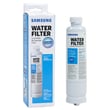
- Refrigerator water filter DA29-00020B (clogged or not seated)
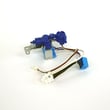
- Refrigerator water inlet valve DA62-04027A (not opening or restricted)
- Refrigerator auger motor assembly DA97-12540G (won’t drive ice out of the bucket)
Why it matters
Ice makers are very sensitive to water flow and temperature. A slightly loose filter, a partially closed shut-off valve, or not allowing a full cool-down period can look like a “bad ice maker” even when the ice system is working normally.
Last updated: February 2026