




How do I tell what model my GE washer is?
Your GE washer’s model number is printed on the appliance ID label. On the GE PTW705BST0WS style of top-load washer, you’ll typically find that label under the lid opening, on the back of the control panel, or on the cabinet side near the bottom.
- Lift the lid and look around the tub opening and underside of the top panel
- Check the back of the control panel (rear exterior)
- Look on the left or right cabinet side near the bottom edge
- If your washer is in a tight space, use a flashlight and take a photo to zoom in
The label usually includes a model number and a serial number. For parts lookup and compatibility, we use the model number.
| You see on the label | What it means | What to do with it |
|---|---|---|
| Model / Model No. | Exact washer model identifier | Use it to match parts and diagrams |
| Serial / S/N | Production identifier | Helpful for service history and age |
| Brand (GE) | Manufacturer | Confirms you’re in the right parts family |
GE can use similar-looking cabinets across multiple washer models, but parts like the water inlet valve, lid lock, and control board can vary by model. Using the exact model number helps you avoid ordering the wrong component.
- Check for a second label on the cabinet side near the bottom
- Look for a stamped or printed tag behind the control panel area
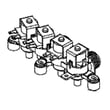
- If you’re replacing a common failure item, match by model once found (for example, the washer lid lock assembly WH08X37859 or washer water inlet valve assembly WH13X26637)
Last updated: February 2026
What voids a GE washer warranty?
For a GE washer like model PTW705BST0WS, the warranty is typically voided by damage caused by misuse or abuse, improper installation or service, unauthorized alterations, and problems caused by incorrect power supply. Lack of routine care and maintenance can also lead to non-covered failures.
- Misuse or abuse (overloading, washing items not intended for a washer, repeated operation with severe out-of-balance loads)
- Improper installation (incorrect drain setup, poor leveling, wrong water hookup)
- Incorrect electrical voltage or current, or power issues that damage electronics
- Unauthorized modification or alteration of the washer
- Lack of proper care and regular maintenance (allowing chronic odor, residue buildup, or repeated clogs to continue)
- Damage from accidents or external events (for example, fire, flooding, or lightning)
These steps help you avoid “non-warranty” causes and can prevent repeat failures:
- Confirm the washer is level and stable on the floor
- Verify hot and cold supply valves are fully open and hoses are not kinked
- Check the drain hose height and routing to prevent siphoning or slow draining
- Use the correct detergent type and amount (too much can cause oversudsing and errors)
- Address draining issues quickly to avoid pump damage
| Symptom | Often involved part | Common non-warranty cause |
|---|---|---|
| Won’t drain, stops mid-cycle | GE washer drain pump assembly WH23X28418 | Coins, socks, hairpins, or debris in the pump |
| Won’t fill or fills slowly | Washer water inlet valve assembly WH13X26637 | Sediment in screens, kinked hoses, low water pressure |
| Dead display or erratic behavior | Main control board w/instructions WH22X37297 | Power surge, incorrect voltage, moisture intrusion |
Warranty decisions often come down to whether the failure looks like a manufacturing defect or damage from installation, environment, power, or use. Preventing clogs, keeping the washer properly leveled, and protecting it from power issues helps keep repairs covered and reduces repeat breakdowns.
Last updated: February 2026
What would cause a GE washer to not spin?
If your GE PTW705BST0WS washer won’t spin, the most common causes are load balance problems, a lid lock issue, a drain problem that prevents high-speed spin, or a drive system/control fault. Start with simple checks, then move to lid lock and draining.
- Redistribute the load; bulky items can stop spin to protect the suspension.
- Run a Drain/Spin cycle with the tub empty to see if it reaches full speed.
- Make sure the washer is level and not rocking; leveling affects out-of-balance detection.
- Confirm the lid closes fully and latches; a weak strike can prevent spin.
- Check for standing water in the tub; many washers will not spin if they cannot drain.
A no-spin complaint often comes down to the lid lock system, draining, or the drive system sensing excessive vibration.
| Symptom you see | What it usually points to | Model-relevant part to check |
|---|---|---|
| Won’t spin and lid won’t lock | Lid lock/strike problem | Lid lock striker WH01X32866 |
| Won’t spin and water remains in tub | Drain pump or drain restriction | GE washer drain pump assembly WH23X28418 |
| Starts to spin then stops, bangs, or shows balance issues | Suspension/vibration sensing | Rod and spring assembly 5.4 WH03X33961 or accelerometer WH03X37841 |
| Random behavior, won’t complete cycle | Control or UI communication issue | Main control board w/instructions WH22X37297 or user interface board WH22X37157 |
- Rule out draining: If water is left in the basket, inspect the drain hose for kinks and check the pump area for debris; a failing pump can also hum without moving water.
- Verify lid lock engagement: If the lid does not lock, the washer will typically refuse to spin; inspect the strike for cracks or looseness.
- Check for severe out-of-balance: Weak suspension rods or a vibration sensor issue can stop spin repeatedly.
- Move to electrical/control checks: If the washer drains and locks but still won’t spin, control-board or motor-drive related faults become more likely.
A washer that cannot drain or confirm a locked lid is designed to stop spinning to prevent flooding, injury, or damage to the basket and suspension.
For code-based direction, use GE top load washer error codes.
Last updated: February 2026
Why is my GE top load washer leaking from the bottom?
A leak from the bottom of your GE PTW705BST0WS top-load washer almost always comes from the drain path (pump or hoses), the fill path (inlet valve or fill hoses), or oversudsing that runs down the cabinet. Pinpoint the leak by matching it to when it happens.
- Leaks during drain or spin: focus on the pump and drain hose.
- Leaks during fill or the first few minutes: focus on the inlet valve and fill hoses.
- Leaks mid-wash/agitation: check internal hoses and clamps for seepage.
- Water at the back: usually fill hoses, inlet valve, or drain hose connection.
- Water at the front corners: often splash-out or dispenser overflow.
- Drain pump housing or seal leaking: look for drips directly under the pump body; replace the pump if it weeps from the seam or shaft area: GE washer drain pump assembly WH23X28418.
- Drain hose issue: inspect for pinholes, rubbing, or a loose clamp; confirm the hose is not pushed too far into the standpipe (can cause backup and overflow).
- Inlet valve seepage: check for slow drips where the hot/cold hoses attach and at the valve body; replace the valve if the body leaks: washer water inlet valve assembly WH13X26637.
- Oversudsing: too much HE detergent can create foam that escapes and looks like a base leak.
- Unplug the washer; pull it forward and dry the floor.
- Run a small fill and watch the rear hose connections and valve area.
- Advance to drain/spin and watch the pump and drain hose.
- Find the highest wet point with a flashlight; the source is almost always above the puddle.
| When it leaks | Most likely source | What to do |
|---|---|---|
| During drain/spin | Pump or drain hose | Inspect, tighten clamps, replace pump/hose |
| During fill | Inlet valve or fill hoses | Tighten fittings, replace valve/hoses |
| Only with big loads | Oversuds or splash | Reduce detergent, rebalance load |
Bottom leaks can damage flooring and can also cause drain problems or electrical issues if water reaches wiring or controls.
Last updated: February 2026


