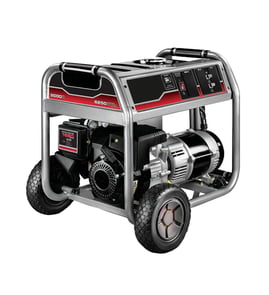

Can a portable generator power an entire home?
Yes, a portable generator can power an entire home, but only if it is correctly sized for your essential loads and connected safely through a transfer switch or interlock. With an All Power APG3001 portable generator, most homeowners plan to run selected circuits (not every appliance at once) during an outage.
What “power an entire home” really means
Most portable generators are best for whole-home essentials, not whole-home everything. The goal is to keep critical circuits running, such as refrigeration, heat circulation, lighting, and device charging.
Common essentials to prioritize
- Refrigerator or freezer
- Furnace blower or boiler circulator (fuel-based heat)
- Sump pump
- A few lighting circuits
- Internet modem/router and phone chargers
- Garage door opener (intermittent)
How to size a portable generator for your house
We size by running watts (continuous) and starting watts (surge). Motors and compressors often need 2 to 3 times their running watts for a few seconds.
| Load type | Examples | What to plan for |
|---|---|---|
| Resistive | lights, chargers, toaster | mostly running watts |
| Motor/compressor | fridge, well pump, sump pump | starting surge matters |
| Heating/cooling | space heater, window AC | high continuous draw |
Sizing steps we recommend
- List the circuits you want powered (not individual outlets).
- Add up running watts for everything you want on at the same time.
- Add the single largest starting surge (often a pump or refrigerator).
- Leave headroom (about 20%) so the generator is not maxed out.
Safe ways to connect to a home
A portable generator should feed your home through a transfer switch or interlock kit installed on your electrical panel.
Do this
- Use a transfer switch or interlock with an inlet box
- Turn off or manage large loads so you do not overload the generator
- Run the generator outdoors, away from doors and windows
Do not do this
- Backfeed through a dryer outlet or other receptacle
- Plug the generator directly into household wiring
- Run it in a garage, basement, or enclosed porch
Why it matters
Correct sizing and a proper transfer setup protect your generator, your appliances, and utility workers. It also prevents nuisance breaker trips and voltage drop that can damage motors and electronics.
For help identifying the exact model number on your unit before ordering generator parts, use how to find your appliance model number (and what it means for parts).
Last updated: February 2026
Who makes the APG3001 generator?
The APG3001 generator is made by All Power (often listed as All Power America). On our parts page, the model is identified as APG3001 and categorized as an All Power power generator, which is the manufacturer name you should match when searching parts and diagrams.
How to confirm you have the right manufacturer and model
Use the generator’s data plate (nameplate) to match the manufacturer and model exactly. For the APG3001, confirm:
- Model number: APG3001 (match every character)
- Brand/manufacturer name: All Power
- Engine family or engine model (if listed)
- Serial number (helps when parts vary by production run)
- Rated watts and running watts (helps match the correct alternator and control parts)
A quick way to avoid ordering the wrong part is to verify the model number format using how to find your appliance model number (and what it means for parts).
Why listings online can look confusing
Some sellers use similar-looking model numbers or reuse “APG” style prefixes across different generator lines. That can make it look like another brand makes the unit, even when the nameplate shows All Power.
Common look-alikes (what to check)
| What you see online | What to check on your generator | Why it matters |
|---|---|---|
| Similar model number | Exact APG3001 on the nameplate | Parts can differ by model family |
| Different brand name | Manufacturer field on the nameplate | Brand drives parts lookup |
| Same wattage rating | Voltage, outlets, and control panel layout | Electrical parts vary by configuration |
Why it matters
Matching the correct manufacturer (All Power) and exact model number (APG3001) is the fastest way to get the right generator parts, wiring components, and electrical accessories the first time.
Last updated: February 2026
What is the average lifespan of APG3001?
Most portable generators like the All Power APG3001 last 10 to 15 years with normal homeowner use and consistent maintenance; in engine hours, that is typically 500 to 2,000 hours depending on load, storage, and service habits.
What affects lifespan the most
- Oil change frequency (the biggest factor for small engines)
- Average load level (running near max output shortens life)
- Fuel quality and storage (stale fuel causes carburetor issues)
- Air filtration (dirty filter increases engine wear)
- Operating environment (dust, moisture, and heat accelerate wear)
Typical lifespan ranges (what to expect)
| Usage pattern | Typical engine hours | Typical years |
|---|---|---|
| Occasional outages, light loads | 500 to 1,000 | 10 to 15 |
| Frequent use, moderate loads | 1,000 to 2,000 | 5 to 10 |
| Heavy use, high loads | 300 to 800 | 2 to 5 |
Maintenance habits that extend APG3001 life
- Change oil on schedule and check level before each run
- Run the generator under load periodically to keep it healthy
- Use fresh fuel and drain or stabilize fuel before storage
- Keep cooling air paths clear; don’t block the muffler side
- Inspect wiring, outlets, and breakers for heat damage
Why it matters
Generator lifespan is mostly about engine wear and fuel-system condition. Good oil and clean fuel prevent the most common failures (low compression, carburetor clogging, and hard starting).
For safe DIY electrical checks (like verifying output voltage), use a meter correctly; our [how to use a multimeter to test electrical parts video] walks through the basics.
Last updated: March 2026