 Owner’s manual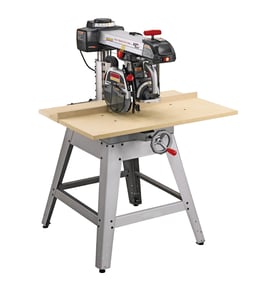

Are radial arm saws worth anything?
Yes. A Craftsman radial arm saw like model 113197150 is still “worth something” when it is complete, aligns accurately, and has all safety hardware installed; it excels at repeatable crosscuts and dado work. Market value varies widely, but practical value is strong if you tune it and use it safely.
What drives the value of a radial arm saw
Radial arm saw value is mostly about condition, completeness, and how confidently it can be set up for accurate cuts.
- Completeness of safety parts: blade guard, anti-kickback pawls, spreader, and readable safety labels
- Ability to align the blade: alignment is critical for accuracy and to prevent binding and thrown workpieces
- Smooth, tight controls: miter, swivel, bevel locks, plus the rip lock (when ripping)
- Table and fence condition: flat table surface and a straight fence improve cut quality
- Motor health: consistent start-up, no burning smell, no excessive sparking, and stable speed
Practical “worth it” tasks (where a RAS shines)
A tuned radial arm saw is a great shop tool for specific jobs.
| Task | Radial arm saw performance | Notes |
|---|---|---|
| Crosscuts on long boards | Excellent | Use table extensions or supports, not helpers |
| Repetitive cut-to-length work | Excellent | Return carriage to the rearmost position after each cut |
| Dadoes and trenching | Very good | Requires careful setup and guarding |
| Ripping | Usable but higher risk | Feed direction and guard setup matter most |
Safety and setup that protect both value and usefulness
For the Craftsman 113197150, safe operation is part of “value” because missing or mis-set safety gear makes the saw less usable.
- Lower the anti-kickback pawls and spreader for crosscutting and ripping
- Set the blade guard horizontal for crosscutting
- Lower the blade guard nose only when ripping
- Keep hands out of the blade path; never reach around the blade
- Lock miter, swivel, and bevel settings before cutting; lock the rip lock when ripping
For the exact alignment sequence and control locations, use the owner's manual.
Why it matters
A radial arm saw can be a bargain tool, but only when it is aligned and used within its strengths. Proper alignment improves accuracy and reduces binding, kickback, and thrown workpieces, which directly affects how often you will actually use the saw.
Finding parts and diagrams
We list model-specific diagrams and replacement parts by model number; start with the parts list for 113197150, then use Sears PartsDirect to search additional Craftsman power tool parts by model.
Last updated: February 2026
What is the best brand of radial arm saw?
There is no single “best” brand of radial arm saw; the best choice depends on how you’ll use it (crosscutting vs. light ripping), your budget, and whether you want a vintage cast-iron saw or a newer production machine. For owners of the Craftsman 113197150, the right “best” brand is the one you can set up accurately and operate safely using the 113197150 operator’s manual and proper support.
How we recommend choosing a “best” brand
A radial arm saw is only as good as its alignment, guarding, and table setup. When comparing brands, we focus on these practical factors:
- Arm and carriage rigidity: less flex means more accurate crosscuts.
- Fence and table system: easy-to-square table boards and a solid fence reduce drift.
- Guarding and feed direction guidance: clear labels and a stable guard help prevent wrong-way feeding.
- Parts and serviceability: availability of switches, cords, bearings, and hardware matters long-term.
- Intended workload: occasional DIY cuts vs. daily shop production.
Brand and use-case comparison (quick guide)
| Use case | What typically works best | What to watch for |
|---|---|---|
| Hobbyist and home shop | Well-maintained vintage saws (including Craftsman) | Alignment time, table wear, missing guards |
| Heavy-duty vintage preference | Older industrial cast-iron designs | Weight, space, electrical condition |
| Production and new equipment | Modern industrial radial arm saw makers | Higher cost, larger footprint |
Why safety and setup matter more than the logo
The Craftsman 113197150 manual emphasizes safe feeding direction and stable work support. For example, wide table extensions need proper support, and we do not recommend using helpers to hold stock because it can increase kickback risk. A “top” brand still performs poorly if the saw is out of square, the table is unstable, or the workpiece is not supported.
What to do if you are buying parts or restoring a saw
Even if you decide another brand is “best,” keeping your current saw running is often the best value.
- Use the parts diagrams and lists in the manual to identify what you need (switch, cord, bearings, table boards, fasteners).
- Replace worn electrical items first (power cord, switch, connectors) before tuning.
- Confirm the saw is secured and the table/fence are flat and square before chasing accuracy issues.
- Order by the correct model number and part number when available.
For replacement parts and model lookups, start with the parts list for Craftsman 113197150, or search by model on Sears PartsDirect.
Last updated: February 2026
When did Craftsman stop making radial arm saws?
Craftsman radial arm saws, including model 113.197150, were phased out of regular new retail production and sales in the early 1990s as the market shifted toward miter saws and other shop saw designs. For model-specific identification and parts diagrams, use the 113197150 owner's manual.
What “stop making” can mean
People use this phrase in a few different ways; the answer depends on which one you mean:
- End of manufacturing for a specific model or model family
- End of new retail sales through Sears channels
- End of catalog availability (still serviceable, but no longer sold new)
- Long-term parts availability changes as inventory ages
What we can confirm for model 113.197150
Your Craftsman 113.197150 is documented as part of the Craftsman 10-inch radial arm saw family (the manual covers 113.197110 and 113.197150) and includes detailed exploded views and parts lists.
- Use the manual’s parts list to identify assemblies like the arm assembly, yoke and motor assembly, and switch housing
- Match the model number exactly: 113197150
- Use part names from the diagrams when searching to avoid mismatches
How to date your saw more accurately
If you are trying to pin down a tighter timeframe than “early 1990s,” these checks usually help:
- Look for a date code or serial information on the model tag (often on the base or column)
- Compare your guard, switch, and table hardware to the diagrams in the manual
- Note any replacement motor cord, switch, or wiring changes that suggest later service work
| Goal | Best source | What you get |
|---|---|---|
| Identify exact configuration | 113197150 owner's manual | Diagrams, part names, and assembly breakdowns |
| Search parts by model number | Sears PartsDirect | Model-based lookup tools and ordering options |
Why it matters
Radial arm saws were produced in many similar-looking versions; using the exact 113197150 model reference prevents ordering the wrong switch components, bearings, or table mounting hardware.
Last updated: February 2026