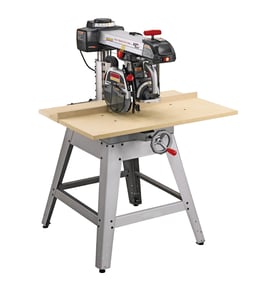

Are radial arm saws worth anything?
Yes. A vintage radial arm saw like the Craftsman 10329310 can be worth money, but value depends mostly on condition, completeness (guards, fence, table), and whether it runs smoothly. In many local markets, older Craftsman radial arm saws sell for modest prices, while premium vintage brands in excellent shape bring more.
What typically drives the value
- Working motor and smooth carriage travel (no binding, excessive play, or grinding)
- Complete safety and alignment parts (blade guard, anti-kickback pawls, yoke locks)
- Table and fence condition (flat, not water-damaged, fence not hacked up)
- Rust and wear level on the arm, column, and ways
- Included accessories (dado set, clamps, original wrenches, extra blades)
- Local demand and pickup logistics (these are heavy and usually local-sale items)
Typical price ranges (real-world expectations)
These ranges are what we commonly see for older 9-inch to 10-inch radial arm saws sold locally; your exact number depends on your area and the saw’s condition.
| Condition | What it usually means | Typical local value |
|---|---|---|
| Parts/unknown | Won’t run, missing guard, heavy rust | $0 to $50 |
| Runs but needs tune-up | Cuts, but needs alignment/table work | $50 to $150 |
| Clean and complete | Runs well, complete guard, decent table | $150 to $300 |
| Collector-grade | Restored, premium brand, excellent cosmetics | $300+ |
Quick checklist before you price it
- Unplug the saw; verify the blade stops quickly and the switch feels solid.
- Check for side-to-side play in the carriage and yoke; excessive slop lowers value.
- Inspect the power cord and wiring for cracks, splices, or brittle insulation.
- Confirm the guard is present and functional; missing guards reduce buyer interest.
- Make a few test cuts (crosscut and shallow dado if equipped) and listen for bearing noise.
Why it matters
Radial arm saws can be very capable for crosscuts and dados, but buyers pay more for saws that are complete, aligned, and safe to operate. A well-tuned Craftsman 10329310 is more attractive than a “project” saw with missing guards or electrical issues.
For safe electrical troubleshooting steps before selling or restoring, we recommend our guide: how to use a multimeter to test electrical parts video.
Last updated: February 2026
What is the best brand of radial arm saw?
There is no single “best” brand for every shop; the best radial arm saw is the one that is accurate, safe, and supported with parts for how you use it. For a vintage Craftsman 10329310 9" radial saw, we focus on condition, alignment, and parts availability as much as brand name.
What to look for when choosing a radial arm saw
- Arm and column rigidity: less flex means straighter crosscuts and safer operation.
- Carriage travel: it should roll smoothly with no binding or side play.
- Fence and table system: easy to replace sacrificial surfaces and keep the fence straight.
- Motor health: starts quickly, runs smoothly, and does not overheat.
- Guarding and controls: a complete blade guard, functional switch, and intact cord.
Brand comparison (practical buying view)
| Brand | Typical strengths | What to watch for | Best for |
|---|---|---|---|
| Craftsman | Common on the used market; good DIY support | Wear in carriage bearings, table/fence condition | Budget shops, light to medium duty |
| DeWalt | Heavy-duty builds on many classic models | Size and weight; needs space | Frequent crosscutting, heavier stock |
| Delta/Rockwell | Strong industrial designs on larger saws | Footprint; parts can be model-specific | Dedicated shop setups |
Quick checks before you buy (or tune up)
- Unplug the saw; spin the arbor by hand to feel for rough bearings.
- Check the arm lock and bevel/miter locks; they must clamp firmly.
- Verify the blade guard is present and moves freely.
- Inspect the power cord and switch for cracks, heat damage, or loose connections.
- Make a test cut and check for square in both miter and bevel.
Why it matters
Radial arm saw performance is mostly about alignment and mechanical condition. A well-tuned Craftsman can outperform a neglected “premium” saw, and a rigid, properly guarded saw is safer and more repeatable for crosscuts, dados, and light ripping.
For help identifying the exact model and matching parts correctly, use how to find your appliance model number (and what it means for parts).
Last updated: February 2026
What are common problems with radial arm saws?
Common radial arm saw problems include inaccurate cuts, rough or burning cuts, excessive vibration, and electrical issues (won’t start or trips a breaker). On a Craftsman 10329310 9" radial saw, most issues trace back to alignment, blade condition, or worn mechanical/electrical components.
Most common symptoms and likely causes
- Inaccurate or out-of-square cuts: fence not straight, arm not indexed at 90°, bevel/miter scales out of calibration
- Blade binds, stalls, or burns wood: dull blade, wrong blade type (rip vs. crosscut), feed rate too fast, blade installed backward
- Excessive vibration or chatter: bent blade, arbor flange debris, loose mounting hardware, worn bearings
- Carriage doesn’t slide smoothly: dirty/dry track, pitch buildup, worn rollers/bushings
- Won’t start or runs intermittently: damaged cord/plug, bad switch, loose internal connection, worn motor brushes (if equipped)
- Trips breaker or blows fuse: shorted wiring, failing motor, pinched cord, incorrect circuit capacity
Quick checks we recommend (safe, high-impact)
- Unplug the saw before any inspection or adjustment.
- Verify the blade is sharp, clean, and correct for the cut (crosscut blade for crosscuts).
- Check the fence is straight and firmly secured; replace if warped.
- Confirm the arm and yoke are locked before cutting; loose locks cause drift.
- Inspect for loose fasteners at the motor mount, arm, and base.
- If it’s an electrical symptom, inspect the cord and switch, then test with a meter.
Troubleshooting guide by problem
| Problem | What to check first | Typical fix |
|---|---|---|
| Cuts not square | Arm at 90°, fence straight | Recalibrate and re-square fence/arm |
| Burning | Blade sharp/type, feed rate | Replace/clean blade; slow feed |
| Vibration | Blade/arbor cleanliness, bearings | Clean flanges; replace blade/bearings |
| Won’t start | Cord, switch, brushes | Repair wiring; replace switch/brushes |
Why it matters
A radial arm saw can “self-feed” during crosscuts if alignment or locks are off. Keeping the Craftsman 10329310 square, tight, and electrically sound improves cut accuracy and reduces kickback risk.
Helpful DIY reference
For electrical testing steps, use our guide: how to use a multimeter to test electrical parts video.
Last updated: February 2026
Why are radial arm saws no longer made?
Radial arm saws (including legacy tools like the Craftsman 10329310 9" radial saw) fell out of favor because newer saws handle the most common cuts with simpler setup, more consistent accuracy, and easier guarding. For many shops, sliding compound miter saws and table saws replaced the radial arm saw’s role.
What changed
- Most users mainly needed crosscuts and miters, not an all-in-one station
- Sliding compound miter saws made crosscuts and miters faster to set and repeat
- Table saws became the go-to for ripping with improved fences, jigs, and workflow
- Portable tools improved, so fewer people bought large stationary saws
Safety and technique factors
Radial arm saws work well when aligned and used correctly, but they demand more attention to setup and feed direction than many modern options.
- Ripping can increase kickback risk if feed direction, blade type, or anti-kickback setup is wrong
- Crosscutting can “self-feed” if the blade and pull technique are mismatched
- Alignment of the arm, yoke, fence, and table affects both accuracy and binding risk
Quick comparison
| Common job | Radial arm saw | Tool most people switched to |
|---|---|---|
| Crosscuts | Very capable with alignment | Sliding compound miter saw |
| Ripping | Possible, higher technique demand | Table saw |
| Repeat cuts | Good with stops/clamps | Miter saw with stop system |
Why it matters for Craftsman 10329310 owners
Treating your saw as a dedicated crosscut station improves results: keep the fence straight, use a sharp blade matched to the cut, and avoid setups that push the tool into higher-risk operations.
Practical upkeep tips
- Keep the table and fence flat and square; replace sacrificial tops when worn
- Clean pitch and sawdust from tracks; confirm smooth carriage travel
- Use clamps and stop blocks for repeat cuts; keep hands out of the line of cut
For safe electrical testing practices that apply to many power tools, use our how to use a multimeter to test electrical parts video.
Last updated: February 2026