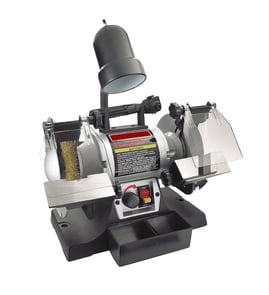

What is the work rest gap for a bench grinder?
For a Craftsman 257192150 bench grinder with a 6-inch wheel, we set the work rest (tool rest) gap as close to the wheel as possible; the standard safe setting is 1/8 inch (3 mm) or less. Recheck and readjust often because grinding wheels wear down as you use them.
Recommended settings (quick reference)
| Adjustment point | Typical safe gap | Why |
|---|---|---|
| Work rest (tool rest) to wheel | 1/8 in. (3 mm) max | Helps prevent the workpiece from getting pulled into the wheel |
| Spark guard (tongue guard) to wheel | 1/4 in. (6 mm) max | Helps contain sparks and debris near the wheel |
How we set the work rest gap safely
- Unplug the grinder before making any adjustments.
- Loosen the work rest hardware and slide the rest toward the wheel.
- Set the gap to 1/8 inch (3 mm) or less across the full width of the wheel.
- Tighten fasteners firmly; replace stripped or missing hardware such as the screw 534222402.
- Spin the wheel by hand to confirm it clears the rest and guards without rubbing.
- Plug in and run the grinder briefly; stop and recheck if you see vibration or contact.
When to readjust the gap
- After dressing the wheel
- When you install a new wheel
- Any time the wheel diameter changes from normal wear
- If the rest gets bumped out of position
Why it matters
A tight work rest gap supports the workpiece close to the grinding surface. That reduces the chance of the part tipping, snagging, or being pulled down between the wheel and the rest, which is one of the most common bench grinder safety hazards.
Last updated: February 2026
What are the 4 important rules for a bench grinder?
For the Craftsman 257192150 6-inch bench grinder, the 4 most important rules are: wear proper eye/face protection, keep the tool adjusted and guarded, grind only on the wheel’s face (not the side), and control startup and shutdown (let it reach full speed, then wait for a complete stop before handling). Use are diy appliance repairs safe as a quick safety refresher.
The 4 rules (with the key details)
- Protect yourself every time: Safety glasses plus a face shield; tie back long hair, avoid loose sleeves, remove jewelry.
- Keep clearances and guards correct: Keep guards in place; keep the work rest close to the wheel (typically about 1/8 inch) so the workpiece cannot wedge.
- Use the wheel correctly: Grind on the front face of the wheel only; never grind on the side unless the wheel is specifically rated for side grinding.
- Respect startup and stopping: Stand slightly to one side at startup; let the wheel reach full speed before grinding; never touch the wheel or adjust parts until it fully stops.
Quick setup checklist before you grind
- Verify the wheel is tight, not cracked, and spins freely by hand (power unplugged).
- Set the work rest close and square to the wheel.
- Set the spark guard and eye shields so sparks are contained.
- Use light pressure; let the abrasive do the work.
- Keep a cup of water nearby to cool the workpiece (prevents overheating and loss of temper).
Common “don’t do this” examples
| Situation | What to do instead |
|---|---|
| Pushing hard to speed up grinding | Use light, steady pressure and dress/replace a glazed wheel |
| Grinding on the wheel’s side | Use the wheel face, or use the correct wheel/tool for the job |
| Leaving the rest far from the wheel | Reset the rest close (about 1/8 inch is typical) |
| Walking away while it coasts | Stay with it until the wheel fully stops |
Why it matters
These rules prevent the most common bench grinder injuries: wheel breakage, kickback from a jammed workpiece, and eye/face injuries from sparks and debris.
Last updated: February 2026
What is a Craftsman bench grinder?
A Craftsman bench grinder (including model 257192150) is a stationary power tool with two grinding wheels (this model uses 6-inch wheels) that we use to sharpen tools, shape metal, remove rust or burrs, and clean up edges with consistent control at a workbench.
What you can do with a bench grinder
- Sharpen chisels, lawn mower blades, and other hand tools
- Grind and shape small metal parts
- Deburr cut edges after drilling or sawing
- Clean metal using a wire wheel (if equipped)
- Smooth welds and remove light rust
Key parts and what they do
A bench grinder is simple, but each component matters for safety and accuracy.
| Component | What it does | Why it matters |
|---|---|---|
| Grinding wheels (6-inch) | Removes material and shapes edges | Wheel condition affects finish and safety |
| Tool rests | Supports the workpiece | Helps keep angles consistent |
| Eye shields/spark guards | Deflects debris and sparks | Reduces injury risk |
| Motor and switch | Powers and controls the grinder | Affects startup, speed, and reliability |
Basic safety and setup we recommend
- Wear eye protection and keep guards installed
- Keep the tool rest close to the wheel (a small gap) so parts do not get pulled in
- Let the wheel reach full speed before grinding
- Use light pressure; forcing the work overheats metal and loads the wheel
- Stop using the grinder if the wheel wobbles, vibrates heavily, or looks damaged
Why it matters
Using the right grinder for the job helps you get cleaner edges, more consistent sharpening angles, and safer results. On a 6-inch bench grinder like Craftsman 257192150, keeping fasteners tight and guards aligned helps reduce vibration and improves control.
Parts for maintenance
If you need a replacement fastener used on the grinder, we list model-matched parts such as the screw 534222402.
Last updated: February 2026
Are eye shields required on bench grinders?
Yes. On a bench grinder like the Craftsman 257192150, you need eye protection every time you grind. A permanently attached eye shield can provide protection, but it does not replace safe setup and proper personal protective equipment (PPE) for flying grit and wheel debris.
What to use for eye protection
- Wear safety glasses with side shields as your baseline protection.
- Use the grinder’s eye shields (if installed) as added protection, not your only protection.
- Add a face shield for heavy grinding, wire-wheeling, or when sparks and fragments are more likely.
- Keep shields clean and positioned between your eyes and the wheel.
- Replace cracked, yellowed, or loose shields before using the grinder.
Setup checks that matter just as much
Proper guarding and adjustment reduce the chance of wheel breakage and kickback.
- Verify the wheel guard is installed and secure.
- Adjust the tool rest close to the wheel (typical target: about 1/8 inch).
- Adjust the spark arrestor close to the wheel (typical target: about 1/16 inch).
- Stand to the side at startup and let the wheel reach full speed before grinding.
- Never grind on the side of a wheel unless the wheel is rated for side grinding.
Quick guide: eye shields vs. PPE
| Protection | What it does | What it does not do |
|---|---|---|
| Eye shields (attached to grinder) | Blocks some direct debris | Does not seal around eyes; can be bypassed by angled debris |
| Safety glasses | Protects eyes from most chips | Less coverage than a face shield |
| Face shield | Adds full-face coverage | Must be used with safety glasses, not instead |
Why it matters
Bench grinders can throw abrasive particles and metal fragments at high speed. Eye injuries happen fast, and they are preventable with the right combination of shields, PPE, and correct rest and guard adjustments.
Parts note for your model
If you are replacing missing or loose hardware on your Craftsman 257192150, match fasteners by size and thread; the parts list for this model includes items like the screw 534222402.
Last updated: February 2026