Owner’s manual
 Error Codes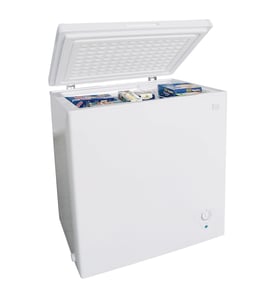



How to drain a Kenmore chest freezer?
To drain your Kenmore 2531692210C chest freezer, we unplug the unit, defrost it with the lid open, then open the defrost drain by removing the outside drain plug and the inside drain plug so meltwater flows into a shallow pan or through a hose. See the owner's manual for the exact drain locations.
Steps to drain it (models with a defrost drain)
- Unplug the freezer before defrosting.
- Remove all food; keep the lid open.
- Place a shallow pan under the drain outlet (some models use a divider/drain pan).
- Pull out the outside drain plug.
- Pull out the inside drain plug (inside the freezer).
- Let water drain; check the pan often so it does not overflow.
- When finished cleaning and drying, reinstall both drain plugs.
Using a hose vs. a pan
A 1/2-inch garden hose adapter can route water to a floor drain; otherwise, a shallow pan works well.
| Drain method | Best for | What to watch for |
|---|---|---|
| Shallow pan | Small to moderate meltwater | Empty/check pan frequently |
| Hose to floor drain | Larger meltwater volume | Keep hose secure; avoid kinks |
Important tips (to prevent warm air leaks)
- Always reinstall the drain plugs after defrosting.
- Do not leave the drain open after you are done; warm air can enter and cause frost buildup.
- Avoid touching interior metal surfaces with wet or damp hands.
Why it matters
Draining correctly speeds up defrosting, prevents water spills, and helps your freezer return to stable temperatures faster after cleaning.
Last updated: February 2026
Is there a reset button on chest freezers?
Most Kenmore chest freezers, including model 2531692210C, do not use a dedicated “reset” button for normal operation. The practical reset is a power reset: unplug the freezer (or switch off the breaker) for about 30 seconds, then restore power and allow several hours for temperatures to stabilize (see the owner's manual).
What to try first (safe, quick reset steps)
- Unplug the freezer for 30 seconds, then plug it back in.
- If you cannot access the plug, turn the circuit breaker off, wait 30 seconds, then turn it on.
- Confirm the power on light is lit (if your unit has one).
- Set the temperature control back to your normal setting and wait several hours before adjusting again.
- If the freezer was recently off, allow up to 4 hours to cool down fully.
If the alarm light is blinking or the buzzer is sounding
On many chest models, a blinking red temperature alarm light means the freezer has not reached a safe temperature yet, or the temperature rose too high. Some models let you silence the buzzer using an alarm button.
| Symptom | What it usually means | What to do |
|---|---|---|
| Red temp alarm light blinking | Freezer temperature is not yet safe | Keep lid closed; allow time to recover |
| Buzzer sounding | High temp alarm condition | Press the alarm off/reset button (if equipped) |
| Freezer recently loaded with warm food | Normal longer run time | Limit warm food loads; let temps recover |
Why it matters
A “reset” does not instantly fix warm temperatures. Chest freezers rely on stable power, a good lid seal, and correct temperature control settings. Frequent lid openings or warm food loads can trigger alarms and extend cool-down time.
Parts that relate to alarms, lid closure, and temperature control
If you are troubleshooting recurring alarms or temperature swings, these model-compatible parts are commonly involved:
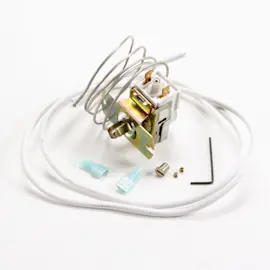
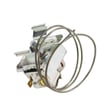
- Freezer temperature control thermostat 5304496559 (controls cooling cycles)
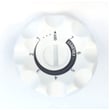
- Freezer temperature control knob 216707200 (lets you set the temperature)
- Freezer door switch 216822900 (on models that use a switch for light/alarm logic)
Last updated: February 2026
How big is a Kenmore chest freezer model 2531692210C?
The Kenmore chest freezer model 2531692210C is a full-size chest freezer; most Kenmore units in this model family measure about 44 to 45 inches wide, 33 to 36 inches high, and 27 to 30 inches deep. For the exact published dimensions for your unit, use the specifications/installation section in the 2531692210C owner's manual.
How to get the exact dimensions (fast and accurate)
Use the manual for the official measurements, then confirm with a tape measure at the widest points.
- Check the specifications or installation/first steps pages in the 2531692210C owner's manual
- Measure width at the widest cabinet point
- Measure height from floor to the top of the lid (include feet/rollers)
- Measure depth including the lid overhang and hinges (and handle if equipped)
- Plan extra space for lid swing and airflow around the cabinet
Typical planning numbers (space and clearance)
These are the common ranges we use for fit planning when the exact spec is not in front of you.
| What you need | Typical range for this size chest freezer |
|---|---|
| Width | 44 to 45 in. |
| Height | 33 to 36 in. |
| Depth | 27 to 30 in. |
| Air space around cabinet | 2 to 3 in. on sides and back |
Why it matters
Correct dimensions prevent delivery-day fit problems and help the freezer run efficiently. Adequate clearance improves condenser airflow, which supports stable temperatures and reduces run time.
Last updated: February 2026
Is it worth repairing a chest freezer?
Yes, repairing a Kenmore chest freezer like model 2531692210C is worth it when the problem is a single, replaceable part and the cabinet and lid seal are in good shape. If the issue points to sealed-system work (compressor or refrigerant leak), replacement usually makes more sense.
Quick way to decide
We use this simple checklist to make the call fast:
- Repair it if the freezer still cools some, the lid closes tightly, and the fix is likely electrical or a small component.
- Repair it if the symptom matches common troubleshooting items in the owner's manual.
- Repair it if you can confirm power and control settings (not set to OFF) and the unit still will not run.
- Replace it if the freezer has repeated cooling failures, loud compressor start attempts, or signs of sealed-system trouble.
- Replace it if the repair requires a major sealed-system component and labor outweighs the freezer’s remaining value.
Common repairs that are often worth it
These are typical “high value” fixes because they are targeted and restore normal operation:
- Replace a failed lid switch: freezer door switch 216822900
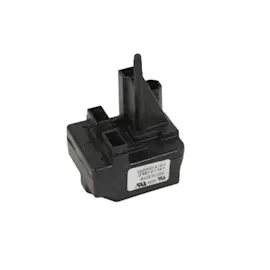
- Replace a worn start device: freezer compressor overload and relay clamp 216954300
- Replace a temperature control component: freezer temperature control thermostat 5304496559
- Replace a missing or broken control knob: freezer temperature control knob 216707200
Cost and complexity comparison
| Repair type | What it usually affects | Typical difficulty | Often worth it? |
|---|---|---|---|
| Switch/thermostat/relay | No-run, warm temps, intermittent running | Moderate DIY | Yes |
| Gasket/air leak related | Frost, long run times, warm spots | Moderate | Often |
| Sealed-system (compressor/refrigerant) | No cooling, poor cooling, hot compressor | Pro-level | Sometimes |
Why it matters
A chest freezer that runs too long or does not run at all can lead to food loss and higher energy use. The troubleshooting steps in the manual (power supply, control setting, door/lid sealing) help you avoid replacing parts that are not causing the problem.
Last updated: February 2026
Where is the model number on a Kenmore chest freezer?
On Kenmore chest freezer model 2531692210C, the model and serial number plate is on the left exterior wall of the cabinet. Copy the model number exactly as shown; we use it to match the correct parts diagrams and specifications in the owner's manual.
Where to check on a chest freezer
On chest-style Kenmore freezers, the ID plate is on the outside of the cabinet, not inside the food compartment.
- Look on the left side panel of the freezer cabinet
- Check toward the back half of that left exterior wall
- Wipe dust off; the label can be hard to see
- Write down both the model and serial numbers
What the label includes
Most Kenmore freezer identification plates list these items.
| Item on label | What it’s used for |
|---|---|
| Model number | Matching exact-fit parts and diagrams |
| Serial number | Identifying production series/version |
| Electrical ratings | Verifying power requirements |
About upright freezers (for comparison)
If you are checking a different freezer style, upright models commonly place the serial/model plate on an inside wall (often upper left) or on an exterior side/back panel, depending on the design. For your chest model 2531692210C, use the left exterior wall location.
Why it matters
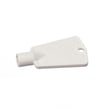
Using the correct model number prevents ordering look-alike parts that do not fit. It also helps us match common replacements for this model, such as the freezer temperature control knob 216707200 or the gibson freezer door key 297147700.
Last updated: February 2026