 Owner’s manual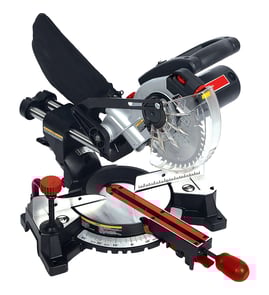

Can I cut a 4x4 with a 10-inch miter saw?
Yes. With the Craftsman 137212310 10-inch compound miter saw, you can cut a dimensional 4x4 (3-1/2 in. x 3-1/2 in.) in one cut by adding a 3/4-inch-thick auxiliary wood fence, as shown in the owner's manual.
What “4x4” means for cutting capacity
A construction 4x4 is typically 3-1/2 in. x 3-1/2 in., and this saw’s manual shows a one-cut method for that size using an auxiliary fence.
Key points to follow:
- Use a 3/4-inch auxiliary wood fence to gain the needed clearance
- Do a dry run with the saw OFF to confirm the blade path
- Keep hands at least 6-3/4 in. from the blade path (the “no-hands zone”)
- Hold the workpiece firmly against the fence to prevent shifting
- After the cut, release the trigger and wait for the blade to stop before raising the arm
Quick setup checklist (safe and accurate)
- Unplug the saw while installing or adjusting the auxiliary fence
- Support long stock on both sides of the saw table
- Clamp the 4x4 when possible to prevent rotation or lift
- Start the saw with the blade clear of the wood
- If you hear unusual noise or feel vibration, stop and correct the issue before continuing
One-cut vs. alternatives
| Approach | When it works best | What to watch for |
|---|---|---|
| One cut with auxiliary fence | Square 90° crosscuts on a 3-1/2 in. 4x4 | Fence must be secure; confirm clearance with a dry run |
| Flip-and-cut (two passes) | If your setup cannot clear in one pass | Keep the cut line aligned; avoid twisting the workpiece |
| Larger saw or slider | Frequent 4x4 cutting or wider stock | More capacity, but still requires proper support and clamping |
Why it matters
A 4x4 can shift or roll during a cut, which affects accuracy and increases kickback risk. Using the auxiliary fence method and a dry run helps confirm the cut is possible and keeps the workpiece stable.
For replacement parts and diagrams for Craftsman 137212310, use the parts list for this model or search by model number on Sears PartsDirect.
Last updated: February 2026
What should you never cut with a miter saw?
On the Craftsman 137212310 compound miter saw, never cut metals or masonry products, and never cut workpieces so small that your hands would be within 6-3/4 inches of the blade. Always clamp and support the workpiece and avoid free-hand cuts; see the 137212310 owner's manual.
Materials and situations to avoid
- Metals or masonry: This saw is designed for wood and wood-like products.
- Very small stock: If the cut forces your fingers inside the 6-3/4 inch no-hands zone, the piece is too small.
- Unclamped workpieces: Do not hand-hold pieces that can shift, roll, or lift.
- Round material without a fixture: Dowels and tubing can roll and cause the blade to bite.
- Any cut near flammables: Do not operate the saw around flammable liquids, vapors, or gases.
Safe alternatives (what to do instead)
Use the approach below to keep control of the cut and keep your hands away from the blade path.
| If you need to cut... | Use this safer method | Goal |
|---|---|---|
| Small trim pieces | Clamp the piece and use a stop block or jig | Keep hands out of the no-hands zone |
| Long boards | Add side support (stands or a stable support surface) | Prevent tipping and binding |
| Round stock | Use a V-block, cradle, or other fixture and clamp it | Stop rolling and blade bite |
| Any setup check | With power OFF, lower the blade to preview the cut line | Confirm clearance and cut path |
Why it matters
A miter saw can pull or pinch a shifting workpiece into the blade. Keeping the material supported, clamped, and outside the 6-3/4 inch no-hands zone reduces kickback risk and prevents accidental contact with the spinning blade.
Ordering parts and getting the right model match
When you are ready to replace worn items (for example, a blade, guard components, or switches), match parts to model 137212310 to avoid fit issues. We list model-specific parts by diagram, and you can also search by model number on Sears PartsDirect.
Last updated: February 2026
Why is 31.6 on a miter saw?
On the Craftsman 137212310 compound miter saw, 31.6° is a built-in positive stop because it is a common setting for making compound cuts for crown molding (especially when the molding is laid flat on the saw table). It helps you set the angle quickly and repeatably.
What 31.6° is used for
The miter scale on this saw includes positive stops at 0°, 15°, 22.5°, 31.6°, and 45°. That 31.6° stop is there because it is frequently used when cutting crown molding corners with consistent results.
- Speeds up setup for repeated crown molding cuts
- Improves consistency versus “eyeballing” the miter scale
- Reduces the chance of drifting off-angle between cuts
- Works with the saw’s positive stop locking lever for quick indexing
For the exact crown molding procedures and diagrams for this model, use the owner's manual.
How to set 31.6° on this model
Use the miter handle and the positive stop locking lever to land on the preset stop.
- Turn the miter handle counterclockwise to unlock the table
- Press and hold the positive stop locking lever
- Rotate the table left or right until it clicks into the 31.6° stop
- Release the lever
- Tighten the miter handle before cutting
Quick reference: common positive stops
| Positive stop | Typical use case |
|---|---|
| 0° | Straight crosscuts |
| 15° | Light angle trim cuts |
| 22.5° | Octagon or segmented projects |
| 31.6° | Common crown molding compound cuts |
| 45° | Standard miter corners |
Why it matters
Crown molding cuts are sensitive to small angle errors. A dedicated 31.6° positive stop helps you make cleaner-fitting inside and outside corners with less trial-and-error, especially when you are making multiple matching pieces.
If you need diagrams, parts lookups, or model-based searching, start with the parts list for model 137212310 and use Sears PartsDirect to search by model number.
Last updated: February 2026