 Owner’s manual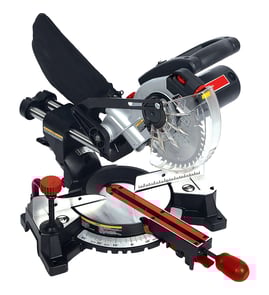

Why is 31.6 on a miter saw?
On the Craftsman 137212150 miter saw, 31.6° is a built-in positive stop (detent) on the miter scale. It is there because 31.6° is one of the most common preset angles used for fast, repeatable cuts, especially for compound crown molding cuts when the molding is laid flat on the saw table (paired with a 33.9° bevel setting). See the owner's manual.
What 31.6° is used for
The manual lists 31.6° as one of the “most common angle settings” with a positive stop, so you can lock in that angle quickly and accurately.
Common uses include:
- Crown molding compound cuts (typical spring angle setups)
- Trim and casing situations where a standard compound setup is needed
- Repeat production cuts where you want the same angle every time
- Faster setup than “dialing in” an angle between detents
How the positive stop works on this saw
Your 137212150 has a positive stop locking lever and miter handle that work together to snap into preset angles.
Basic steps:
- Lift/unlock the miter table lock.
- Hold the positive stop locking lever down.
- Rotate the table with the miter handle to 31.6° left or right.
- Release the lever and “wiggle” slightly until it fully engages the detent.
Crown molding quick-reference (why 31.6° shows up)
When crown is laid flat, many standard inside and outside corner cuts use the same miter setting.
| Cut type (laid flat) | Typical miter | Typical bevel |
|---|---|---|
| Inside corner (left or right piece) | 31.6° | 33.9° |
| Outside corner (left or right piece) | 31.6° | 33.9° |
Why it matters
That 31.6° detent reduces measuring errors and setup time. For trim work, a small angle mistake can open up gaps at corners, so a factory preset helps you get consistent results.
Last updated: February 2026
Does Craftsman make a double bevel miter saw?
Yes. Craftsman makes double bevel miter saw models, but the Craftsman 137212150 covered by this page is a compound miter saw with a 0° to 45° left bevel range (single-bevel), not a double-bevel design. For the exact bevel features and adjustments, use the owner's manual.
How to tell if a miter saw is double bevel
A double bevel miter saw tilts the blade both left and right for bevel cuts. A single bevel saw tilts one direction only.
Check these items on the saw (or in the manual):
- Bevel scale markings: left-only vs left and right
- Bevel lock handle and positive stops: whether stops exist on both sides
- Bevel range statement (example: “0° to 45° left”)
- Fence clearance notes for bevel cuts
- Any mention of “dual bevel” or “double bevel” in the feature list
What the Craftsman 137212150 manual indicates
In the Craftsman 137212150 documentation, the bevel scale is described as measuring the bevel angle 0° to 45° left, which matches a single-bevel compound miter saw.
Quick comparison
| Feature | Single bevel miter saw | Double bevel miter saw |
|---|---|---|
| Bevel direction | Left or right | Left and right |
| Common use | Basic trim, framing | Faster crown molding and complex trim |
| Workpiece flipping | More often | Less often |
Why it matters
Double bevel capability saves time and reduces handling errors because you can make matching bevel cuts without flipping long boards. If you do a lot of crown molding or repeated compound cuts, double bevel is a practical upgrade.
Last updated: February 2026
What should you never cut with a miter saw?
For the Craftsman 137212150 miter saw, never cut metals or masonry, and never cut small pieces that would put your hands within 8-1/2 inches of the blade. Also avoid any freehand cut; the work must be held firmly against the fence and table (use a clamp whenever possible). See the owner's manual for the full safety rules.
Never cut these materials
- Masonry products (brick, tile, concrete, stone)
- Ferrous metals (steel, rebar, nails in lumber)
- Unknown materials that can shatter, melt, or grab the blade
- Wood with embedded fasteners (screws, staples, hidden nails)
Never make these types of cuts
- Small workpieces where your hand or fingers would be within 8-1/2 inches of the blade path
- Freehand cuts (no fence contact, no clamp, or trying to “hold it steady” by hand)
- Cuts with the work not flat on the table and tight to the fence (twisted, bowed, or rocking stock)
- Cuts with the guard defeated or not operating normally
Blade and setup limits that matter on this model
This model is designed for cross-cutting on wood and wood-like products. Blade choice and setup affect safety as much as the material.
| Item | What to use | What to avoid |
|---|---|---|
| Blade type | Cross-cutting miter saw blade; carbide-tipped with negative hook angle | Thin kerf blades (can deflect and contact the guard) |
| Work holding | Fence + table contact; clamp when needed | Hand-held metal, round stock that can roll, or anything unstable |
| Cutting sequence | Let motor reach full speed; wait for blade to stop before raising | Reaching around the blade; lifting the saw before the blade stops |
Why it matters
Unsafe materials and unstable workpieces can bind the blade, cause kickback, or pull the work into the blade path. Keeping hands at least 8-1/2 inches away and clamping small or awkward stock prevents sudden movement during the cut.
Last updated: February 2026
What are the parts of a miter saw?
A miter saw is made up of the cutting head (motor, handle, switch, and blade), the guarding system, and the base/table assembly that positions and supports your workpiece. On the Craftsman 137212150 miter saw, you will also see features like a fence, miter and bevel controls, and dust collection parts (see the owner's manual).
Main assemblies you will see on the Craftsman 137212150
- Cutting head assembly: motor, cutting head handle, and trigger switch
- Blade and arbor area: saw blade, arbor, and arbor lock (for blade changes)
- Guarding system: upper blade guard and lower blade guard (retracts as you cut)
- Base and table: base, rotating table, and mounting holes for securing the saw
- Work support: fence, left and right extension wings, and sliding fence
- Angle controls: miter handle, miter scale, bevel lock handle, bevel scale, and positive stop locking lever
- Dust management: dust chute, dust bag, and dust collector elbow
What each key part does (quick reference)
| Part | What it does | Why you care |
|---|---|---|
| Fence | Keeps the workpiece from shifting; helps with repeatable cuts | Improves accuracy and safety |
| Miter handle and miter scale | Rotates the table left or right for miter cuts | Sets precise angles |
| Bevel lock handle and bevel scale | Tilts and locks the saw head for bevel cuts | Enables bevel and compound cuts |
| Lower blade guard | Covers the blade when raised; retracts during the cut | Reduces contact risk |
| Arbor lock | Holds the blade from spinning during blade removal/installation | Makes blade changes safer |
| Extension wings | Support long boards on both sides of the table | Prevents tipping and binding |
Common accessories and small parts included with many setups
These are often supplied with the saw or used during setup and blade changes:
- Blade wrench (often stored on the saw)
- Hold-down clamp (helps secure the workpiece)
- Dust bag and dust collector elbow
- Power cord storage clips
Why it matters
Knowing the names and functions of the miter saw parts helps you set angles correctly, clamp and support material safely, and identify what to inspect when cuts are inaccurate (for example, fence alignment, miter lock, bevel lock, or guard movement).
Last updated: February 2026
Can you cut a 4x4 with a 12 inch miter saw?
Yes, you can cut a 4x4 with a 12-inch miter saw, but on the Craftsman model 137212150 it is not a single-pass cut at 90 degrees. A 4x4 is about 3-1/2 inches thick, and this saw’s 90-degree crosscut capacity is 2-1/2 inches tall, so you cut it by flipping and cutting from the other side; follow the 137212150 owner's manual for safe setup.
What the Craftsman 137212150 can cut (key capacity)
A 4x4 fails the height limit for a one-pass crosscut on this model.
| Cut type | Capacity | What that means for a 4x4 |
|---|---|---|
| 90-degree crosscut | 2-1/2 in. x 7-7/8 in. | Too short for a 3-1/2 in. thick post in one pass |
How we cut a 4x4 on this saw
Use a flip-cut method so the blade reaches the full thickness.
- Mark the cut line on all four faces of the post.
- Set miter and bevel to 0 degrees for a straight crosscut.
- Hold the post firmly against the fence and table; clamp it whenever possible.
- Make the first cut as deep as the saw allows without forcing the blade.
- Turn the 4x4 over (keep the same face against the fence), align the kerf to your line, then finish the cut.
Blade and material rules that matter
This model is designed to run a 12-inch blade; using the right blade improves control and cut quality.
- Use only crosscutting miter saw blades; carbide-tipped blades should have a negative hook angle.
- Do not use thin-kerf blades (they can deflect).
- Let the motor reach full speed before starting the cut.
- Keep guards in place and wait for the blade to stop before raising the head.
- Cut wood and wood-like products only; do not cut metal, masonry, or use abrasive wheels.
Why it matters
A flip-cut keeps the work supported and controlled while matching the saw’s 2-1/2 inch vertical capacity. Forcing a one-pass cut on oversized stock increases binding, kickback risk, and poor accuracy.
Last updated: February 2026