Installation guide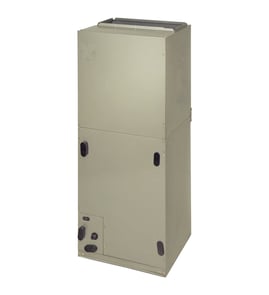



How many cfm is a 4 ton air handler?
A 4-ton air handler is typically set up for about 1,600 CFM (using the common rule of ~400 CFM per ton). On Carrier FY4ANF036000, actual airflow depends on blower speed and total external static pressure; use the installation guide airflow tables to match your duct conditions.
Most residential cooling systems are designed around these targets:
- 350 CFM per ton: better dehumidification (often used in humid climates)
- 400 CFM per ton: common “standard” target
- 450 CFM per ton: higher airflow (can reduce humidity removal)
| System size | Typical airflow (400 CFM/ton) | Common range (350 to 450 CFM/ton) |
|---|---|---|
| 3 ton | 1,200 CFM | 1,050 to 1,350 CFM |
| 4 ton | 1,600 CFM | 1,400 to 1,800 CFM |
| 5 ton | 2,000 CFM | 1,750 to 2,250 CFM |
Even if the system is “4 ton,” the delivered CFM changes with setup and restrictions:
- Total external static pressure (TESP) from ductwork, coil, and filter
- Blower speed tap/setting (low, medium, high)
- Filter type and cleanliness (a loaded filter can drop airflow fast)
- Electric heat kit installed (adds pressure drop)
- Voltage (some setups deliver less airflow at lower voltage)
We use the airflow performance tables in the installation guide and match them to your measured static pressure.
- Measure TESP with a manometer (return + supply static).
- Identify the blower speed setting being used.
- Read the corresponding CFM from the table for your size.
If you are troubleshooting low airflow, common electrical causes include a failing control board or transformer; the parts list for this model includes the central air conditioner air handler fan control board HK61EA006 and the central air conditioner air handler transformer HT01CN241.
Correct CFM protects comfort and equipment: too low can cause coil icing and poor cooling; too high can reduce dehumidification and, on some setups, contribute to condensate carryover. For parts and diagrams by model number, we list FY4ANF036000 components on this page and you can also search by model on Sears PartsDirect.
Last updated: February 2026
Where is the filter on the Carrier FY4ANF036000?
On the Carrier FY4ANF036000 air handler, the filter is installed in the return-air path, either in a return duct filter rack/grille or in an internal filter kit location (when the unit is set up for an inside-the-cabinet filter). The installation instructions also warn to never run the unit without a filter.
- Return-air grille (wall or ceiling): the grille opens and the filter slides out
- Return duct filter rack near the air handler: a slot in the ductwork just before the cabinet
- Inside the air handler cabinet: only when a factory-authorized filter kit is used for an internal filter location
- Filter base under the unit (some installations): a filter slides in from the side
- Turn off power to the air handler at the disconnect(s) before opening panels.
- Follow the large return duct (the duct that pulls air back to the unit) and look for a filter slot or filter grille.
- If you do not see a filter in the return, check whether your setup uses an internal filter kit; internal filters are only used when the unit is configured for that and the correct kit is installed.
- Confirm the correct access panels and airflow direction using the installation guide.
The installation guidance for FY4A-style fan coils is clear: if the filter is located inside the unit, a factory-authorized filter kit is required; if internal access is impractical, a field-supplied filter must be installed in the return duct system.
| Installation style | Where you will find the filter | What it looks like |
|---|---|---|
| Return grille filter | Behind the return grille door | 1-inch pleated or fiberglass filter |
| Return duct rack | Slot in ductwork near the unit | Slide-in filter, often 1 inch |
| Internal filter kit | Inside cabinet (kit-dependent) | Filter frame or track inside unit |
A missing or badly clogged filter restricts airflow, which can lead to poor heating/cooling performance and can damage the blower and coil over time. Replacing or cleaning the filter monthly is the main routine maintenance most homeowners need to do.
If you are ordering repair parts for the FY4ANF036000 (for example, electrical controls), we list model-matched parts on this page and you can also search by model on Sears PartsDirect.
Last updated: February 2026
Do I have an air handler?
If your home uses a central HVAC system with ductwork, you have an air handler (or a furnace that performs the same air-moving job). For Carrier model FY4ANF036000 specifically, it is an air handler that houses the blower and controls that circulate conditioned air through your supply and return ducts.
- Look for a large indoor metal cabinet connected to ductwork (often in a closet, attic, basement, or garage).
- Check for a return-air grille that pulls air back to the system and supply vents that deliver air.
- If you have an outdoor condenser or heat pump and indoor ducts, the indoor unit is typically an air handler.
- If your indoor unit has refrigerant tubing (two copper lines) entering it, that strongly points to an air handler with an indoor coil.
- If you have baseboard heat, radiators, or window AC units only, you typically do not have an air handler.
An air handler is the indoor unit that moves air and often contains the indoor coil and electrical controls. The FY4ANF036000 installation instructions describe duct connections and electrical connections using a printed-circuit board (PCB) with a 5-amp low-voltage protective fuse, speed-tap terminals, and a time-delay relay feature.
| Component | What it does | Example part for this model |
|---|---|---|
| Fan control board (PCB) | Controls blower operation and timing | Central air conditioner air handler fan control board HK61EA006 |
| Transformer | Steps voltage down for low-voltage controls | Central air conditioner air handler transformer HT01CN241 |
| Blower wheel | Moves air through the duct system | Furnace blower fan wheel LA22RA100 |
Knowing whether you have an air handler helps you choose the right troubleshooting steps and parts. For example, many “no fan” or “no cooling” complaints trace back to low-voltage power (transformer or fuse) or the control board logic that runs the blower.
Use the installation guide to match your unit orientation (upflow, downflow, horizontal) and to understand duct, electrical, and condensate drain requirements. For ordering model-matched replacement parts, use the parts list for FY4ANF036000 on this page or search by model on Sears PartsDirect.
Last updated: February 2026