Owner’s manual
 Error Codes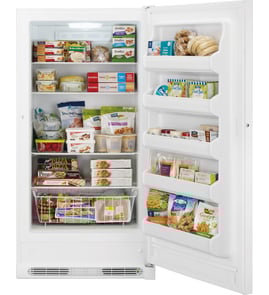



How long does a Kenmore upright freezer last?
A Kenmore upright freezer like model 11122182120 typically lasts 10 to 15 years. With steady temperatures, good airflow around the cabinet, and clean door gaskets, many units reach the high end of that range.
Typical lifespan and what affects it
Most upright freezers wear out due to compressor run time, heat load, and moisture getting into the cabinet.
- Room temperature and ventilation: hot garages and tight enclosures shorten life
- Door seal condition: leaks cause longer run times and frost buildup
- Defrost system health: heavy frost forces the unit to work harder
- Power quality: frequent outages or surges stress electrical components
- How full it stays: a reasonably full freezer holds temperature better than an empty one
What “end of life” usually looks like
These symptoms often show up as a freezer approaches the end of its service life.
| Symptom | What it often means | What to do first |
|---|---|---|
| Runs constantly | Air leak, dirty condenser area, weak cooling system | Check gasket seal and airflow; verify temperature setting |
| Warm temps, food softening | Cooling system or control issue | Keep door closed; move food to another freezer if needed |
| Heavy frost on walls/shelves | Door left ajar, gasket leak, defrost issue | Inspect gasket; reduce door openings |
| Clicking or buzzing, no cooling | Start device/compressor issue | Unplug for 5 minutes, then restart; monitor |
Steps that help your freezer last longer
We recommend these practical habits for the 11122182120.
- Keep the door closed as much as possible and avoid propping it open
- Allow proper cool-down time after plugging in (see the owner's manual)
- Do not overload with unfrozen food all at once; freeze in smaller batches
- Keep shelves and bins secure and avoid damage that can prevent a good door close
- After a power failure, keep the door closed to hold safe temperatures longer
Why it matters
A freezer that runs longer than necessary uses more electricity and is more likely to develop temperature swings that can cause freezer burn and shorten food storage times.
Last updated: February 2026
How to manually defrost an upright freezer?
To manually defrost your Kenmore upright freezer model 11122182120, move food to a cooler, unplug the freezer, and let the frost melt naturally; then wipe up water and restart the unit. This model is designed for automatic defrost, but manual defrost helps if interior wall frost builds up.
Manual defrost steps (safe and effective)
- Transfer frozen food to an insulated cooler (keep the door closed as much as possible).
- Turn the control off if your unit has that option, then unplug the freezer.
- Leave the door open to speed melting.
- Place towels at the base to catch water.
- Let frost melt, then wipe the interior dry with a towel.
- Plug the freezer back in and allow about 4 hours to cool before loading unfrozen food.
What not to do
- Do not chip ice with knives, screwdrivers, or sharp tools (it can puncture the liner or cooling surfaces).
- Do not use boiling water inside the cabinet.
- Do not use a heat gun or open-flame heat source.
Drainage and water cleanup (what to expect)
This freezer’s defrost water normally drains through a rear duct into a concealed pan at the base where it evaporates. During manual defrost, you may see water collect on the bottom; towels and a shallow pan help keep floors dry.
| Method | Time | Best for | Risk level |
|---|---|---|---|
| Door open, unplugged (natural melt) | 2 to 24 hours | Heavy frost | Lowest |
| Door open plus room fan blowing into cabinet | 1 to 8 hours | Moderate frost | Low |
| Warm (not hot) damp towels on frosted areas | 1 to 6 hours | Spot frost | Low |
Why it matters
Excess frost reduces usable space, restricts airflow, and can make the freezer run longer than normal. A careful manual defrost restores efficient cooling and helps protect stored food quality.
For model-specific operating details and control panel guidance, follow the 11122182120 owner's manual.
Last updated: February 2026
Where is the thermostat on a Kenmore upright freezer?
On Kenmore upright freezer model 11122182120, the temperature control (thermostat function) is typically on the front control panel on the outside of the freezer door, so you can adjust temperature without opening the door. For exact control locations and features, use the owner's manual.
What you will see on this model
The manual describes a door-mounted control area used to set freezer temperature and features like lock and alerts.
- Front control panel is on the freezer door exterior
- “+” and “-” buttons adjust the set temperature
- A Lock function can prevent accidental changes
- High temp alert can indicate the freezer warmed up
- Door-open alarm can sound if the door is left open
Thermostat vs. defrost thermostat (important difference)
Many customers mean one of two parts when they say “thermostat.” Here is how to tell which one you are looking for:
| What you mean | What it does | Where it usually is |
|---|---|---|
| Temperature control (thermostat function) | Sets the target freezer temperature | On the exterior door control panel for this style |
| Defrost thermostat (bi-metal) | Helps control the defrost heater cycle to prevent overheating | Inside the cabinet, clipped to evaporator tubing behind an interior panel |
If you are trying to replace a defrost thermostat
On upright freezers, the defrost thermostat is commonly behind the rear interior panel near the evaporator coil. Access typically involves removing shelves/bins, taking out the interior panel screws, and carefully moving the panel to reach the evaporator area.
- Unplug the freezer before opening panels
- Protect the evaporator fins; they bend easily
- Do not chip ice with sharp tools
- Take a photo of wire routing before disconnecting anything
- If wires look damaged, repair them correctly before reassembly
Why it matters
If the freezer is too warm or too cold, you troubleshoot the temperature control/settings first. If the freezer ices up heavily or stops cooling after frost builds, you focus on the defrost system (defrost thermostat, heater, and related wiring).
Last updated: February 2026
Is there a reset button on a Kenmore upright freezer?
Kenmore upright freezers like model 11122182120 typically do not have a single dedicated “reset” button. Most reset-type fixes are done by unlocking the control panel and reselecting settings, or by power-cycling the freezer to clear a temporary control glitch (see the control instructions in the owner's manual).
What to try first (safe reset steps)
- Power-cycle reset: unplug the freezer (or switch the breaker off), wait 5 minutes, then restore power.
- Unlock the controls: press and hold Mode for 3 seconds to unlock, then adjust settings.
- Re-lock after changes: press and hold Mode for 3 seconds to lock (some versions use a Lock button).
- Wait for stabilization: after changing temperature, allow 24 hours for temperatures to fully stabilize.
- Use Quick Freeze only when needed: it can run up to 50 hours and targets about -8°F (-22°C) internally.
Control-panel “reset” vs. a true reset button
A “reset” on this Kenmore upright freezer is usually one of these actions:
| What you do | What it affects | When it helps |
|---|---|---|
| Unplug for 5 minutes | Control board and display | Display glitches, unresponsive keys |
| Unlock with Mode (3 seconds) | Lets you change settings | Panel seems stuck or won’t change temp |
| Re-select temperature | Setpoint only | Temps were accidentally changed |
Why it matters
If the panel is locked, it can look like the freezer is “not responding,” even though it is running normally. Unlocking the controls and confirming the set temperature prevents unnecessary part replacement and helps restore normal operation faster.
Last updated: February 2026
How to tell how big a freezer is upright?
An upright freezer’s “size” is defined by its storage capacity (cubic feet) and its exterior dimensions (height, width, depth). For Kenmore model 11122182120, use the capacity and specification information in the 11122182120 owner's manual to identify the exact cubic feet and the footprint you need.
What “big” means for an upright freezer
You will see size described in a few practical ways:
- Capacity (cu. ft.): total storage volume rating
- Exterior dimensions (in.): how much space it takes in the room
- Door swing clearance: space needed to open the door fully
- Usable layout: shelves, door bins, and drawer bins affect how much you can actually store
How to measure the exterior size (fit in your space)
Measure with the door closed, then plan clearance.
- Measure width at the widest point (often the hinge side)
- Measure height from floor to top (include hinges if they stick up)
- Measure depth front to back (include handle if it protrudes)
- Add clearance for airflow behind and above, and for door swing
Quick exterior checklist
| Measurement | What to include | Why it matters |
|---|---|---|
| Width | cabinet plus hinges | prevents rubbing on walls/cabinets |
| Depth | cabinet plus handle | avoids blocking walkways |
| Height | cabinet plus hinge cover | ensures it fits under shelves |
How to estimate capacity (if you only have measurements)
Capacity is normally listed by the manufacturer, but you can estimate interior volume:
- Measure interior height, width, depth (in inches)
- Multiply to get cubic inches
- Divide by 1,728 to convert to cubic feet
Conversion table
| If you have | Convert to | Math |
|---|---|---|
| Cubic inches | Cubic feet | ÷ 1,728 |
| Cubic feet | Cubic inches | × 1,728 |
Why it matters
Capacity helps you compare storage volume, but exterior dimensions and door clearance determine whether the upright freezer fits your space and opens comfortably.
Last updated: February 2026