Owner’s manual
 Error Codes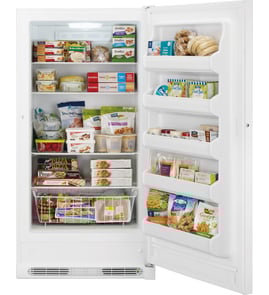



How do you reset a Kenmore stand up freezer?
For the Kenmore KRFU018AWD0 upright freezer, a practical “reset” is a power reset: unplug the freezer for 5 minutes, then plug it back in and allow about 4 hours to fully cool. Use the control panel to unlock and reselect your temperature setting as needed (see the owner's manual).
Quick reset steps (recommended)
- Unplug the freezer (or switch the circuit breaker off).
- Wait 5 minutes.
- Plug it back in (or turn the breaker on).
- Confirm the Power On light is on.
- Let the freezer run for 4 hours before adding unfrozen food.
- Recheck the temperature setting after the unit stabilizes.
If the controls will not change settings
This model uses a lock function on the control panel. If the panel is locked, temperature buttons will not respond.
- Unlock: press and hold Mode for 3 seconds until the Lock icon blinks and turns off.
- Lock: press and hold Mode for 3 seconds until the Lock icon stays on.
- The panel can auto-lock after about 20 seconds of no button presses.
Temperature settings you can select
On KRFU018AWD0, pressing Mode cycles the freezer temperature setting.
| Setting | Approx. °F | Approx. °C |
|---|---|---|
| Cold | 6°F | -15°C |
| Colder | 0°F | -18°C |
| Coldest | -6°F | -21°C |
Why it matters
A power reset clears minor control glitches and restarts the cooling cycle. Unlocking the panel prevents “false” no-response symptoms that look like a failed control when it is simply locked.
Last updated: February 2026
Where is the model number on a Kenmore upright freezer?
On the Kenmore upright freezer model KRFU018AWD0, the model and serial number label is located on the lower left wall inside the appliance. You can confirm the exact label location and cleaning guidance in the owner's manual.
Where to look first (fastest check)
- Open the freezer door and look along the left interior wall
- Focus on the lower section of that wall (near the bottom)
- Look for a serial plate or rating label with model and serial fields
- Use a flashlight; labels can be easier to read at an angle
If you still do not see it
Some upright freezers also place identification labels in other common spots. Check these areas next:
- Inside the cabinet near the front frame (around the door opening)
- Behind the kick plate (lower front grille area)
- On the back exterior panel
How to read and care for the label
The model number is what we use to match the correct Kenmore parts diagrams and compatible replacement parts.
| What you need | What it’s used for | Where it appears |
|---|---|---|
| Model number | Finding the correct parts list and diagrams | On the serial plate/label |
| Serial number | Identifying production details for service records | On the same label |
- Write the model and serial number down for future reference
- Clean the serial plate using soap and water only
- Avoid abrasive cleaners that can remove printed characters
Why it matters
Using the exact model number (like KRFU018AWD0) prevents ordering the wrong shelves, door bins, controls, or electrical parts, since similar Kenmore upright freezer models can use different components.
Last updated: February 2026
How to tell cubic feet of Kenmore refrigerator by model number?
For Kenmore model KRFU018AWD0, the capacity is 18 cu. ft. (this model is an upright freezer, not a refrigerator). The fastest way to confirm cubic feet by model number is to match your exact model to the capacity listed in the owner's manual.
Quick ways to find cubic feet by model number
- Check the rating label inside the cabinet for the full model number (letters and numbers matter).
- Match the model number to the capacity listed in the manual or spec information.
- If you only have dimensions, calculate an estimate using interior measurements.
- Use the serial/model record section in the manual to ensure you are using the exact model.
Capacity for common Kenmore K*FU upright freezer models
These capacities are listed in the same Use & Care Guide family as KRFU018AWD0.
| Model family (example) | Listed capacity |
|---|---|
| K*FU015AWD# | 15 cu. ft. |
| K*FU018AWD# | 18 cu. ft. |
| KFU021AWD# / KFU021AWE# | 21 cu. ft. |
If you need to estimate capacity from measurements
If you are working with a refrigerator (or you cannot access the manual), we use this standard volume conversion:
- Measure interior height, width, and depth in inches
- Multiply:
H x W x D = cubic inches - Divide by 1,728 to convert to cubic feet
Example
If the interior measures 60 x 24 x 20 inches:
- 60 x 24 x 20 = 28,800 cubic inches
- 28,800 / 1,728 = 16.7 cu. ft. (approx.)
Why it matters
Cubic feet helps you compare storage space, choose the right replacement shelves/bins, and set realistic expectations for how much food the freezer or refrigerator can hold.
Last updated: February 2026
How do I know if my compressor is bad in my Kenmore freezer?
If your Kenmore KRFU018AWD0 upright freezer is warm and the compressor runs constantly, trips the breaker, or makes abnormal noises, the compressor or its start components may be failing. Use the troubleshooting steps in the owner's manual to rule out airflow, door-seal, and control-setting issues first.
Quick checks before blaming the compressor
These items commonly cause “not cold enough” symptoms even when the compressor is OK:
- Confirm the temperature control is set colder; allow several hours for temperatures to stabilize.
- Make sure the door is closing and sealing fully; warm air leaks can mimic compressor failure.
- Reduce door openings; frequent openings quickly warm the cabinet.
- Avoid loading hot food; it forces longer run times.
- If the freezer was unplugged, allow about 4 hours to cool down completely after plugging back in.
What’s normal vs. not normal
The manual notes that some compressor-related sounds and heat can be normal during operation.
| What you notice | Often normal | More likely a problem |
|---|---|---|
| Low hum while running | Yes | No cooling even after hours |
| Brief louder start-up sound | Yes | Loud clicking repeatedly (start attempts) |
| Bubbling or gurgling | Yes (refrigerant moving) | Breaker trips when compressor starts |
| Warm exterior walls | Yes (can feel noticeably warm) | Compressor extremely hot and unit stays warm |
How to confirm a likely compressor issue
A compressor is more likely at fault when these are true at the same time:
- The freezer stays too warm after the 4-hour cool-down period.
- The door seal is good and the door is not being left open.
- The control is set correctly and you have not recently loaded warm food.
- You hear repeated start attempts (clicking) or the unit trips the circuit breaker.
Why it matters
Replacing a compressor is a sealed-system repair and is typically more involved than replacing electrical parts like a relay, overload, or thermostat. Doing the basic checks first prevents unnecessary repairs and helps you decide whether to schedule service.
Last updated: February 2026
How long does a Kenmore upright freezer last?
A Kenmore upright freezer like model KRFU018AWD0 lasts 10 to 15 years. With steady temperatures, good airflow around the cabinet, and clean door gaskets, many upright freezers reach the upper end of that range.
Typical lifespan and what affects it
Most of the wear happens in the sealed cooling system and the compressor run time. These factors have the biggest impact:
- Room temperature and ventilation (hot garages and tight enclosures shorten life)
- Door openings and loading habits (warm food and frequent openings increase run time)
- Door seal condition (air leaks cause frost and longer cycles)
- Defrost and airflow (blocked vents and heavy frost strain the system)
- Power quality (outages and surges increase stress on electrical components)
Quick care checklist to help it reach 15 years
Use these habits to reduce compressor run time and prevent frost issues:
- Keep the freezer level so the door seals evenly.
- Allow about 4 hours for the freezer to cool fully after plugging it in before loading unfrozen food.
- Freeze fresh food in smaller batches; a common guideline is about 3 lb per cubic foot at one time.
- Keep the door closed during outages; food typically stays frozen at least 24 hours if the door stays shut.
- Clean the interior and keep bins and shelves seated correctly so the door closes completely.
What “end of life” usually looks like
If you are deciding whether to repair or replace, these symptoms usually signal major wear:
| Symptom | What it often points to | What to do first |
|---|---|---|
| Runs constantly, temps still warm | Air leak, airflow restriction, or sealed-system wear | Check door seal and interior airflow; confirm control settings |
| Heavy frost buildup | Door not sealing, frequent openings, humid air intrusion | Inspect gasket and door alignment |
| Clicking, then no cooling | Start device or compressor issue | Unplug, wait a few minutes, then retry; plan a diagnosis |
Why it matters
A freezer that is running longer than normal uses more electricity and can struggle to keep food safely frozen. Keeping the door sealed and the load managed helps the freezer maintain stable temperatures with less strain.
For model-specific operating and care details, use the owner's manual.
Last updated: February 2026