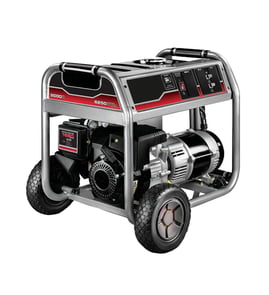

Can a 3500 watt generator run a house?
A Generac 3500XL (3,500-watt class) generator can run selected household essentials, but it will not run an entire typical house at once. We recommend powering only a few priority circuits and managing starting watts so you do not overload the generator.
A 3,500-watt portable generator is best for “survival loads” and short outages.
- Refrigerator or freezer (one at a time)
- A few LED lights
- TV, modem/router, phone chargers
- Small fan
- Microwave or coffee maker (often one at a time)
These loads commonly exceed capacity, especially at startup.
- Central air conditioning
- Electric water heater
- Electric range/oven
- Electric dryer
- Well pump or large sump pump (depends on size)
Many motors need extra power for a few seconds to start. Plan for both numbers.
| Appliance type | Typical running watts | Typical starting watts |
|---|---|---|
| Refrigerator/freezer | 150 to 800 | 800 to 2,200 |
| Sump pump (small) | 800 to 1,200 | 1,500 to 3,000 |
| Microwave | 900 to 1,500 | 900 to 1,500 |
| Space heater | 1,500 | 1,500 |
We recommend using a proper transfer method so you are not backfeeding power.
- Use a transfer switch or interlock kit installed to local code
- Use heavy-duty outdoor-rated cords sized for the load
- Start the generator first, then add loads one at a time
- If the engine bogs down or breakers trip, reduce load immediately
Overloading a generator can trip the circuit breaker, cause low voltage that damages electronics, and shorten engine life. Good load management keeps your Generac 3500XL stable and safer to use.
For electrical troubleshooting (no output, tripping, intermittent power), a common first check is the generator breaker and related wiring; see cir break 706178 if you need the correct breaker for this model.
Last updated: January 2026
What are the most common issues with 3500XL?
The most common issues we see on the Generac 3500XL generator are no-start or hard-start problems, surging or hunting at idle, and low or no AC output. These usually trace to fuel delivery (carburetor), ignition or starting components, or the generator head electrical parts.
- Won’t start / starts then dies: stale fuel, clogged carburetor jets, restricted fuel flow, fouled spark plug
- Surges at no-load or light load: dirty carburetor, governor linkage issues, air leak at a gasket
- No AC power or weak output: worn brushes, tripped breaker, bad switch, loose wiring
- Pull cord problems: frayed rope, recoil not retracting smoothly
- Runs rough under load: fuel restriction, ignition miss, low compression (engine wear)
- Reset output protection: check the breaker and outlets; a tripped breaker is a common “no power” cause.
- Confirm fresh fuel: drain old fuel and refill; old gasoline causes hard starting and surging.
- Inspect the air intake and linkage: make sure the throttle and governor move freely.
- Check for spark and basic wiring condition: look for damaged insulation, loose terminals, or corrosion.
- If it still won’t run cleanly: plan on cleaning or replacing the carburetor.
| Symptom | Common fix | Example part on this model page |
|---|---|---|
| Hard start, surging, won’t stay running | Clean/replace carburetor | Carb 0836660SRV |
| No/low AC output | Inspect/replace generator brushes | Brush assembly 0663860SRV |
| No output on one/both receptacles | Check breaker and switch | Cir break 706178, switch 0D9235BSRV |
| Pull cord frayed or broken | Replace starter rope/handle | Rope&hndle 095268ASRV |
A 3500-watt class portable generator like the Generac 3500XL depends on stable engine speed for correct voltage and frequency. Fuel or governor issues cause surging; brush or breaker issues cause “runs fine but no power.” Fixing the root cause prevents damage to connected loads.
Last updated: March 2026
What is the average lifespan of 3500XL?
A Generac 3500XL portable generator typically lasts 10 to 15 years with normal homeowner use and consistent maintenance. In run-time terms, many units reach 1,000 to 2,000 hours before major engine or alternator work becomes likely.
- Oil change frequency and correct oil level (low oil shortens engine life fast)
- Load level (running near max output continuously increases wear)
- Fuel quality and storage (stale fuel and varnish damage the carburetor)
- Operating environment (dust, moisture, and heat accelerate wear)
- Storage habits (dry storage, stabilized fuel, and periodic exercise runs help)
- Change oil on schedule; check level before each use
- Keep the air intake and cooling fins clear of debris
- Drain or stabilize fuel for storage; clean the tank cap area
- Inspect electrical output components if power becomes unstable (brushes, breaker, switch)
- Replace worn starting components if recoil becomes hard to pull
| What you’re dealing with | Typical symptom | Example part on this model page |
|---|---|---|
| Fuel delivery issue | Surging, won’t stay running | Carb 0836660SRV |
| Output wear item | Low/unstable voltage | Brush assembly 0663860SRV |
| Protection/control | No power at outlets, trips | Cir break 706178 |
| Starting system | Rope won’t retract, hard start | Rope&hndle 095268ASRV |
Generator lifespan is mostly about preventing avoidable damage: dirty fuel and low oil cause the most expensive failures. Replacing smaller parts early often prevents a no-start situation during an outage.
Last updated: March 2026