Error Codes





What is the 3 minute rule for air conditioners?
The 3-minute rule means waiting at least 3 minutes after turning your GE APCD08JASWG1 room air conditioner off before turning it back on. That short pause lets refrigerant pressures equalize, which helps prevent hard starts, nuisance shutdowns, and long-term compressor damage.
When an air conditioner stops, refrigerant pressure can remain uneven for a short time. Restarting immediately can force the compressor to start under load, which increases electrical stress and heat.
Benefits of waiting 3 minutes:
- Reduces the chance of compressor overload trips
- Helps prevent short cycling (rapid on and off operation)
- Lowers strain on the start components and control board
- Improves reliability during thermostat or power interruptions
Use the 3-minute rule any time the unit stops unexpectedly or you shut it off yourself.
Common situations:
- You changed modes (Cool to Fan, Fan to Cool)
- Power flickered or the unit was unplugged and plugged back in
- You adjusted the temperature and the unit stopped, then you want it running again
- The unit shut off due to a full internal water tank (portable AC behavior)
Many portable room ACs include a built-in compressor time delay. Even if you press ON right away, the fan may run while the compressor waits.
| What you see | What it usually means | What to do |
|---|---|---|
| Fan runs but no cold air yet | Compressor delay is active | Wait 3 minutes |
| Unit clicks, then stops | Compressor tried to start under load | Turn off, wait 3 minutes, restart |
| Repeated quick restarts | Short cycling risk | Stop adjusting settings, let it stabilize |
A restricted filter can make the unit run hotter and cycle more often.
- Clean or replace the air filters on schedule
- Make sure the exhaust hose and window kit are sealed and not kinked
- Keep the unit a few inches from walls and curtains for airflow
If you need replacements for this model, we stock the upper filter WJ85X27854 and lower filter WJ85X27855.
Last updated: January 2026
Do all portable air conditioners need to be vented out a window?
Most portable air conditioners, including typical setups for GE model APCD08JASWG1, need to vent hot air to the outdoors, usually through a window kit. Without venting, the unit will recirculate heat back into the room and cooling performance drops fast.
A portable AC removes heat from the room; that heat has to go somewhere. In most designs, the exhaust hose carries that heat outside.
Common signs your unit is designed to be vented:
- It has an exhaust hose connection on the back
- It includes a window slider panel and hose adapter
- The room feels humid or warm around the unit when the hose is off
- Cooling is weak even though the compressor runs
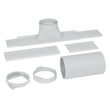
If you need the correct venting hardware for this model, use the portable ac window kit RAP01.
Some products marketed as “portable cooling” are not true air conditioners.
Here is what typically does and does not need venting:
| Product type | Needs window vent? | What it actually does |
|---|---|---|
| Portable air conditioner (single-hose or dual-hose) | Yes | Moves heat outdoors through an exhaust hose |
| Evaporative cooler (swamp cooler) | No | Uses water evaporation; adds humidity |
| Fan | No | Moves air only; does not lower air temperature |
Both styles vent outdoors, but they behave differently.
- Single-hose: vents hot air out; can pull some indoor air out of the room
- Dual-hose: one hose brings in outside air, one exhausts; often cools more efficiently
- Either way: the window seal matters for comfort and energy use
If your hose or adapters are missing or damaged, the haier portable ac dual hose kit RAP02 can be a fit for dual-hose configurations.
Proper venting is the difference between “cooling the room” and “running constantly while the room stays warm.” A tight window seal also helps reduce humidity and prevents hot outdoor air from leaking back in.
Last updated: January 2026
Is 1 ton AC enough for a 12X12 room?
Yes. For a 12 x 12 room (144 sq ft), a 1-ton air conditioner is typically more than enough cooling capacity; most rooms this size do well with roughly 5,000 to 8,000 BTU. With a GE portable room A/C like model APCD08JASWG1, correct venting and clean filters matter as much as raw tonnage.
Most 12 x 12 bedrooms and offices cool best when the unit is sized to the room and the heat load.
- Typical target for 144 sq ft: 5,000 to 8,000 BTU
- 1 ton equals about 12,000 BTU, which is usually oversized for 144 sq ft
- Oversizing can cause short cycling (frequent on/off) and weaker humidity removal
- Undersizing can run constantly and still feel warm
- Portable A/C performance depends heavily on exhaust setup and air leaks
Use these common “load” factors to decide whether you should size up or stay closer to the typical range.
| Room condition | Cooling load impact | What to do |
|---|---|---|
| Strong afternoon sun, west-facing windows | Higher | Consider the upper end of the BTU range |
| Poor insulation or lots of air leaks | Higher | Seal gaps; improve venting |
| Many occupants or heat-producing electronics | Higher | Add capacity or reduce heat sources |
| Humid climate | Higher | Prioritize steady run time and good dehumidification |
If your APCD08JASWG1 is not keeping up, these fixes often help more than buying a larger unit.
- Clean or replace the filters; a clogged filter restricts airflow (see upper filter WJ85X27854 and lower filter WJ85X27855)
- Make sure the window vent kit fits tightly and is sealed (see portable ac window kit RAP01)
- Keep the exhaust hose as short and straight as possible
- Close doors to isolate the room; block sunlight with curtains
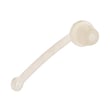
- Drain water as needed so the unit can run efficiently (see drain plug WJ01X26226)
Right-sizing helps the A/C run longer, steadier cycles, which improves comfort, humidity control, and energy use. For a small 12 x 12 room, focusing on airflow, filtration, and tight venting usually delivers the biggest improvement.
Last updated: January 2026
What is the average cost of a whole house air conditioner?
A whole-house (central) air conditioner typically costs $6,000 to $10,000 installed for many homes, with real-world totals ranging from about $3,000 to $20,000+ depending on system type, home size, efficiency, and ductwork. This is separate from your GE APCD08JASWG1 portable room A/C.
- System type: central A/C vs. heat pump vs. ductless mini-split
- Home size and load: tonnage (capacity) and number of zones
- Efficiency rating: higher efficiency usually costs more up front
- Ductwork condition: repairs, sealing, or full replacement can add a lot
- Electrical and pad work: disconnect, breaker, line set, condenser pad
- Labor and permits: varies by region and complexity
| System type | Typical installed range | Best fit for |
|---|---|---|
| Central A/C (split system) | $6,000 to $10,000 | Homes with existing ducts |
| Heat pump (heating + cooling) | $7,000 to $15,000 | All-in-one comfort upgrade |
| Ductless mini-split | $3,000 to $20,000+ | No ducts, additions, zoned rooms |
- Start with your square footage and number of floors
- Note whether you have existing ductwork and its condition
- Decide if you want single-stage, two-stage, or variable-speed comfort
- Ask contractors for an in-home load calculation (not just “same size as before”)
- Compare quotes that list equipment model, labor scope, and warranty
A correctly sized, properly installed system controls humidity, runs efficiently, and avoids short-cycling. The biggest cost swings usually come from ductwork and installation complexity, not just the outdoor unit.
If you are budgeting because your portable unit is missing accessories, these model-matched parts can help restore performance:
Last updated: January 2026