 Owner’s manual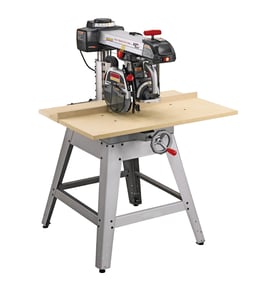


Are radial arm saws worth anything?
Yes. A Craftsman radial arm saw like model 11329461 can be worth money and worth keeping if it is complete, runs smoothly, and can be tuned to cut accurately. Most value comes from condition, included accessories (guard, fence, table), and how well the arm and carriage lock and index.
What drives the value of a used radial arm saw
- Completeness: blade guard, anti-kickback parts, sawdust chute, fence, and table boards present
- Accuracy and indexing: the arm should lock solidly and hit positive stops at 0° and 45° left/right
- Smooth travel: carriage rolls without binding; no excessive play
- Motor health: starts quickly, reaches speed, no burning smell, no heavy sparking
- Safety condition: guard fits and stays in place; switches and wiring are intact
Quick condition check (what we look at first)
| Check | What “good” looks like | What lowers value fast |
|---|---|---|
| Arm lock and latch | Locks firmly; repeatable 0° and 45° stops | Slips, won’t index, damaged lock pin behavior |
| Carriage movement | Smooth pull for crosscuts | Jerky travel, loose bearings, excessive wobble |
| Guard and feed direction parts | Guard present and usable | Missing guard or anti-kickback components |
| Table and fence | Flat, secure, fence straight | Broken table, missing fence, warped surfaces |
Why safe setup matters (and affects “worth”)
This saw is capable of rotating the arm through a full range, but it should never be operated with the blade outside the table area. For ripping, the workpiece is fed from the sawdust chute side, not from the anti-kickback side. Those safety basics protect you and also protect the saw from damage that can ruin accuracy. See the owner's manual for the arm-latch controls, indexing technique, and operating requirements.
Tips to get the most value from your 11329461
- Clean and wax the arm ways and table surface
- Verify the arm locks tightly before cutting
- Use the correct blade type and keep the arbor nut tight
- Keep the guard in place except when an operation requires removal, then reinstall it
- Remove loose cutoffs immediately so they cannot contact the back of the blade
Last updated: February 2026
What are the most common issues with 11329461?
The most common issues we see with the Craftsman 11329461 10-inch accra-arm radial saw involve cut accuracy (won’t stay square), rough or hard sliding travel on the arm, and electrical problems such as a motor that won’t start or trips a breaker. The 11329461 owner's manual helps confirm alignment points and safe checks.
Common symptoms and likely causes
- Cuts aren’t square or repeatable: arm yoke or column alignment out of adjustment; fence not straight; table surface worn or uneven.
- Blade binds or burns wood: dull blade, incorrect blade type, misalignment, or feed rate too fast.
- Carriage doesn’t slide smoothly: dirty or dry tracks/rollers, pitch buildup, or worn bearings.
- Motor hums but won’t start: failed start capacitor (if equipped), stuck switch, or low voltage at the outlet.
- Trips breaker or blows fuse: shorted cord, damaged insulation, failing motor windings, or incorrect circuit size.
- Excess vibration: bent blade, loose arbor hardware, worn bearings, or saw not bolted down.
Quick checks we recommend (safe, high-value)
- Unplug the saw; lock the arm and carriage before touching anything.
- Inspect the power cord and plug for cuts, heat marks, or loose prongs.
- Verify the blade is sharp, clean, and installed correctly (proper rotation).
- Check fence straightness and table flatness; replace sacrificial surfaces if grooved.
- Confirm the saw is secured to a stable bench or stand; recheck fasteners.
- Clean sawdust and pitch from sliding surfaces; apply a light, dry lubricant where the manual allows.
Troubleshooting guide by symptom
| Symptom | Most common cause | Best next step |
|---|---|---|
| Won’t start | Switch, cord, capacitor | Test power and switch continuity; inspect wiring |
| Cuts out of square | Alignment drift | Perform full alignment procedure |
| Hard to slide | Dirty/worn rollers | Clean tracks; inspect rollers/bearings |
| Excess vibration | Blade/arbor/bearings | Swap blade; check arbor tightness |
Why it matters
A radial arm saw that is out of alignment or has electrical wear can create kickback risk and poor cut quality. Keeping the carriage travel smooth, the fence true, and the motor circuit healthy improves safety and accuracy.
For electrical diagnosis steps and safe disassembly guidance, use our how to use a multimeter to test electrical parts video.
Last updated: March 2026
What is the best brand of radial arm saw?
There is no single best brand for every shop; the best radial arm saw is the one that matches your work type, accuracy needs, and parts support. If you already own a Craftsman 11329461 10-inch Accra-Arm radial saw, keeping it properly adjusted and used correctly often matters more than switching brands.
How we recommend choosing a “best” radial arm saw brand
Use these practical filters first; they determine satisfaction more than the name on the badge:
- Use case: occasional DIY crosscuts vs. daily production cutting
- Accuracy expectations: how often you need repeatable miters and bevels
- Condition and completeness: guard, anti-kickback pawls, fence, table, and cord
- Serviceability: availability of wear parts (cord, guard components, switches, bearings)
- Safety features and habits: proper feed direction, guarding, and controlled pull-through
Brand and machine type comparison (what “best” usually means)
| What you want most | What to look for | Brand examples people commonly favor |
|---|---|---|
| Heavy-duty vintage build | Cast iron, tight arm/yoke locks, minimal play | DeWalt (older), Delta/Rockwell (older) |
| New, production-grade | Modern manufacturing, current parts pipeline | Original Saw Company, Maggi |
| Best value used | Solid design, common parts, lots of used inventory | Craftsman (older models like 113-series) |
Why setup and technique can beat brand
Your Craftsman 11329461 is designed for precision indexing and repeatable settings when you lock in adjustments consistently. The manual also calls out key safety technique, including feeding the work from the sawdust-chute side during ripping and using controlled, steady pull-through during crosscutting. For model-specific operating and adjustment details, use the 11329461 owner's manual.
Quick checks that improve results on most radial arm saws
- Confirm the guard assembly is installed and moves freely
- Verify the anti-kickback pawls function during ripping setups
- Check the carriage travel for smooth movement without side play
- Square the fence and table to the blade path; replace worn table surfaces
- Use a sharp, correct 10-inch blade for the cut type (crosscut vs. rip)
Why it matters
Radial arm saw performance is mostly about rigidity, alignment, and safe feed control. A well-tuned saw with complete guarding and good technique produces cleaner, more accurate cuts than a “better brand” saw that is worn, missing safety parts, or out of adjustment.
Last updated: February 2026