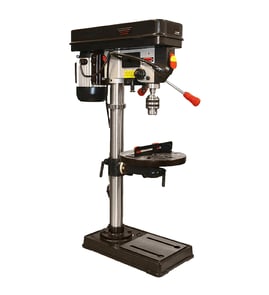

What are the parts of a drill press called?
Most drill presses (including Craftsman model 335259261) use the same core component names: the base and column support the machine, the table supports the workpiece, and the head contains the motor and drilling mechanism (quill, spindle, and chuck).
- Base: Heavy platform that stabilizes the drill press; often has slots for bolting down.
- Column: Vertical post that supports the head and table; keeps alignment.
- Table: Adjustable platform for supporting the work; may tilt and raise/lower.
- Table clamp or lock: Secures the table height and rotation on the column.
- Head: Upper housing that supports the drive system and quill assembly.
- Motor and drive (belt/pulleys or gears): Provides power and sets spindle speed.
- Quill: Sliding sleeve that moves up and down during drilling.
- Spindle: Rotating shaft inside the quill that drives the chuck.
- Chuck: Holds the drill bit (or other tooling).
- Feed handle (quill feed lever): The handle you pull to lower the quill.
- Depth stop: Limits how deep the bit can drill.
- On/off switch: Power control (often with a safety key).
| Part name | Where it is | Why it matters |
|---|---|---|
| Base | Bottom | Stability and accuracy |
| Column | Vertical post | Keeps head and table aligned |
| Table | Midsection | Supports workpiece and vise |
| Quill/spindle/chuck | Front of head | Controls drilling action and bit holding |
Knowing the correct part names helps you troubleshoot issues (wobble, runout, slipping belts, table drift) and match the right replacement components when you search diagrams and parts lists.
If you are identifying a specific component to replace, use our model number lookup tips in how to find your appliance model number (and what it means for parts) to confirm you are searching under 335259261.
Last updated: February 2026
How to repair a drill press spindle?
On the Craftsman 335259261 drill press stand, spindle repair typically means removing the quill assembly, replacing worn spindle bearings or the spindle itself, then reassembling and rechecking runout and chuck seating. This restores smooth rotation and reduces wobble during drilling.
- Unplug the drill press and remove the chuck key.
- Lower the table or remove the workpiece and clamps.
- Mark the depth stop and quill return spring position so reassembly is easier.
- Take photos as you disassemble; it helps with washer and spacer order.
- Clean chips and dust from the head so debris does not enter bearings.
Most drill presses follow a similar sequence:
- Remove the chuck (often by lowering the quill and using a wedge/drift if applicable).
- Remove the quill retaining hardware (retaining ring, collar, or cap, depending on design).
- Slide the quill and spindle assembly out of the head.
- Separate the spindle from the quill and press off the bearing(s).
- Install new bearing(s) on the spindle, then reinstall the spindle into the quill.
- Reinstall the quill assembly, set the return spring tension, and verify smooth travel.
- Spindle bearings: roughness, play, noise, heat discoloration.
- Quill bore and spindle shaft: scoring, galling, rust.
- Pulley and belt alignment: wobble, set-screw tightness.
- Chuck and taper: dirt, nicks, or a loose-fitting taper.
| Symptom | Most likely cause | Typical fix |
|---|---|---|
| Wobble at the bit | worn bearings or dirty taper | replace bearings; clean taper and chuck |
| Grinding noise | failing bearing | replace bearing(s) |
| Quill sticks | debris or damaged quill bore | clean; inspect for scoring |
| Chuck falls off | taper not seated or damaged | clean and reseat; replace chuck if needed |
A worn spindle or bearing set can cause oversized holes, chatter, and premature bit wear. Fixing the spindle assembly improves accuracy and reduces vibration, which also protects the motor pulley and belt.
For help confirming you have the correct model number before ordering parts, use how to find your appliance model number (and what it means for parts).
Last updated: February 2026
What are 5 important rules for a drill press?
For the Craftsman 335259261 drill press stand setup, five must-follow drill press rules are: wear eye protection and avoid loose items, clamp the workpiece, remove the chuck key, use the correct speed, and control feed pressure (especially at breakthrough). These rules prevent injuries and improve hole accuracy.
- Wear safety glasses (and hearing protection when needed); tie back hair and remove jewelry.
- Clamp the workpiece in a vise or with clamps; never hold it by hand.
- Remove the chuck key immediately after tightening the bit.
- Set the correct spindle speed for the material and bit size before drilling.
- Feed smoothly; reduce pressure as the bit breaks through to prevent grabbing and tear-out.
| Check | What to do | Why it matters |
|---|---|---|
| Workholding | Clamp or vise the material | Prevents spinning and hand injuries |
| Bit condition | Use a sharp, straight bit | Reduces heat and wandering |
| Speed | Slower for larger bits and metal | Prevents overheating and breakage |
| Table height | Keep the bit travel short | Improves control and accuracy |
A drill press can grab the work and spin it instantly. Good workholding, correct speed, and removing the chuck key are the biggest preventers of sudden kick, broken bits, and damaged material.
If you are troubleshooting power, switches, or wiring on a drill press setup, we use these basics for safe electrical checks: how to use a multimeter to test electrical parts video.
Last updated: February 2026
How to change the chuck on a Craftsman drill press?
To change the chuck on your Craftsman drill press model 335259261, you typically remove the chuck from its taper (or arbor), then seat the replacement chuck firmly back onto the taper. The key is using the correct removal method for your chuck style and pressing the new chuck on straight so it runs true.
- Unplug the drill press (or lock out power) before touching the spindle or chuck.
- Lower the quill and lock it if your drill press has a quill lock.
- Open the chuck jaws fully so you can access the inside.
- Clean the taper surfaces (spindle taper and chuck/arbor taper) with a clean, dry rag.
- Avoid oil or grease on tapers; it can make the chuck slip.
Most drill presses use one of these setups:
| Chuck type | How it attaches | How it usually comes off |
|---|---|---|
| Taper-fit chuck (Jacobs-style) | Pressed onto a taper (often with an arbor) | Wedges or a sharp downward “pop” method |
| Threaded chuck | Screws onto a spindle | Unscrews (often with a set screw) |
- Lower the quill until you can access the chuck and spindle area.
- If your drill press has a drift slot in the quill/spindle, align the slot and insert a drift key/wedge, then tap it to pop the arbor/chuck loose.
- If there is no drift slot, support the chuck and use the manufacturer-recommended wedge method for your chuck/arbor style.
- Seat the chuck onto the taper by hand first, keeping it straight.
- Press it on firmly by pushing the chuck upward against a block of wood on the table (or by applying steady upward pressure with the quill feed).
- Verify it is fully seated by lightly pulling down; it should not drop off.
- Spin the chuck by hand and watch for wobble.
- Tighten a straight drill bit and run the press at low speed; stop if you see heavy wobble.
- If it wobbles, remove it, re-clean the tapers, and reseat it.
A properly seated chuck improves drilling accuracy, reduces vibration, and helps protect the spindle bearings and quill from unnecessary wear.
For general repair readiness and the right hand tools for jobs like this, use our guide: must have tools for appliance repair.
Last updated: February 2026