Owner’s manual
 Error Codes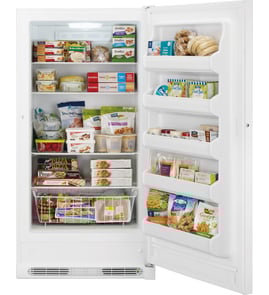




What is the average lifespan of an upright freezer?
An upright freezer typically lasts 10 to 15 years, and that’s a solid expectation for the Criterion CUF208WD1W as well. Lifespan depends most on compressor run time, ventilation/cleanliness, and how well the door gasket seals; consistent care can push service life toward the high end.
What affects lifespan the most
- Room temperature and ventilation: keep airflow clear around the cabinet so the compressor does not overwork.
- Door seal condition: a leaking gasket causes longer run times and heavier frost.
- How often the door is opened: frequent openings add moisture and heat load.
- Cleaning habits: keeping the interior and exterior clean helps efficiency.
- Power quality: repeated outages or low voltage can stress the compressor.
Care steps that help your CUF208WD1W last longer
We recommend following the maintenance and setup guidance in the CUF208WD1W use & care guide.
- Leave proper clearance around the freezer for air circulation.
- Keep the door closed as much as practical; organize food to reduce “search time.”
- Clean interior surfaces with mild solutions (avoid harsh abrasives).
- Level the freezer so the door aligns and seals correctly.
- If frost builds up on interior walls, remove food, unplug, let frost melt, and wipe dry.
Quick lifespan expectations
| Item | Typical range | What usually shortens it |
|---|---|---|
| Upright freezer overall | 10–15 years | Poor airflow, warm location, bad door seal |
| Compressor (major driver) | 10–15 years | Overheating, frequent cycling, power issues |
Why it matters
A freezer that runs longer than necessary uses more electricity and can struggle to hold safe temperatures. Good airflow, a tight door seal, and routine cleaning reduce compressor strain and help protect frozen food quality.
Last updated: January 2026
Is it worth getting an upright freezer?
An upright freezer is worth it when you want fast access and better organization; for the Criterion CUF208WD1W upright freezer, shelves, door bins, and drawer bins make it easier to see and separate foods than a chest freezer. The main tradeoffs are higher cost and needing door-swing clearance.
Upright freezer benefits (why many people choose them)
- Easier to find items quickly because food is stored on shelves at eye level
- Better day-to-day organization using shelves, door bins, and drawer bins
- Less “digging” and fewer forgotten items at the bottom
- Typically easier to keep categories separated (meat, vegetables, prepared meals)
- Convenient for frequent access in kitchens, garages, or basements
Upright freezer drawbacks to consider
- Usually costs more than a similar-capacity chest freezer
- Needs space in front for the door to open (and for you to stand there)
- Can lose cold air faster during long door-open times
- If the door is not sealing well, you can see more frost or temperature swings
Quick comparison: upright vs chest
| Feature | Upright freezer (like CUF208WD1W) | Chest freezer |
|---|---|---|
| Organization | Strong (shelves/bins) | Moderate (baskets help) |
| Footprint | Narrower, but needs door clearance | Often larger footprint, no door swing |
| Access | Fast, eye-level | Slower, requires digging |
| Cost | Typically higher | Typically lower |
Why it matters
If you open your freezer often and want to reduce food waste, an upright freezer is usually the better “everyday use” choice. If you want maximum storage per dollar and you rarely access it, a chest freezer often wins.
For model-specific features like temperature settings, door swing reversal, and clearance guidance, use the CUF208WD1W use & care manual.
Last updated: January 2026
Which is cheaper to run, chest freezer or upright freezer?
In most homes, a chest freezer is cheaper to run than an upright freezer because it typically loses less cold air when opened and often has simpler airflow. Your Criterion CUF208WD1W is an upright freezer; its exact operating cost depends on room temperature, usage habits, and settings in the CUF208WD1W use & care manual.
Why chest freezers often cost less to operate
Chest freezers usually have an efficiency advantage because cold air naturally “stays low” when the lid is opened.
- Less cold air spills out during door openings
- Often fewer air leaks around the lid compared to tall doors
- Typically less frost and moisture intrusion from frequent access
- Can hold temperature longer during short power outages
- Often used as “bulk storage,” so the lid is opened less often
What matters most for your CUF208WD1W (upright freezer)
Even though uprights can cost a bit more to run, you can narrow the gap with good setup and habits.
- Keep the door closed as much as possible; frequent openings add run time
- Place the freezer in a cooler, well-ventilated area (avoid heat sources)
- Maintain proper clearances for airflow around the cabinet
- Use the temperature control settings appropriately (avoid “coldest” unless needed)
- Keep the door gasket clean so it seals tightly
Quick comparison
| Feature | Chest freezer | Upright freezer (like CUF208WD1W) |
|---|---|---|
| Typical energy use | Lower | Slightly higher |
| Organization/access | Harder to sort | Easier shelves and bins |
| Cold air loss when opened | Lower | Higher |
| Footprint | Wider | Taller, narrower |
Why it matters
Over a year, small efficiency differences add up. Choosing the right style and using good energy-saving habits can reduce compressor run time, help food stay safely frozen, and lower your electric bill.
Last updated: January 2026
What is the difference between an upright freezer and a garage ready upright freezer?
An upright freezer is defined by its vertical, front-opening design and shelving. A “garage-ready” upright freezer is a model specifically designed and marketed to maintain safe freezing performance across wider garage temperature swings. For Criterion CUF208WD1W, we can confirm placement temperature guidance from the CUF208WD1W use & care manual, but the manual does not label this model as “garage-ready.”
What “garage-ready” means in practical terms
“Garage-ready” is a manufacturer label, not a universal standard. In general, it indicates the freezer is intended to operate reliably when the surrounding air gets hotter or colder than typical indoor conditions.
Common differences you may see in garage-ready models:
- Wider rated ambient temperature range
- Controls and sensors tuned for large temperature swings
- Better cold-weather reliability (less risk of temperature drift)
- Design changes such as insulation, airflow, or control strategy (varies by brand)
What we can confirm for Criterion CUF208WD1W
The CUF208WD1W Use & Care Guide gives specific installation guidance:
- For efficient operation, locate it where surrounding temperatures will not exceed 110°F (43°C)
- It states 32°F (0°C) and below will not affect appliance operation
- It recommends clearances for airflow (back/top/sides)
Those statements help you decide if your garage conditions fit this model’s intended operating environment, but they are not the same as the product being marketed as “garage-ready.”
Quick comparison
| Item | Upright freezer | Garage-ready upright freezer |
|---|---|---|
| Primary meaning | Vertical freezer design | Manufacturer-rated for wider ambient temps |
| Where it is intended to work best | Typical household environments | Garages, workshops, variable-temp spaces |
| What to verify | Capacity, features, clearances | Ambient temp rating and manufacturer claims |
Why it matters
Ambient temperature affects compressor run time, energy use, and the freezer’s ability to hold safe food temperatures. Matching your garage’s real temperature extremes to the model’s guidance helps prevent inconsistent freezing.
Last updated: January 2026