Owner’s manual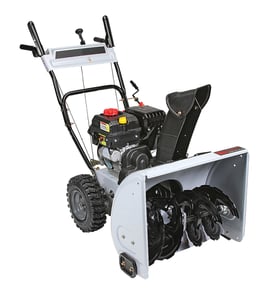



How many years should a snowblower last?
For the Craftsman CMXGBAM1054544 gas snowthrower, the operator guidance lists an average useful life of 7 years (or about 60 hours of operation). With consistent maintenance and proper off-season storage, many gas snowblowers can continue running beyond that, but they should be inspected regularly for safe operation. See the CMXGBAM1054544 operator’s manual.
What “average useful life” means for this model
The 7-year or 60-hour figure is a safety and wear benchmark, not a hard stop date. It helps you plan inspections and maintenance as the machine ages.
- If you use the snowblower lightly (a few storms per year), 60 hours can take many seasons to reach.
- If you clear long driveways or heavy snow often, you can reach 60 hours much sooner.
- As the unit ages, cables, belts, bearings, and friction-drive parts typically need more attention.
How to help your snowblower reach its full lifespan
Good maintenance is what turns “average” life into long life.
- Use fresh fuel and store fuel correctly at season’s end.
- Change engine oil on schedule and before long storage.
- Keep the auger and drive controls adjusted so they fully disengage.
- Lubricate the hex (gear) shaft at least once per season or every 25 hours.
- Clear packed snow after use to reduce freeze-up and corrosion.
- Inspect fuel lines, tank, cap, and fittings for cracks or leaks.
Quick rule-of-thumb table
| Usage pattern | Typical time to reach 60 hours | What to do |
|---|---|---|
| Light (small area, occasional storms) | 7 to 15+ years | Focus on storage, oil changes, and inspections |
| Moderate (regular driveway use) | 4 to 8 years | Add mid-season checks of cables, friction drive, and shear pins |
| Heavy (long runs, frequent deep snow) | 2 to 5 years | Plan for more frequent wear-part replacement and annual inspection |
Why it matters
A snowblower can still “run” while key safety systems are worn. Following the maintenance and storage steps in the CMXGBAM1054544 operator’s manual helps prevent unsafe operation, poor throwing performance, and expensive drivetrain damage.
Last updated: January 2026
What is the most common problem with snow blowers?
For the Craftsman CMXGBAM1054544 gas snowthrower, the most common real-world problem is snow not discharging because the chute or auger area gets clogged. The manual also emphasizes that clearing clogs safely is critical because hand contact with the impeller inside the chute is a leading cause of injury; follow the steps in the CMXGBAM1054544 owner's manual.
Most common issues we see (and what they look like)
- Clogged chute assembly: snow packs in the discharge chute and output drops or stops.
- Foreign object in the auger: auger jams after hitting ice chunks, gravel, or a hidden object.
- Shear pin(s) sheared: engine runs but auger does not move snow effectively.
- Auger cable out of adjustment: auger engagement feels loose or inconsistent.
- Auger belt loose or damaged: auger slips under load or stops turning.
Quick checks you can do first (safe and fast)
- Shut the engine off and wait for all moving parts to stop before inspecting.
- Look for a packed chute and clear it using a clean-out tool (never your hand).
- Inspect the auger area for a jammed object.
- Check for broken shear pins and replace as needed.
- If the auger engages poorly, check cable adjustment guidance in the manual.
Troubleshooting guide (symptom to likely cause)
| Symptom | Most likely cause | Typical fix |
|---|---|---|
| Runs but won’t throw snow | Chute clogged | Clear chute with clean-out tool |
| Loud stop or jam | Object lodged in auger | Remove object after shutdown |
| Auger won’t turn | Shear pin(s) sheared | Replace shear pins |
| Weak auger engagement | Cable needs adjustment | Adjust auger control cable |
Why it matters
A clog is more than an inconvenience. It is the situation most associated with unsafe clearing attempts, and it can also lead to belt strain, shear pin failure, and poor throwing performance in wet or heavy snow.
Last updated: January 2026
How to find snowblower model number?
On a Craftsman gas snowthrower like model CMXGBAM1054544, the model number is printed on the machine’s identification label (not on the controls). We typically see it on the rear of the unit, often between the wheels, or on the back of the frame. Use the CMXGBAM1054544 owner's manual to confirm the exact label location for your build.
Where to look on the snowblower
Check these common label locations first:
- Rear of the snowblower frame, between the wheels
- Back of the housing near the engine mounting area
- Side of the frame rail near the axle
- Handle support area (lower handle tubes)
- Under a protective flap or near the belt cover (varies by model)
What the label usually shows
Most Craftsman snowblower ID labels include several numbers. Here’s how to use them.
| Label item | What it’s used for | Example |
|---|---|---|
| Model number | Identifies the exact machine for parts diagrams | CMXGBAM1054544 |
| Serial number | Identifies your specific unit | Varies |
| Engine info | Helps with engine-specific parts (spark plug, carburetor) | Varies |
Tips to read it accurately
A dirty or worn label is common on snow equipment.
- Wipe the label clean and use a flashlight at an angle
- Take a close-up photo and zoom in to read characters
- Write it down exactly, including letters and dashes
- Match the model number on the label to the model number you search
Why it matters
The model number controls which parts fit your snowblower, including wear items like the auger shear pin and drive components. For example, the manual for these Craftsman models calls out using the correct OEM shear pin, such as 738-04124A on many 2-stage designs.
Last updated: January 2026
How do I tell what year my Craftsman snowblower is?
The most reliable way to identify the year of your Craftsman gas snowthrower model CMXGBAM1054544 is to use the serial number from the product identification label; the serial number contains the manufacturing date code. Use the CMXGBAM1054544 operator’s manual to confirm label location and model family.
Step 1: Find the model and serial number label
On Craftsman snowblowers, the ID label is typically on the frame near the engine, on the rear of the unit, or near the auger housing.
- Look for a sticker or metal tag labeled Model and Serial
- Clean the label so every character is readable (snow, salt, grime)
- Write the serial number exactly as shown (letters and numbers)
- Take a clear photo for your records
Step 2: Use the serial number to determine the year
For outdoor power equipment, the serial number is what identifies the build date. The model number (CMXGBAM1054544) identifies the correct parts family, but it does not reliably encode the year by itself.
| Identifier | What it tells you | Best use |
|---|---|---|
| Model number (CMXGBAM1054544) | Parts and diagram match | Ordering the correct Craftsman parts |
| Serial number | Manufacturing date code | Determining the year (and often month) |
| Engine model/type | Engine-specific parts | Matching spark plug, carburetor, recoil parts |
Quick cross-checks (to avoid decoding the wrong unit)
- Confirm the model number on the tag matches CMXGBAM1054544 exactly
- Compare your control layout (drive control, auger control, chute controls) to the illustrations in the manual
- If the tag is missing or unreadable, check for a second label on the frame or near the auger housing
Why it matters
The correct year helps us match the right diagrams and parts for your snowblower, especially for wear items like shear pins, drive components, and control cables.
Last updated: January 2026