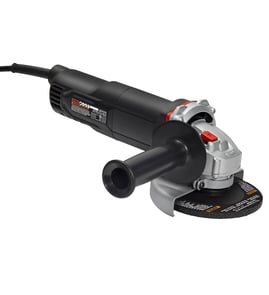

Which is better, a 4 inch or 5-inch angle grinder?
A 4-inch (often 4-1/2 inch) angle grinder is better when you want lighter weight and tighter control for detail cutting and light grinding; a 5-inch angle grinder is better when you want more cutting depth and faster material removal for general-purpose grinding and cutting. For Craftsman model 135277020, choose based on the wheel size your guard and flange are designed to accept.
Quick comparison: 4-inch vs 5-inch
| Feature | 4-inch (or 4-1/2 inch) | 5-inch |
|---|---|---|
| Control and comfort | Easier to handle one-handed for short tasks | Heavier; steadier for longer passes |
| Cutting depth | Shallower | Deeper (typically about 1/2 inch more than 4-1/2 inch) |
| Best use cases | Thin metal, tile, small brackets, touch-ups | General cutting, grinding welds, thicker stock |
| Access in tight spaces | Better | Slightly worse |
| Consumables | Very common | Common, but not as universal as 4-1/2 inch |
How we recommend choosing for your job
- Pick 4-inch or 4-1/2 inch if you prioritize control, reduced fatigue, and working in tighter spaces.
- Pick 5-inch if you need more reach into the cut, faster grinding, or you routinely work thicker material.
- Match the wheel diameter to the guard rating; never install a larger wheel than the guard allows.
- Confirm the arbor size and that the wheel type matches the task (cut-off wheel vs grinding wheel vs flap disc).
- If you do mixed work, many DIYers prefer 4-1/2 inch as the most versatile “everyday” size.
Why it matters
Wheel size affects leverage, cutting depth, and how stable the tool feels. Using the correct size for your Craftsman 135277020 helps the guard fit properly, keeps the wheel within its safe operating range, and improves control during cutting and grinding.
Helpful related DIY reading
If you are troubleshooting power, switches, cords, or intermittent operation on a grinder, our electrical testing basics apply directly: how to use a multimeter to test electrical parts video.
Last updated: February 2026
What size is the arbor hole on a grinder?
The arbor hole is the center hole in the wheel or accessory that fits over the spindle (arbor) on your Craftsman angle grinder model 135277020. Most small angle grinders use a 5/8 in (16 mm) arbor, while many larger grinders use a 7/8 in (22 mm) arbor; match the accessory to your grinder’s spindle and flange.
How to identify the correct arbor hole size
- Check the wheel label/packaging; it lists the arbor hole size (for example, 5/8 in or 7/8 in).
- Measure the grinder’s spindle diameter with a ruler or caliper (power unplugged).
- Confirm whether your grinder uses a threaded spindle (common on angle grinders) plus a clamping flange.
- Make sure the inner and outer flanges seat flat; a mismatched arbor hole can prevent proper clamping.
- If you use adapters (bushings), use only ones made for the accessory and application.
Common arbor hole sizes (quick reference)
| Grinder size (typical) | Common arbor hole | Notes |
|---|---|---|
| 4 to 4-1/2 inch | 5/8 in (16 mm) | Very common for compact grinders |
| 5 inch | 7/8 in (22 mm) or 5/8 in | Varies by brand and region |
| 6 inch and up | 7/8 in (22 mm) | Common on larger grinders |
Why it matters
Using the correct arbor hole size helps the wheel center properly and clamp securely. A wheel that does not fit the spindle and flanges correctly can wobble, vibrate, and wear unevenly, which reduces control and cutting or grinding performance.
Related DIY help
For safe electrical troubleshooting on power tools (cord, switch, continuity checks), use our guide: how to use a multimeter to test electrical parts video.
Last updated: February 2026
Can you use a smaller disc on an angle grinder?
Yes, you can use a smaller disc on a Craftsman angle grinder like model 135277020 as long as the disc’s rated RPM meets or exceeds the grinder’s no-load speed and the disc fits the correct arbor size. Keep the guard installed and set for the disc size; never remove the guard to “make it fit.”
What must match before you install a smaller disc
- Disc rated RPM: the disc rating must be at least the grinder’s maximum RPM.
- Arbor size: the disc hole must match the grinder’s spindle/arbor (common sizes are 5/8 in. or 7/8 in., depending on accessory type).
- Disc type: use the right accessory for the job (cutoff wheel vs grinding wheel vs flap disc).
- Guard compatibility: the guard must still cover the wheel properly.
- Flange/nut seating: the inner flange and outer nut must clamp the disc flat and centered.
Safe setup checklist (what we recommend)
- Unplug the grinder (or remove the battery if applicable).
- Inspect the disc for chips, cracks, or moisture damage.
- Confirm the disc RPM rating and arbor size printed on the disc.
- Install the disc and tighten the flange nut securely.
- Run the tool at no-load for 30 to 60 seconds in a safe direction before contacting material.
Smaller disc vs larger disc: what changes
| Change | What you’ll notice | Why it matters |
|---|---|---|
| Smaller diameter | Less reach and shallower cut depth | You may need more passes to cut through material |
| Less mass | Often smoother startup | Can feel easier to control |
| Reduced contact area | Slower material removal | Grinding takes longer |
Why it matters
Angle grinder injuries often happen when the wheel binds, shatters, or kicks back. Keeping the guard on, using a disc with the correct RPM rating, and matching the arbor size reduces the chance of disc failure and improves control.
For more DIY safety guidance before working on power tools, review are diy appliance repairs safe.
Last updated: February 2026
What are the parts of an angle grinder?
An angle grinder like the Craftsman 135277020 is built around a motor that spins a spindle (arbor) to drive a grinding or cutting disc, with controls and guards that help you handle the tool safely and accurately. Most models share the same core components even when housings and features vary.
Main parts you will see on most angle grinders
- Power switch/trigger (sometimes with a lock-on feature)
- Motor (armature and field/stator inside the housing)
- Gear case and bevel gears (transfer motor rotation to the spindle)
- Spindle/arbor (the threaded shaft the wheel mounts to)
- Spindle lock button (locks the spindle for wheel changes)
- Wheel guard (deflects sparks and debris)
- Side handle (adds control and reduces kickback risk)
Common internal wear parts (what typically fails)
These are the parts we most often see involved when a grinder loses power, runs rough, or sparks excessively:
| Symptom | Common part involved | What you notice |
|---|---|---|
| Won’t start | Switch, power cord, brushes | Dead tool or intermittent power |
| Runs but weak | Brushes, armature, bearings | Slower speed, hot smell |
| Loud grinding noise | Gear set, bearings | Growling, vibration |
| Excessive sparking | Brushes, commutator/armature | Bright arcing at vents |
How to identify what you need before ordering
- Confirm the model number 135277020 from the tool’s label.
- Note whether the issue is electrical (no start, intermittent) or mechanical (noise, vibration).
- Check the wheel size and arbor thread on your current setup so replacements match.
- Inspect the guard and handle for cracks or stripped threads.
- If you suspect an electrical issue, test safely with a meter before replacing parts.
A good walkthrough for basic electrical testing is how to use a multimeter to test electrical parts video.
Why it matters
Knowing the correct component names (switch, brushes, spindle, guard, gear case) helps you match symptoms to the right repair path, avoid ordering the wrong item, and get your Craftsman grinder back to smooth, controlled operation.
Last updated: February 2026
What cannot be cut with an angle grinder?
An angle grinder like the Craftsman 135277020 can cut many metals and masonry with the correct wheel, but it should not be used on materials that melt, clog, ignite, or grab the wheel, and it will struggle against purpose-built grinder-resistant composites. Avoid cutting anything that can explode, burn, or bind the disc.
Materials and items we do not cut with an angle grinder
- Wood and many plastics (nylon, PVC, acrylic): they can melt, gum up the wheel, and grab, causing kickback.
- Flammable or pressurized items: fuel containers, aerosol cans, propane cylinders, and similar items.
- Magnesium and unknown “light” metals: magnesium dust and chips ignite easily; treat unknown alloys as high risk.
- Thin sheet metal that chatters or flexes: it can pinch the wheel and shatter a cutoff disc.
- Hardened glass or ceramics under tension (for example, spark plugs): they can shatter unpredictably.
- Grinder-resistant composites: some advanced security materials are designed to deflect or rapidly wear cutting discs.
Common “can I cut this?” guidance (quick check)
| Material or item | Typical result | Better approach |
|---|---|---|
| Mild steel, rebar | Cuts well with the right cutoff wheel | Use a metal cutoff wheel; clamp the work |
| Concrete, stone, tile | Cuts with a diamond blade | Use a diamond blade; control dust |
| Aluminum | Often clogs abrasive wheels | Use a wheel rated for non-ferrous metals |
| Wood | High kickback risk | Use a saw designed for wood |
Why it matters
Most angle grinder injuries happen when the wheel binds, shatters, or kicks back. Materials that melt, flex, or snag increase those risks, and flammable or pressurized items add fire and explosion hazards.
Safer cutting setup (applies to most jobs)
- Match the wheel type to the material (cutoff wheel vs. diamond blade vs. non-ferrous rated wheel).
- Inspect the wheel for cracks and confirm the RPM rating meets or exceeds the grinder speed.
- Clamp the workpiece; never “hand-hold” small parts while cutting.
- Use the guard and a two-hand grip; keep your body out of the wheel’s line.
- Control sparks and dust; work in a clear area away from combustibles.
For general safety practices before DIY repairs or tool work, use our are diy appliance repairs safe guide.
Last updated: February 2026