Owner’s manual
 Error Codes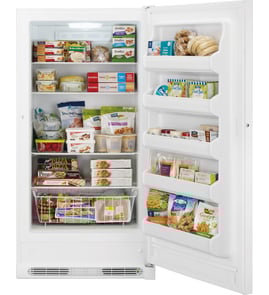



What is the most common problem on a freezer?
The most common freezer problem is poor cooling caused by restricted airflow or warm air leaking in through the door, which leads to frost buildup and longer run times. On the Kenmore KRFU021AWD0 upright freezer, everyday habits like overloading, frequent door openings, and blocked air circulation are common triggers (see the KRFU021AWD0 owner's manual).
- Freezer not cold enough: blocked airflow, heavy loading, or door not sealing
- Excessive frost/ice buildup: warm, moist air entering through the door or frequent openings
- Compressor runs a lot: warm air leaks, dirty condenser area, or overloaded cabinet
- Door feels hard to open right after closing: normal pressure difference for about 1 minute
- Give it time after plugging in: allow about 4 hours to cool fully before loading unfrozen food.
- Avoid overloading: freeze only about 3 lb of fresh food per cubic foot at one time, and spread packages out.
- Keep air moving: do not line shelves/bins with foil or paper; liners reduce cold air circulation.
- Reduce door-open time: organize and label food so the door closes quickly.
- Confirm the control panel is not locked: unlock by holding Mode for 3 seconds, then set temperature.
| Symptom | Most likely cause | Best first action |
|---|---|---|
| Warm temps | Airflow blocked or overloaded | Repack items, leave space for circulation |
| Frost buildup | Door opened often or not sealing | Check closure, minimize openings |
| Runs constantly | Heat load too high | Cool hot foods first, reduce door time |
| Door “stuck” after closing | Normal pressure equalization | Wait about 1 minute, then reopen |
When airflow is restricted or warm air leaks in, the freezer has to run longer to recover temperature. That increases frost buildup, can soften food, and wastes energy.
Last updated: January 2026
How long should a Kenmore upright freezer last?
A Kenmore upright freezer like model KRFU021AWD0 typically lasts 12 to 20 years, with about 16 years being a common average when it is installed correctly, kept clean, and the door seals stay tight. Consistent temperatures and good airflow help maximize freezer life.
Most upright freezers reach the longer end of the range when they avoid heat stress, heavy frost buildup, and frequent warm-air intrusion.
- Room conditions: Hot garages and tight enclosures make the compressor work harder.
- Door openings: Frequent openings add moisture and raise internal temperature.
- Door gasket condition: Leaks cause longer run times and frost.
- Loading habits: Overloading blocks airflow; underloading can increase temperature swings.
- Power events: Repeated outages and surges add wear to electrical components.
These habits align with how the freezer is designed to cool and recover after loading.
- Allow about 4 hours for the freezer to cool fully after plugging in before loading unfrozen food.
- Freeze fresh food in smaller batches (a common guideline is about 3 lb per cubic foot at a time) so temperatures recover faster.
- Keep the door closed during a power failure; many freezers can hold safe temps around 24 hours if unopened.
- Keep shelves and bins secured and the cabinet level to reduce door alignment issues.
- Follow the cleaning and operating guidance in the KRFU021AWD0 use and care guide.
| Symptom | What it often means | What to check first |
|---|---|---|
| Runs constantly | Heat load or sealed-system strain | Door gasket seal, airflow, room temp |
| Warm freezer, no run | Electrical or control issue | Outlet power, control settings |
| Heavy frost | Moisture intrusion | Door not closing, gasket damage |
| Loud clicking/humming | Start device or compressor stress | Power supply stability, ventilation |
A freezer that is nearing the end of its expected lifespan often uses more electricity and struggles to maintain safe food storage temperatures. Catching gasket leaks, airflow problems, and loading issues early can add years of reliable service.
Last updated: January 2026
Is there a reset button on a Kenmore upright freezer?
Kenmore upright freezers such as model KRFU021AWD0 typically do not have a dedicated “reset” button. Most “reset” results come from restoring normal operation by unlocking the control panel, reselecting the temperature, or power-cycling the freezer using the steps in the KRFU021AWD0 use and care guide.
- Unlock the controls: Press and hold Lock for 3 seconds; the panel can auto-lock after about 20 seconds of no button presses.
- Set the freezer temperature again: Use the + / - buttons to choose your target temperature.
- Exit special modes: If Quick Freeze is on, press the Quick Freeze button to cancel it.
- Power-cycle the freezer: Unplug for 5 minutes, then plug back in (or switch the breaker off then on).
- Give it time to stabilize: After a reset or power-cycle, allow 24 hours for temperatures to fully normalize.
| Goal | What we do | What you should see |
|---|---|---|
| Unlock panel | Hold Lock 3 seconds | Lock icon changes state; panel responds |
| Change set temp | Press + or - | Set temperature changes |
| Switch modes (if applicable) | Hold Mode 3 seconds | Freezer or Fridge indicator changes |
| Quick Freeze | Press Quick Freeze once | Quick Freeze icon toggles |
- Confirm the freezer is in Freezer mode (not Fridge mode, if your unit supports both).
- Check the door is sealing and closing fully; warm air leaks can mimic a control problem.
- Make sure vents are not blocked by food packages.
- Listen for the evaporator fan inside; no airflow often points to a fan, frost buildup, or control issue.
- If you recently moved it, let it sit upright before running (to protect the sealed system).
Most “reset” issues on an upright freezer are actually control lock, mode selection, or temperature setting problems. Using the correct button sequence prevents unnecessary parts replacement and helps restore stable freezer temperatures faster.
Last updated: January 2026