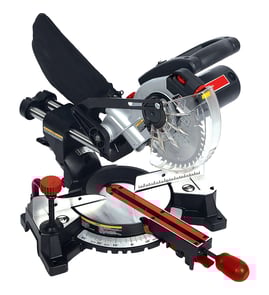

What is the 31.6 on a miter saw?
On a Craftsman miter saw like model 88136344, 31.6° is a common miter detent used for cutting crown molding laid flat. It’s typically paired with a 33.9° bevel setting so inside and outside corners fit tightly without complex compound layout.
What that 31.6° setting is used for
When you see 31.6° on the miter scale, it’s there to speed up repeatable crown molding cuts.
- Used when crown molding is cut flat on the saw table (not nested against the fence)
- Works with a matching bevel angle (commonly 33.9°) to create a compound cut
- Helps you hit consistent angles using the saw’s detents (click-stops)
- Most useful for standard crown spring angles (commonly 38° or 45° crown profiles)
- Reduces measuring errors when you have many corners to cut
Quick reference: typical crown molding “flat cut” settings
These are the common starting points many saws reference; always test-cut on scrap because crown profiles vary.
| Crown spring angle (typical) | Miter setting | Bevel setting |
|---|---|---|
| 38° crown (common) | 31.6° | 33.9° |
| 45° crown (common) | 35.3° | 30.0° |
How to use it without wasting material
Use this process to dial in the fit before cutting your finished trim.
- Confirm whether your crown is 38° or 45° spring angle (often on the packaging)
- Make two short test pieces and label them “left” and “right”
- Set the miter to 31.6° and bevel to 33.9° (for 38° crown)
- Cut an inside-corner pair, then an outside-corner pair, and check the seams
- Fine-tune by tiny adjustments if your wall corners are not perfectly 90°
Why it matters
Crown molding corners show gaps easily. The 31.6° detent is there because it’s a proven, repeatable shortcut for clean joints when you’re doing a lot of trim work and want consistent results.
Related DIY help: how to find your appliance model number (and what it means for parts)
Last updated: February 2026
What should you never cut with a miter saw?
For a Craftsman miter saw model 88136344, never cut anything you cannot hold firmly and safely against the fence and table. Avoid freehand cuts, tiny offcuts without a clamp or stop, and any material that can bind the blade or get pulled into the teeth, because that leads to kickback and loss of control.
Never cut these materials or setups
- Small pieces you cannot secure (no clamp, no stop block, hands too close to the blade path)
- Round stock (dowel, pipe, conduit) unless it is fully captured in a V-block jig and clamped
- Warped, bowed, or twisted lumber that will not sit flat on the table and tight to the fence
- Loose stacks (multiple boards at once) that can shift during the cut
- Metal unless you are using the correct blade and the saw setup is intended for metal cutting
- Anything with hidden fasteners (nails, screws, staples) in the cut line
Cuts and habits to avoid (kickback triggers)
Kickback usually happens when the workpiece moves or the blade binds. Avoid these common triggers:
- Starting the cut with the workpiece not fully seated against the fence
- Letting the cutoff piece get trapped between the blade and fence
- Reaching under or behind the blade to grab offcuts before the blade stops
- Cutting with a dull, damaged, or incorrect blade for the material
- Defeating or tying back the blade guard
Safer alternatives for “too small” or “awkward” cuts
| If you need to cut… | Use this approach instead | Why it’s safer |
|---|---|---|
| Very short trim pieces | Clamp a longer board, cut, then trim to final length | Keeps hands farther away |
| Repeated short pieces | Use a stop block and clamp the stock | Prevents shifting |
| Round material | Use a V-block jig plus a clamp | Stops rolling |
| Questionable material | Inspect, remove fasteners, or choose another tool | Prevents tooth strike and binding |
Why it matters
A miter saw is designed for controlled crosscuts with the work held flat and square to the fence. When the stock is unstable, the blade can grab and throw the workpiece, damage the blade, and cause serious injury.
Helpful DIY reference
For general safety guidance before any DIY repair or adjustment, review are diy appliance repairs safe.
Last updated: February 2026
How to get a miter saw to lift up?
On the Craftsman miter saw model 88136344, the saw head lifts only after the transport or down-lock is released. The standard method is to press the handle down slightly to remove tension, then release the lock pin or lever near the pivot so the head can rise under control.
Safe unlock steps
- Unplug the saw before touching the head, guard, or pivot area.
- Hold the handle firmly and push the head down about 1/4 to 1/2 inch.
- Find the transport lock at the rear pivot area (commonly a pull pin or small lever).
- Pull the pin out or move the lever to the unlock position.
- Slowly let the head rise; do not let it snap up.
If the head still will not lift
Binding is usually caused by debris, a mis-set lock, or a damaged pivot or lock mechanism.
- Clear packed sawdust around the pivot, spring area, and lock pin.
- Confirm the bevel lock and miter lock are not overtightened.
- Check the blade guard is not wedged against the fence or table.
- Inspect the lock pin or lever for bending, cracks, or looseness.
- If the handle or release lever is broken, stop using the saw until it is repaired.
Quick diagnosis guide
| What you see | What to try | Most common cause |
|---|---|---|
| Pin or lever will not move | Push head down slightly more, then try again | Tension on the lock |
| Pin moves but head stays down | Clean pivot area; check locks | Sawdust binding or overtightened lock |
| Head rises partway then sticks | Check guard clearance; inspect pivot | Guard interference or pivot wear |
Why it matters
Forcing the head up can bend the lock hardware, damage the pivot, and throw off cutting accuracy. Releasing tension first protects the arm assembly and keeps the saw operating smoothly.
For general repair safety practices before working around moving parts, use: are diy appliance repairs safe.
Last updated: February 2026
Can you cut a 4x4 with a 12-inch miter saw?
Yes. A 12-inch miter saw typically cuts a standard 4x4 (about 3-1/2 inches actual thickness) in one pass at 90 degrees. For your Craftsman model 88136344, the real deciding factor is the saw’s maximum cut capacity and fence clearance, not the model number alone.
What determines if it’s a one-pass cut
A 4x4 cut depends on vertical cut capacity (upright against the fence) and the blade’s path at the angle you’re using.
- Upright capacity: the key measurement for cutting a 4x4 standing up
- Bevel angle: beveling often reduces usable height
- Fence design and inserts: tall fences or add-on fences can limit travel
- Blade condition: a dull or warped blade increases burning and binding
- Work support: poor support can twist the post and pinch the blade
Best methods to cut a 4x4 on a miter saw
Use the method that matches your saw’s capacity and the accuracy you need.
- Upright against the fence (preferred) for square, repeatable crosscuts
- Lay it flat if upright height is limited (you may need to flip to finish)
- Flip-cut: cut as deep as possible, rotate the post 180 degrees, finish the cut
- Clamp the workpiece to reduce movement and kickback risk
- Support both ends with stands so the post stays level through the cut
Quick capacity check (safe, practical)
| Check | What we do | What it confirms |
|---|---|---|
| Unplugged plunge test | With the saw unplugged, place the 4x4 where you’ll cut and slowly lower the head | Whether the blade reaches full depth |
| Bevel test | Still unplugged, set your common bevel and lower again | Whether angled cuts still clear |
| Fence clearance | Verify the fence and any auxiliary fence do not block the blade path | Prevents partial cuts and binding |
Why it matters
A true one-pass cut keeps the end square and reduces binding, burning, and stepped cut lines. If your saw cannot clear a 4x4 upright, the flip-cut method gives clean results without forcing the tool.
For general safety practices that apply to power-tool DIY work, use are diy appliance repairs safe.
Last updated: February 2026
Which Mitre saw is the most accurate?
The most accurate miter saw is the one that cuts square and stays calibrated over time. For your Craftsman miter saw model 88136344, accuracy comes from proper setup (fence, miter detents, bevel stops), a stable work surface, and the right sharp blade for the material.
What “most accurate” means in real use
Accuracy is a combination of initial calibration and repeatability.
- Miter detents hit common angles (0°, 22.5°, 45°) without shifting after you lock
- Bevel returns to true 0° and 45° consistently
- Fence stays square to the blade and remains straight
- Minimal play in pivots, slides, and bearings
- Clean, controlled cuts without deflection or burning
How to make your 88136344 cut as accurately as possible
These steps improve accuracy more than switching brands.
- Unplug the saw; remove dust and pitch from the table and fence
- Verify the fence is square to the blade plate (avoid the teeth)
- Confirm the 0° miter and 0° bevel stops; adjust if your saw allows
- Use a fine-tooth crosscut blade for trim and hardwoods; replace dull blades
- Support long stock and clamp the workpiece to prevent movement
Quick accuracy test (repeatable and reliable)
Use this to compare any miter saw, including Craftsman, DeWalt, Bosch, and Makita.
| Test | What you do | What “accurate” looks like |
|---|---|---|
| 90° crosscut | Cut a board, flip one piece, butt edges | No gap along the joint |
| 45° miter | Cut two 45° pieces, form a 90° corner | Tight corner, no open heel/toe |
| Bevel check | Cut a bevel, flip and mate | Faces meet flat with no rocking |
Why it matters
A saw that stays calibrated reduces recuts, improves trim fit, and keeps miters tight without filler. If you are comparing parts diagrams or ordering components that affect alignment (fence hardware, detent parts, pivot hardware), matching the exact model number is critical.
For model identification tips, use how to find your appliance model number (and what it means for parts).
Last updated: February 2026