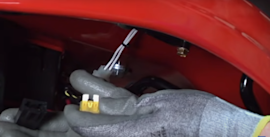
Installation guide
 Owner’s manual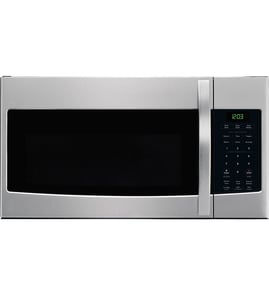


Can you reset a LG microwave?
Yes. On LG microwave/hood combo model LMV1831BD, the most reliable “reset” is a power reset: unplug the microwave (or switch the breaker off) for about 1 minute, then restore power and re-set the clock and any preferences using the steps in the LMV1831BD owner's manual.
Quick reset options (what to try first)
- Power reset (best for glitches): Unplug for 60 seconds, then plug back in.
- Stop/Clear reset (ends a cycle): Press STOP/Clear to cancel cooking and clear most entries.
- Child lock toggle (if controls seem “frozen”): Press and hold STOP/Clear until you hear 2 beeps and see “Loc” (about 4 seconds); repeat to turn it off.
- Door reset (if it stopped mid-cycle): Close the door and press START/Enter to resume.
When a “reset” fixes the problem (and when it will not)
A reset helps when the control board is confused by a power blip, a stuck key, or an interrupted cycle. It will not fix a heating failure caused by a high-voltage component.
| Symptom | Reset likely helps? | What to check next |
|---|---|---|
| Display acts odd after outage | Yes | Power reset, then set clock |
| Buttons do nothing, “Loc” shows | Yes | Turn off child lock |
| Microwave runs but does not heat | No | Use why is my microwave not heating troubleshooting |
| Dead, no display | Sometimes | House breaker, outlet, then internal fuse (service) |
Why it matters
Resetting the right way prevents repeated nuisance issues and helps you separate a simple control lockout from a real parts problem (like a fuse, door interlock, or magnetron).
Last updated: January 2026
Is a 1.6 cu ft microwave big?
A 1.6 cu. ft. microwave is considered mid-size to large for most kitchens; it typically fits full-size dinner plates and many casserole dishes. For the LG LMV1831BD microwave/hood combo, the cavity volume is actually 1.8 cu. ft., which is firmly in the “large” range for over-the-range models (check the LMV1831BD user manual for the listed specifications).
What “big” means in real use
A 1.6 to 1.8 cu. ft. microwave usually works well for family meals and frequent reheating because it has enough interior space for wider bowls and taller containers.
Common items that usually fit comfortably:
- Standard 10 to 11 inch dinner plates
- Medium casserole dishes (check handle-to-handle width)
- Large microwave-safe bowls
- Multi-portion leftovers in deeper containers
Size comparison (quick guide)
Use this as a practical way to think about capacity when shopping or comparing models.
| Microwave capacity | Typical label | Best for |
|---|---|---|
| 0.7 to 1.1 cu. ft. | Compact | Small plates, snacks, tight spaces |
| 1.2 to 1.6 cu. ft. | Mid-size | Most households, everyday reheating |
| 1.7 to 2.2 cu. ft. | Large | Families, larger dishes, frequent cooking |
Over-the-range fit considerations
Even if the cavity is “big,” an over-the-range microwave must also match cabinet and cooktop clearances.
For installations like the LG LMV1831BD, we recommend confirming:
- Cabinet opening width and required clearances
- Mounting support requirements (wall studs and anchors)
- Minimum height above the cooktop
Those requirements are spelled out in the LMV1831BD installation guide.
Why it matters
Capacity affects what you can heat without rotating dishes or switching to smaller cookware. Installation clearances matter just as much for a microwave/hood combo because the unit must mount securely and vent properly.
Last updated: January 2026
What are the common problems with the LMV1831BD?
Common problems we see with the LG LMV1831BD microwave/hood combo include no heat, no power, turntable not rotating, door/interlock issues, sparking/arcing, and weak or noisy venting. Many symptoms trace back to power supply, door switches, fuses, or vent installation details in the LMV1831BD owner's manual.
Most common symptoms and what they usually mean
- No heat or weak heating: often a high-voltage component issue (magnetron, diode, transformer) or a control problem.
- Won’t turn on (no display, dead): commonly a blown fuse, tripped breaker, loose power cord connection, or a noise filter/power input issue.
- Runs but won’t stop: typically a stuck keypad/control board problem or a door switch/interlock problem.
- Tray won’t turn: turntable motor issue, coupler/roller alignment, or the tray not seated correctly.
- Door not closing properly: latch housing/interlock alignment, worn door parts, or mounting/leveling issues.
- Sparking/arcing: metal/foil use, food splatter/grease buildup, or waveguide cover area damage.
- Vent weak, noisy, or overheating: blower direction, damper/duct connection, or blocked airflow (installation-related).
Quick checks we recommend before replacing parts
- Confirm the outlet has power; reset the breaker and test the outlet with another device.
- Verify the power cord connection is fully seated and not pinched.
- Inspect the cavity for foil, metal, twist ties, or a rack not intended for microwave mode.
- Clean grease and food splatter from the interior and around the waveguide cover area.
- For vent issues, confirm the damper opens freely and the duct path is not crushed or blocked.
- If the unit vibrates or is noisy, confirm it is level and the mounting hardware is tight per the LMV1831BD installation guide.
Parts that commonly solve these symptoms (when diagnosis confirms)
| Symptom | Common suspect part | Example part for LMV1831BD |
|---|---|---|
| Dead/no power | Fuse or fuse assembly | Microwave fuse 3B74133Q or microwave fuse assembly EAF36358314 |
| No heat | Magnetron or diode | Microwave magnetron 2B71165R or microwave diode 6851W1A002E |
| Starts then stops, door-related errors | Door switch/interlock | Microwave door latch housing and interlock switch assembly 3501W1A019S |
| Turntable not rotating | Turntable motor | Microwave turntable motor 6549W1S013H |
Why it matters
Microwave/hood combos like the LMV1831BD rely on correct door interlock operation and proper venting. A misaligned damper or blower setup can cause weak ventilation, abnormal noise, and overheating; power issues can also look like “no heat” when the unit is not getting stable input.
Last updated: January 2026