Owner’s manual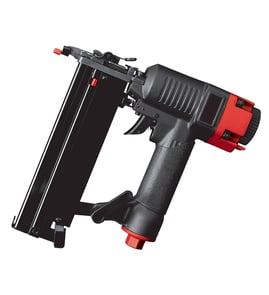

Can I use a 16-gauge nail in an 18 gauge nail gun?
No. An 18-gauge brad nailer is built for thinner 18-gauge brads, so a thicker 16-gauge finish nail will not feed correctly and commonly causes jams or damage. Craftsman model 351183210 is a 16-gauge finish nailer, so it uses 16-gauge finish nails, not 18-gauge brads (see the 351183210 owner's manual).
What Craftsman 351183210 is designed to shoot
The specifications for Craftsman 351183210 call for 16-gauge finish nails.
- Nail gauge: 16 gauge
- Nail length range: 3/4 in. to 2-1/2 in.
- Magazine capacity: 100 finish nails
- Operating pressure: 60 to 100 PSI
- Best practice: use recommended fasteners for consistent feeding and depth
What happens if you mix 16-gauge and 18-gauge fasteners
Gauge is a fit requirement, not a preference. The magazine rails, driver blade, and nose are sized to one fastener thickness.
- Misfeeds because the strip does not sit correctly in the magazine
- Frequent jams at the nose/driver path
- Nails can deform, causing inconsistent depth and poor finish
- Extra wear on the driver and nose components
- Increased risk of double-fires or angled shots
Quick compatibility table
| Nailer type | Correct fastener | Result |
|---|---|---|
| 16-gauge finish nailer (Craftsman 351183210) | 16-gauge finish nails | Proper fit and reliable feeding |
| 18-gauge brad nailer | 18-gauge brads | Proper fit and smaller holes |
| 18-gauge brad nailer | 16-gauge finish nails | Not compatible; jams and possible damage |
Why it matters
Using the correct gauge protects the magazine and nose area, reduces jams, and gives you predictable holding power and finish quality on trim, cabinetry, doors, and windows.
Getting nails and repair items
Use the model number 351183210 when shopping so you match the correct fastener type and any replacement parts. If you need to search beyond the model page, use Sears PartsDirect.
Last updated: February 2026
Is a 16-gauge nailer good for trim?
Yes. The Craftsman 351183210 is a 16-gauge finish nailer designed for interior and exterior trim work; it drives 16-gauge finish nails from 3/4 inch to 2-1/2 inches long, which is a strong, reliable range for most casing, baseboard, and other trim installs.
When a 16-gauge nailer is the right choice for trim
A 16-gauge finish nailer is a good fit when you want more holding power than an 18-gauge brad nailer, especially on thicker trim or when fastening into studs.
- Installing baseboards, door casing, and window casing
- Fastening thicker trim (commonly 1/2 inch to 3/4 inch and up)
- Nailing into framing where you want better bite
- Projects where you plan to fill nail holes and paint or stain
Nail size guidance for this model
Our Craftsman 351183210 uses 16-gauge nails only (they are not interchangeable with 18-gauge brads). Choose nail length based on trim thickness and how much wood you need to penetrate behind it.
| Trim situation | Typical nail length | Why it works |
|---|---|---|
| Thin trim or returns | 3/4 inch to 1-1/4 inch | Reduces blowout and splitting |
| Most casing and baseboard | 1-1/2 inch to 2 inch | Good balance of hold and control |
| Thick trim into studs | 2 inch to 2-1/2 inch | Maximizes holding power |
Setup tips that help trim look cleaner
These steps reduce dents, proud nails, and split trim.
- Set air pressure in the tool’s operating range (60 to 100 PSI) and fine-tune from there
- Use the depth adjustment knob to set nails slightly below the surface
- Keep the contact trip flat to the work to prevent angled drives
- If you hit frequent jams, use the quick-release nose cover to clear the fastener path
- Use only recommended 16-gauge finish nails for best feeding and consistent drive
Why it matters
Trim is a finish surface. A 16-gauge nailer like the Craftsman 351183210 gives you stronger holding power for long-term stability, while still leaving a small enough hole to fill for a clean final look.
For model-specific operating and safety details (including loading, adjustments, and jam clearing), use the 351183210 owner's manual. For parts and supplies, start with the model parts list, or search by model number on Sears PartsDirect.
Last updated: February 2026
What is better, an 18 gauge or a 16 nailer?
For the Craftsman 351183210, a 16-gauge finish nailer is the better choice when you need stronger holding power for trim and woodworking because it drives thicker nails; an 18-gauge brad nailer is better for lighter, more delicate work with smaller holes. Lower gauge means a thicker nail; check the 351183210 owner's manual for the nail sizes and operating specs.
Quick comparison: 16 gauge vs 18 gauge
| Feature | 16-gauge finish nailer (like model 351183210) | 18-gauge brad nailer |
|---|---|---|
| Nail thickness | Thicker nail | Thinner nail |
| Holding power | Higher | Moderate |
| Hole size | Larger | Smaller |
| Best for | Baseboards, door/window casing, exterior and interior trim, cabinetry | Light trim, small moldings, crafts, tacking pieces before glue cures |
| Typical risk | More likely to split very thin stock | More likely to loosen on heavier trim |
What our Craftsman 351183210 is designed to do
This model is a Craftsman 16-gauge finish nailer. Our manual calls out these key specs:
- Drives 16-gauge finish nails
- Nail length range: 3/4 inch to 2-1/2 inches
- Magazine capacity: 100 nails
- Operating pressure: 60 to 100 PSI
How to choose what is “better” for your job
Pick based on the material thickness and how much strength you need:
- Choose 16 gauge for door jambs, baseboards, thicker trim, and assemblies that need more bite.
- Choose 18 gauge for thin trim, delicate moldings, and projects where appearance matters most.
- If you see splitting on thin wood with 16 gauge, pre-drill, reduce depth, or switch to 18 gauge.
- If nails back out or joints move with 18 gauge, step up to 16 gauge or add adhesive.
- Match air pressure and depth-of-drive to the material to avoid overdriving and surface damage.
Why it matters
Using the right gauge helps prevent common finish problems: split trim, loose joints, visible nail holes, and callbacks. With the 351183210, you are already set up for stronger trim fastening; for ultra-fine work, an 18-gauge brad nailer complements it.
To find diagrams, nail recommendations, and safe operating steps, use the model parts page or search by model number on Sears PartsDirect.
Last updated: February 2026