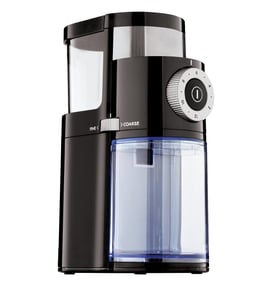

Is it worth it to buy an expensive coffee grinder?
Yes, an expensive coffee grinder is usually worth it because it delivers more consistent grind size, which improves flavor and extraction. For a KitchenAid coffee grinder like model KPCG100PM0, the value shows up most when you brew often, use espresso or pour-over, and want long-term durability.
- More uniform particle size (fewer “fines” and “boulders”), so coffee tastes less bitter or sour
- More precise grind adjustment, especially helpful for espresso
- Better burr alignment and stability, which keeps results consistent over time
- Quieter, smoother operation (typically less vibration and rattling)
- Longer service life with replaceable wear parts (burrs, switches, cords)
A premium grinder is less important if you:
- Brew only occasionally
- Use a drip machine with pre-ground coffee and are happy with the taste
- Prefer convenience over dialing in grind settings
| Feature | Expensive burr grinder | Budget grinder (or blade) |
|---|---|---|
| Grind consistency | High | Medium to low |
| Adjustment range | Wide, repeatable | Limited or inconsistent |
| Best for | Espresso, pour-over, precision brewing | Casual drip, basic use |
| Longevity | Typically longer | Typically shorter |
Grind consistency controls extraction. When particles are even, water extracts flavor more evenly, so you get sweeter, clearer coffee with less harshness.
If your KPCG100PM0 starts producing inconsistent grinds, stalls, or gets noisy, focus on the wear items and fit:
- Inspect and clean the burr area; oils and fines can cause clumping
- Check for looseness in the grind path and covers
- Replace worn burr components when grind quality drops (see coffee grinder burr assembly W11109860)
- If the unit will not start reliably, test the switch circuit (see switch 4176758)
Last updated: January 2026
What is the best coffee grinder on the market?
There is no single “best” coffee grinder for everyone; the best choice depends on brew method, budget, and how consistent you need the grind. For most homes, a burr grinder is the best pick for flavor and repeatability, and your KitchenAid KPCG100PM0 is designed around that same consistency-first approach.
- Best overall value (most people): Baratza Encore ESP
- Best for drip and pour-over: Fellow Ode Gen 2
- Best budget burr option: OXO Brew conical burr grinder
- Best for espresso-focused dialing in: Eureka Mignon series
- Best for compact, modern design: Fellow Opus
- Burr type: Conical burrs are common and forgiving; flat burrs can excel for clarity in filter coffee.
- Adjustment range: Espresso needs finer, more precise steps than drip.
- Retention and mess: Lower retention means less stale grounds and easier dosing.
- Noise and speed: Higher-end grinders often run quieter and smoother.
- Serviceability: Replaceable wear parts (like burrs) extend grinder life.
| Feature | Burr grinder | Blade grinder |
|---|---|---|
| Grind consistency | High | Low |
| Flavor clarity | Better | Often muddier |
| Espresso capable | Often yes | No |
| Control | Precise | Limited |
If grind quality has dropped (more fines, uneven grind, slower output), the most common fix is refreshing the burr set and checking for worn seals or loose hardware.
- Inspect and clean the burr area; oils and compacted grounds cause inconsistency.
- If burr edges look rounded or performance changed noticeably, replace the burr set.
- Check for vibration or rattling that can affect grind uniformity.
Helpful model-matched part options include the coffee grinder burr assembly W11109860 and, if you are addressing looseness or vibration, the seal, vibration 4176726.
A grinder has more impact on taste than most coffee makers. Consistent particle size improves extraction, which means better sweetness, less bitterness, and more repeatable results across espresso, pour-over, and drip.
Last updated: January 2026
What is the life expectancy of a coffee grinder?
Most coffee grinders last about 5 to 15 years with normal home use. For the KitchenAid KPCG100PM0 coffee grinder, lifespan depends most on burr wear, how often you grind, and how well you keep oils and grounds from building up in the burr area.
- Burr grinders: typically 8 to 15 years
- Blade grinders: typically 5 to 7 years
- Hand/manual grinders: typically 5 to 15 years
In a burr grinder, the burr set and the drive components take the most abuse. If grind quality drops (more dust and boulders, inconsistent flow), replacing the burr assembly often restores performance.
- Burrs get dull from friction and hard beans
- Coffee oils cause buildup that increases load on the motor/gearbox
- Switches and cords can fail from repeated use and flexing
- Seals can harden over time and allow vibration or misalignment
| Symptom | Most likely cause | Best next step |
|---|---|---|
| Grind is inconsistent at the same setting | Dull/dirty burrs | Clean; if still poor, replace coffee grinder burr assembly W11109860 |
| Grinder will not start | Power issue or failed switch | Check outlet/cord; test/replace switch 4176758 or power cord 4176757 |
| Excess vibration or rattling | Worn isolator/seal or loose hardware | Inspect mounts; consider seal, vibration 4176726 |
- Clean the burr area regularly (dry brush or vacuum; avoid water near the motor)
- Do not grind flavored or oily beans often (they leave heavy residue)
- Let the grinder rest between large batches to reduce heat buildup
- Keep the grind setting mechanism free of packed grounds
- Store beans properly so you are not grinding overly hard, stale beans
A grinder can “run” for years while producing poor grind consistency. Tracking grind quality and motor strain helps you replace the right parts at the right time, so your coffee tastes better and the grinder avoids unnecessary wear.
Last updated: January 2026