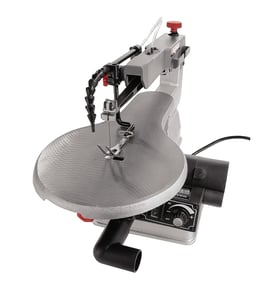

What do the numbers mean on scroll saw blades?
The numbers on scroll saw blades mainly describe the blade’s size and aggressiveness: lower numbers are finer for thin stock and tight, detailed cuts; higher numbers are larger, remove material faster, and handle thicker wood but leave a rougher kerf.
How blade numbers relate to cut quality
In general, as the blade number goes up, the teeth get larger and the cut gets faster but less refined.
- Lower numbers (fine blades): best for thin wood, veneers, and intricate fretwork
- Higher numbers (coarse blades): best for thicker stock and faster straight or gentle curves
- Finer blades: tighter turning radius, smoother edges, less tear-out
- Coarser blades: faster feed rate, more sawdust, more sanding afterward
- Very small blades: easier to break if you push too hard or tension is too high
Quick selection guide for a Dremel 1671 scroll saw
Use this as a practical starting point, then adjust based on how hard the wood is and how tight your curves are.
| What you’re cutting | Blade number direction | What you’ll notice |
|---|---|---|
| Thin stock and delicate patterns | Lower | Cleaner detail, slower cutting |
| Medium thickness general work | Middle range | Balanced speed and control |
| Thick stock or fast rough cuts | Higher | Faster cutting, rougher edge |
Setup tips that matter as much as the blade number
Even the “right” blade number will cut poorly if setup is off.
- Set proper blade tension so the blade tracks straight without flutter
- Use a slower, steady feed on fine blades to prevent breakage
- Support the work flat on the table to avoid twisting the blade
- Check blade direction (teeth should cut on the downstroke on most setups)
- Use a test cut on scrap before starting a detailed pattern
Why it matters
Matching blade number to material thickness and detail level helps your Dremel 1671 cut straighter, reduces blade breakage, and minimizes burning and sanding time.
For general tool and safety best practices that also apply to scroll saw work, we recommend reviewing are diy appliance repairs safe.
Last updated: February 2026
What size blade is a 1671 Dremel scroll saw?
The Dremel scroll saw model 1671 is a 16-inch scroll saw (throat size). It typically uses 5-inch plain-end (pinless) scroll saw blades; choose the blade type and tooth pattern based on your material and the cut you want.
Blade size and what it means
Most scroll saw blades for this style of saw are standardized at about 5 inches long. What changes is the blade’s:
- Width (narrower for tight curves)
- Thickness (thicker for straighter cuts)
- Teeth per inch (TPI) (higher TPI for smoother cuts)
- Tooth style (skip tooth, double skip, reverse tooth, spiral)
Quick blade selection guide
- Tight curves and fretwork: narrow blade, higher TPI
- General wood cutting: medium blade, medium TPI
- Cleaner bottom edge on plywood: reverse-tooth blade
- Very intricate inside cuts: very fine blade, higher TPI, slower feed rate
Common cutting capacity (typical for 16-inch scroll saws)
Cut capacity varies by material, blade choice, and feed rate. For many 16-inch scroll saws, a practical range is:
| Material | Typical practical thickness | Notes |
|---|---|---|
| Softwood | Up to about 2 in. | Use a coarser blade and steady feed |
| Hardwood | About 3/4 to 1-1/2 in. | Slower feed, sharper blade |
| Plywood | About 1/4 to 3/4 in. | Reverse-tooth helps reduce tear-out |
Why it matters
Using the correct 5-inch pinless blade and matching the TPI to your stock reduces blade breakage, improves cut accuracy, and helps the Dremel 1671 track straighter with less burning.
For help confirming the exact model identification before ordering blades or parts, use our guide: how to find your appliance model number (and what it means for parts).
Last updated: February 2026
What are some common scroll saw mistakes?
The most common mistakes on a Dremel scroll saw like model 1671 are incorrect blade tension, using the wrong blade for the material, forcing the feed rate, and skipping basic safety steps. Fixing setup and technique prevents broken blades, rough cuts, and loss of control.
Common mistakes (and what they cause)
- Blade tension too loose: the blade wanders, cuts curve, and the workpiece can “chatter.”
- Blade tension too tight: blades snap early and the saw vibrates more.
- Wrong blade for the job (too coarse, too fine, wrong style): burning, tear-out, slow cutting, or frequent breakage.
- Feeding the wood too fast: overheats the blade, pulls the pattern off-line, and breaks blades.
- Incorrect blade direction: poor cutting and grabbing; on most scroll saw blades, teeth should point down so the cut happens on the downstroke.
- Not keeping the work flat to the table: bevel cuts and inconsistent accuracy.
- Skipping dust control and PPE: more cleanup, more irritation, and less visibility at the cut line.
Quick setup checklist for cleaner cuts
- Tension the blade so it feels firm and produces a clear “ping” when plucked.
- Verify the blade is installed straight and centered in the clamps.
- Start with a moderate speed; increase only if the cut stays smooth.
- Let the blade do the work; guide the wood steadily without twisting.
- Use a sharp, appropriate blade for thickness and material (hardwood vs. softwood, tight turns vs. straight cuts).
Troubleshooting guide
| Symptom | Most likely mistake | What to do next |
|---|---|---|
| Blades keep breaking | Too much tension, forcing feed, twisting in turns | Reduce feed pressure, re-tension, use a blade suited for tight curves |
| Rough bottom edge | Teeth direction wrong, dull blade, feed too fast | Reinstall blade correctly, slow down, replace blade |
| Cut is beveled | Work not flat, table not square | Keep steady downward pressure; check table squareness |
| Wood “jumps” or chatters | Loose tension, vibration, poor support | Increase tension slightly; stabilize the saw and support the work |
Why it matters
Most scroll saw problems are technique-related, not tool-related. Correct blade selection, tension, and feed rate improve accuracy, reduce vibration, and extend blade life on your Dremel 1671.
Helpful DIY reference
For electrical issues that can feel like “power loss” or intermittent running, we use the same basic testing approach shown in how to use a multimeter to test electrical parts video.
Last updated: February 2026
Can you use a Dremel as a scroll saw?
Yes, but only certain Dremel tools are designed to function as a true scroll saw. Your Dremel scroll saw model 1671 is already a dedicated stationary scroll saw; a typical handheld Dremel rotary tool does not replace it for controlled, table-guided scroll-saw cutting.
What “using a Dremel as a scroll saw” really means
A handheld Dremel rotary tool is built for grinding, sanding, carving, and light cutting with small accessories. A scroll saw (like the Dremel 1671) is built for precision, tight-radius cuts using a thin reciprocating blade held under tension.
Practical differences
- Blade motion: scroll saw blades move up and down; rotary tools spin accessories
- Work support: scroll saw uses a flat table to support the workpiece
- Cut control: scroll saw excels at intricate curves and inside cuts
- Kerf and finish: scroll saw blades typically leave a narrower kerf than many rotary cutting wheels
- Material handling: scroll saw is better for thin wood, craft stock, and detailed patterns
When a Dremel tool can be a good substitute
If your goal is small, detailed work but you do not need the table-guided precision of a scroll saw, a rotary tool can help.
- Trimming small areas after a cut
- Light shaping and sanding edges
- Cutting in tight spots where a saw frame will not fit
- Detail carving (signs, inlays, craft projects)
Quick decision guide
| Your goal | Best choice | Why |
|---|---|---|
| Intricate curves and pattern cutting | Dremel 1671 scroll saw | Stable table support and fine blade control |
| Inside cuts (piercing) | Dremel 1671 scroll saw | Blade can be threaded through a starter hole |
| Sanding, shaping, cleanup | Dremel rotary tool | Accessory-based finishing control |
| Fast rough trimming | Depends on material | Rotary can work, but control is harder |
Why it matters
Using the right tool protects your workpiece and improves accuracy. For most scroll-saw style projects, the Dremel 1671 gives better control, cleaner curves, and safer handling than trying to “make” a rotary tool behave like a scroll saw.
Safety basics we recommend
- Unplug the tool before changing blades or accessories
- Wear eye protection and avoid loose sleeves
- Secure small workpieces; keep fingers clear of the cut line
- Use the correct blade or accessory for the material thickness
For general DIY safety guidance, see are diy appliance repairs safe.
Last updated: February 2026
How thick of wood can a 16 scroll saw cut?
Most 16-inch scroll saws (including the Dremel 1671 scroll saw) cut wood up to about 1 3/4 to 2 1/4 inches thick, depending on the blade type, wood hardness, and how well the saw is tuned. For clean, accurate cuts, we typically recommend staying closer to the lower end on hardwoods.
What actually limits cut thickness
“16-inch” describes throat capacity (how far you can cut from the blade to the rear frame), not thickness. Thickness is mainly limited by:
- Blade length and tooth design (skip-tooth and reverse-tooth blades clear sawdust differently)
- Wood species (pine cuts thicker than oak or maple at the same settings)
- Feed rate (pushing too fast causes blade deflection and burning)
- Blade tension and tracking (low tension increases wandering)
- Vibration and hold-down pressure (more vibration reduces control on thick stock)
Practical thickness guidelines (what we see most often)
Use these as a reliable rule of thumb for a 16-inch scroll saw:
| Material | Typical “easy” thickness | Possible max thickness (slow feed) |
|---|---|---|
| Softwood (pine, cedar) | 1 1/2 in. | ~2 1/4 in. |
| Hardwood (oak, maple) | 3/4 to 1 1/4 in. | ~1 3/4 in. |
| Plywood | 3/4 to 1 1/2 in. | ~2 in. |
Tips to cut thicker wood cleanly
- Use a fresh blade; dull blades overheat and drift.
- Choose a coarser blade for thick stock (fewer teeth per inch clears chips better).
- Reduce speed slightly if you see burn marks, but keep the feed steady.
- Drill a larger entry hole for inside cuts so the blade does not bind.
- If the cut wanders, increase blade tension and slow your feed rate.
Why it matters
Cutting beyond the saw’s practical thickness range increases blade breakage, burning, and inaccurate patterns. Staying within a realistic thickness for your wood type gives smoother edges and better control, especially on tight-radius scroll work.
For help identifying the exact model number before ordering blades or tune-up items, use how to find your appliance model number (and what it means for parts).
Last updated: February 2026